.

.

Sunday, 16 June 2019

Soccer In The USA: Private Training Charlatans

If you enjoy my content and want to express gratitude, I would be so happy if you made a contribution towards my Argentina trip in the summer of 2021. The plan is to go there for four weeks and look at everything football, development, coaching, and culture. Any amount helps. I won't be upset if you ignore this message, as I produce this content purely for the enjoyment of it. Here is the link: http://fnd.us/c1en5f?ref=sh_98yL48

Over the next year, I am going to produce a series of articles that document my thoughts and feelings on soccer in this great country. Now yes, many will feel that I should be saying "football" but the American version of the beautiful game is such a diluted and deranged version of the beautiful game, that I believe "soccer" and "football" to be two entirely different sports. Americans play soccer, the rest of the world plays football. And this is where we reach an impasse.

What do I want to do with this? Maybe someone will collate everything and put it into a book for me. Perhaps some parent somewhere will stumble across my corner of the internet and will be red pilled into change. Or even one of the dickheads I am going off on will realise that they are a dickhead. This is a very complex landscape, and so much is nuanced. Not everything can be made right. Not everyone will agree with me. Not everyone will walk away from reading this without being offended. But here goes.

Soccer In The USA: Private Training Charlatans

In my experience, this is something which I feel is unique to the United States. Hence why we play "soccer" here, and not "football." Nowhere else I have worked offers such a service on such a grand scale. I suppose there are two factors involved here; soccer is catered to middle class white kids, other people in other countries play more football and thus have little need for private training.

For those who may be unfamiliar with this, for those who were born outside of the Matrix, it often goes a little like this. One coach with between one and four players, working on individual skills. They are quite pricey, and can, depending upon the reputation (not quality or level of expertise) of the coach, can be upwards of $100 per hour. If you are like me, and believe to subscribe to some semblance of morals, you may feel this is wrong. If you wish to capitalise on the ignorance of others and make a lot of cash, this is your opportunity.

Let's first talk about the price of these sessions. The market here is strange. Parents are unaware that soccer coaching credentials exist. As someone with an accent who owns multiple tracksuits, I could quite easily fill my boots. Go out several times per day, charge a fortune, and make tons of money. My conscience doesn't allow me to do that. There are hyper-competitive parents out there who wish to buy their children into success. I do think some are genuinely trying to do the right thing, and are just misguided, which is where the morality of it creeps in. What something is worth is simply defined by what people will pay for it. What am I worth? However much I can get, really. So how much can I get? A lot.

I feel that outside the Matrix, the need for these sessions does not exist, because of three main factors;
1. Kids play football with their friends, so do not need to pay an expensive babysitter to supplement their soccer training.
2. Parents outside the Matrix are not stupid enough to pay an extortionate hourly rate to dribble around cones while coach yells at a kid to hustle.
3. Parents outside the Matrix still play with their kids, and do not need to offset that quality time to outside agents.

We shall discuss these factors further.

1. Kids play football with their friends. Simply, the more you do something, the better you get at doing it. Quality of training is more important than quantity of training, yes, but the training here is so formalised, kids are not afforded much opportunity to play. For every one hour of a formal practice, young players should be engaging in four hours of unstructured, unsupervised play. This does not happen in the Matrix, because black people, and everybody is a paedophile (for those of you new to my humour, it's worth noting that I think the biggest cowards on the planet are white middle class Americans. They drive big cars, wear camo, tactical sunglasses, but are afraid of their own shadow, set security cameras around all over their house, have apps on their phones which allow them to view their house cameras at any time, and some even have panic rooms. I mention black people, because so much of the fear held within the average American is based on race, and paedophiles because this demographic believes that everyone is out to get them. They watch Fox News, so everything is a threat to their life. I will not be explaining further jokes in this article).

Kids can't be dropped off at the park, left in the street, or even allowed in their back yard, such is the fear that permeates American society. I live in a very safe neighbourhood, but never see kids in the parks. They are always accompanied. And every second of kids' lives have to be scheduled. There's no time left over for dossing around with their mates and making up games. Kids wouldn't know how to. They literally do not have the skills, because parents do everything for them. When left to their own devices, American kids really struggle to initiate in play. More on this in a later article.

2. Parents outside the Matrix are not stupid. Not true in absolute terms, but relative to this sport, yes. If you asked an English parent for £60 to coach their kid for an hour, they would probably smack you in the mouth. £60 for an hour? Four hours with that one coach, and that's their entire season's club fee paid. So you see, it's all relative. Americans pay a fortune for soccer anyway, so what's an extra $60 or more for ONE ON ONE PROFESSIONAL TRAINING. And as they were not born into the Matrix, they are not plugged into this pointless competition, which is a zero sum game. The hyper competitiveness of parents inside the Matrix leads them to spend vast fortunes of money to gain the smallest of edges over other kids. American kids spend more on boots than English kids spend on football in a whole year. Why? Is it because American kids care more? No, it's because some charlatan has duped them, robbed them blind, and left them with their pants down. The charlatan is often not around by the time it all comes crashing down when the kid's journey is over. They have skipped town, found other clients, or the kids are at a different club, different, high school, or have left for college.

The ruse is simply if you want to be a better soccer player, pay for training with me, and you will learn new things. The parents fall for it. They are desperate through fear of missing out. They want to be a good parent. They want to win the dick measuring contest against other parents. It's like being told you need oxygen to live, and being convinced to live in a room that is 100% oxygen. It's not doing you any good. And as I try to tell people, one guitar lesson with Jimi Hendrix isn't going to solve anything, especially if they don't know how to hold a guitar.

3. Parents outside the Matrix still play with their kids. I think this is a huge factor culturally. Parents outside the Matrix actually know how to play football, so can join in with their kids. Parents inside the Matrix don't know how. The ones who told me they used to play in high school or college, upon seeing them in action, are shockingly bad. I mean kick with their toes bad. I mean fall over when trying to control a ball bad. And it's no secret that American parents aren't necessarily the most physically active. Some can hardly walk for two minutes without wheezing and needing a sandwich. So essentially they pay someone else to parent their kid for them for a while. Then a picture of it will go up on social media #baller #superstar #futureUSWNT to indicate that they have been duped into giving away vast sums of money, while offsetting their parenting, like a true American capitalist.

"But Will!" I hear you cry, "What does it matter if some snakeoil salesmen are ripping off people with deep enough pockets for this to just be spare change?" Good question. I am glad you asked. The United States soccer sphere has a problem with recognising what is actually important in football, and what is required to be good or successful at it. These charlatans with their bland advice and their obstacle courses, simply obscure and muddy people's judgement.

Coach A, who played in high school, works at a local club, and has an E license, high fives my kids, has nicknames for them, and has taught them all these cool tricks, like how to do toe-taps around cones, jump over hurdles with the ball between their feet, and juggle a tennis ball.

Coach B, didn't play in high school, has qualifications and experience that I can't understand, and isn't eccentric in his personality, simply told my kid that they need to reconstruct the way they strike the ball when shooting, because some coach should have taught them that four years ago. Most of his work is slow motion, repetitive, and isn't full of high fives. How am I supposed to tell who is better?

A big part of American training in general is that it lacks realism, and is based off of gimmicks. Gimmicks sell. People here want something tangible. My kid can do 300 juggles! My kid can do an around the world! It looks cool, but it is largely unhelpful. It's enough to pull the wool over their eyes, and make them think their kid is doing something useful. I have a boy who is fifteen who started coming to our practices. He has never played football before, but he has a good attitude, and is a quick learner, so we are going to give him a chance. He has learnt how to do an around the world. What he can't do is strike a pass, control a ball, or move into space to receive. Those things are hard to measure, and therefore, it becomes harder to sell the progress made to parents. Fundamentals are boring, but you can easily trick people into thinking they had a good time with catchphrases and high fives. I learnt that at Disney.

How can I, a force for good, affect positive change, if these charlatans are lying to parents? It's very difficult. And people inside the Matrix do not like negativity, as it threatens their world view, so they tend to switch off, or tell you to quit your bitching.

I don't believe that most personal training coaches are deliberately trying to deceive. Even worse, I believe many are so ignorant of real football, how to break it down into smaller chunks, and how to teach it, that they end up doing a bad job. Most people who get into coaching emulate the coaches they had, before realising that they were complete idiots, and then changing their ways. How terrible would you still be as a coach, had you not experienced that epiphany? In England, I did the FA Goalkeeping Level 2. In the US, I completed the USC 1, 2, and 3 goalkeeper courses. I am far more qualified than people out there who charge a fortune, and I also have less confidence in by ability to effectively deliver, thanks to impostor syndrome.

With keepers, it is different. They are a different animal. I do believe they require one-to-one work, and many footballing parents would not have the expertise required to help them. Still, a parent outside the Matrix could at least hit a few shots on target for their child to dive around for.

Look at it this way. All sessions, regardless of size, need to be ticking these three boxes; repetition, realism, relevance. Often in private training, the only box ticked is the repetition. They repeat the wrong things, or unhelpful moves. So much of the private training lacks the context of the game and the perceptual cues to have any useful transfer to the real game. Every now and then, a video will do the rounds on social media, some kid performing amazing skills with a ball, but when you take a step back, these are all circus tricks. They are essentially trained seals. But it looks cool, so people will pay for it.

We should call them for what they are. Most private sessions are just SAQ with a ball. That's fine. There is a place for that. But nobody is turning an average kid into a superstar by doing an hour of SAQ with them every now and then. Complete the obstacle course, do a million stepovers, and then volley a tennis ball into a pugg goal off a rebounder. Private sessions could be a great opportunity to work on coordination, but that would require a level of expertise far beyond what most of these trainers could obtain. Going into the mechanics of how a player's body moves, and then working to make it more effective, that is hard work. If their striking technique or balance is off, they might need adjustments. It is boring, takes a lot of hard work to affect, and needs to be constantly reinforced. It could even be a great opportunity to work on something psychological, like confidence in front of goal. Could your private trainer break down the decision making required to put the ball in the back of the net? No? Well here's a tennis ball. Do a rainbow.

Working with better players is fine. They bring the skill, the intensity, and the focus. Plus you're not reconstructing, but topping up. Most of the sessions we do are with disinterested ten year olds who have been dragged out by their parents. They do everything half-arsed, and keep asking if they can go home. They will not think about football again until they are dragged to their next session. But hey, as long as the money keeps coming in, keep charging, right?

It's 99% parent lead. The players don't get involved. They aren't lying awake at night in their beds thinking about how they need to spend a fortune on private training to become a professional soccer player. The parents though, they are tossing and turning. And then they talk to me with sheer hope and desperation in their voices. "My son just really loves soccer and he is not being challenged enough on his team" and then reel off a bucket load of clichés about all sorts of nonsense; kid needs a heavy foot, he's fast but doesn't use it, sometimes doesn't hustle, can jump really high, doesn't take enough shots, and on it goes. The kids don't wake up begging their parents to take them out to a private session. They, as the player, realise that what they are about to work on, will not really transfer very well, because it lacks teammates and opponents, so they become disengaged. They're not interested. Who can they beat? Who can they show off to?

And the market is full of gimmicks. Here are a couple of the more flashier ones.


Don't get me wrong. There is a use for this kind of thing. Especially for players that don't have the time or space to get a coach. That's why programmes like Coerver, Beast Mode Soccer, and Football Starts at Home are so good. They help you work on fundamentals in your own time, at your own location. And the advancements in technology, they are great for tracking your progress. My question will always be about the impact long term. At what point will kids get bored of this? How many days until it is stacked in the cupboard and never brought out again?

These gimmicks are not the difference makers. You don't buy a kid an expensive piano if they are not inspired by music. Having a Fitbit to track your exercise and weight loss makes no difference if you do not first attack the psychological problems that have caused the weight gain or lack of exercise. Spending loads of money on gimmicky toys and private training will make no difference if your kid does not actually love them game.


Have a look at where Usain Bolt trains, and the equipment he uses. Hardly what you would expect. The Bolt Supremacy is a fantastic book. Essentially, all the gimmicks in the world do not make up for lack of desire and poor fundamentals. I'm not saying don't invest in better training or better training equipment. I'm saying don't spend a fortune on a kid that isn't really that interested. Don't fool yourself into thinking it is necessary.

And try spending more time being mum or dad, rather than being their agent.

DON'T FORGET TO LIKE MY FACEBOOK PAGE FOR 5% OFF YOUR NEXT PRIVATE SESSION
BUY MY T-SHIRT FOR $20 AND SPREAD THE WORD TO YOUR RICH ACQUAINTANCES

Monday, 16 July 2018

Rondo Is Life

Great coaching convention talks on rondos.

Greg Ramos 2013 Variations of Barcelona Rondo
Greg Ramos 2014 Rondo Training Progressions

There's a lot of disdain towards rondos that exist out there. Much of it seems unjustified. Anything that is so popular and widespread is always going to draw criticism, but how much of it is vindicated? I believe much of it comes from people judging it on just one factor, and then running with it. Confirmation bias works on both sides, yet I will try to disassemble the irrational hatred towards it.

Within US Soccer education, there are many reports coming out from course candidates that are saying their assessors and mentors are describing rondos as "bullshit" and any coach using one on the course will fail. It seems that is not the view shared throughout the entire federation, yet there is a large element of it. "Rondo" the noun is Spanish for "round." In music, it means "a musical composition, commonly of a lively, cheerful character, in which the first strain occurs after each of the other strains." The word "rondo" and "rondeau" are used frequently within classical music, to signify a return, or a repetition, like something keeps going around, and back to the start. In English, the musical term "round" means a perpetual canon (canon perpetuus), in which three voices sing the same melody in the unison, but beginning at different times, so that the different parts of the melody coincide, while fitting together harmoniously.

That's rather poetic, when viewed from that perspective, and considered against the US' description of "bullshit." What makes football different to other sports is that we can go around in circles, spiralling over the field, attempting to create an opening. It's a low scoring game, that runs for forty-five minutes at a time with minimal interruption. The tempo of the game changes, and it can look like a dance to an unheard melody. We have to see the game on a deeper level, to be able to strip it down to its simplest form, to be able to start again on the right track.

Why are rondos viewed as a waste of time? The basic rondo is a 4v1 or a 5v2. The passers largely stay in place, only moving a matter of inches. It's often played one touch, sometimes two depending on some of the important variables, such as time, space, and quality. There's no shooting, no running, and no changing of angles, thus the translation to the real game and the bigger picture is minimal. Is that really the case? To me, that depends on how you view the game, which is really where we need to start.

Football is an invasion game, which means we defend one area, and attack another. To do that, requires the creation and exploitation of space. The ball is the necessary component to achieving points, via scoring goals. Counter intuitively, it's not the goal that teams seek to protect, but the space in front of the goal. In rugby and gridiron, games that utilise end zones, the ball is often carried into the end zone, whereas in football, it's shot into a goal. The difference being that it is more of an effective strategy to prevent the shot from being taken, rather than trying to block the shot. A good way of making sure the opposition can't score, is to not let them have the ball in dangerous areas. Pressure is the best playmaker, because if we win the ball high, it means we only have around thirty yards to go to goal. Likewise, losing the ball thirty yards from goal, means we are susceptible to conceding goals. Therefore, lose possession where it is dangerous. One option is to get rid of the ball when under pressure or in dangerous areas. The other option is to keep the ball while in dangerous areas.

Getting rid of the ball immediately tips the balance the other way, but in order to be effective, the team needs to have players forward that are capable of winning it back in the other team's half. More numbers makes that more effective, but the risk and reward involved causes many to not send large numbers forward, meaning that it works about one in sixty times. Keep kicking the ball forward, and eventually, it might end up being with one of your teammates in a dangerous position. The other idea, keeping the ball, even when under pressure in your defensive third, invites the press. It requires a high amount of quality to get right. And the risk is high, because losing the ball in front of your goal can be fatal. We pass the ball to move the opposition, so that wherever the ball is, the defending team positions themselves to defend from there. By inviting a high press, and playing through it, gives us plenty of space to attack with, be it a horizontal switch, a pass behind the defence, or a ball into a midfielder in space, who is able to drive at a retreating opposition. Essentially, the team has kept the ball, drawn the opposition in, kept the ball in tight areas, created high and low pressure areas, and found away to avoid having the ball stolen, while being able to penetrate and exploit the now available space.

What do rondos have to do with this? Everything.

In 2013, Xavi Hernandez achieved something rare in a Champions League match against PSG. The Barcelona midfielder completed 96 out of 96 passes. Paris could not take the ball off him. At that time, only ten other players had achieved 100% pass completion in a CL game. After Xavi was Javier Zanetti at 74. Third to eleventh sees a range of 54 to 43. Not many players play perfect passing games, and Xavi was around double the average. Quite incredible, really. This wouldn't necessarily be celebrated or noticed by Americans, who would say, and with a fair amount of value, that the number of passes tells us very little. It could easily be in his own half, and under no pressure. Sure, but that's not the case, as 68% of Xavi's passes were in the Paris half of the field. In that same game, the rest of the Barcelona starters ranged from 23 to 85 passes attempted, and 13 to 73 completed passes.

"I see the space and I pass. That's what I do." - Xavi Hernandez.

Xavi didn't learn to identify space and select passing options by competing unopposed passing drills, and running around cones. He did it from rondos, and from plenty of small sided, possession based games. To give you a clear idea of a footballer's breakdown, and why rondos make so much sense as a practice tool, here are some more stats:

Players cover between 9-12km per 90 minutes.
Only around 800m is sprinted at full speed.
Ground is covered at usually lower intensity speeds.
The ball is only carried by each individual of a distance of 200m.
Each player has the ball for, on average, less than sixty seconds each.
Defenders average 60 touches.
Midfielders average 70 touches.
Forwards average 50 touches.
Usually around 12 shots per game.

Taking more shots is often the American answer, but it's not the real answer. They love to recite Wayne Gretzky's "You miss 100% of the shots you don't take" thinking that "putting the ball on frame" enough times is what is required to outscore the opposition. You're far more likely to score from ten yards than you are from thirty, but it's very hard to get the ball ten yards from the opponent's goal compared to just thirty. The closer a team gets, the more desperate and meaningful the defending. The answer is not to shoot more from outside the box, but to get better at taking the ball into their box.

As an example, one of the most famous games in recent history, World Cup 2014 Semi Final, Brazil 1 - 7 Germany. Which team do you think took more shots?


It was Brazil, the losing team who scored that one consolation goal in the 90th minute, when already losing 7-0, that had the most shots. Brazil even got more shots on target than Germany. How can that be?

Here's a summary of Brazil's shots versus Germany.
Blue - On target but saved.
Red - Off target.
Grey - Blocked
Yellow - Goal.

And now for Germany's shots from the same game.
Brazil were shooting from a wide variety of angles and distances, whereas the majority of Germany's shots were from between the posts, of a distance between ten and twenty yards. What's the message here? It's not the frequency of shots being taken, but the likelihood of those shots going in. It's not quantity, but quality. If you had an opportunity to win £1,000,000, and all you had to do was hit the crossbar, would you prefer two shots from the penalty spot, or ten shots from the halfway line? If a person of average attractiveness were to successfully find a date, would they be better off mingling in a group of catwalk models, or going to a local hangout to meet singles? It doesn't matter how many phone numbers you ask for, if they don't find you attractive. Number of shots total doesn't matter, likelihood of scoring those shots does.

How do we get more shots in the box? You're probably going to think that my answer is possession, since this is an article about rondos. That's not the case. The possession was pretty even, at 51% to 49% in Brazil's favour. It's the old adage that "it's what you do with it that counts." Another example from dating; it's not the size of the bait but the motion in the ocean. Again, I believe the reader would expect me to hype up the importance of a possession game, since this is about rondos, but that's not true. It's not only the ability to keep the ball that rondos teach, but the decision making involved to be able to know when to play up or back, retain or penetrate, fake left or go left.

Everything you think you know is wrong. Americans love to measure stuff. In baseball, there is a stat for everything, and due to the limited outcomes and repeated process of pitcher v batter, the smaller number of variables means that the ratios and percentages known and recorded by stats, may actually have some profound prediction qualities. If you know a batter's hit percentage, or RBI, you have a better idea of what to expect, than if you know of a striker's goals per game ratio. More variables, more influencers, more choice, more random element in football than in baseball, so stats carry less weight.

Objectively, we can all spot a tall, strong, fast player. It's plain to see. With the average American not knowing what they are looking at, they don't know which of the attributes of a soccer player are most important. They don't know the game, so can't really assess a player's decision making. Speed is obvious, so it must be a good thing. People have a tendency to place importance in weight in areas that they understand, and disregard that which falls outside of their understanding. Therefore, because a parent cannot objectively understand, judge, or measure a player's passing choices, technique, or movement, they can't assess it, and so don't try to. But boy, that speed! They would take Theo Walcott over Xavi. They would take Peter Crouch over Iniesta. They would take Akinfenwa over Modric. Messi only gets credit within the US because he has the trophies to back it up. Not that the other three mentioned don't have the trophies to back it up, just that they're not really known players to the average American.

In other sports, measurable physical attributes like acceleration, height, arm span etc. tend to mean so much, which is why they view the game this way. I would have thought Moneyball would have had more of a dent in that way of thinking than it has done, showing that what you think is important, isn't always important. Like Einstein said; "Not everything that can be counted counts, and not everything that counts can be counted." We like evidence, but even when Xavi achieved his perfect game of 96/96 completed passes, his team still drew 1-1. Xavi didn't even get the assist for Barcelona's goal, so what's the point in knowing what his 96 passes did?

This next image can perhaps shed a little more light.


This represents the passing map for the first thirty minutes of Brazil 1 - 7 Germany. After thirty, Germany were winning 5-0. Brazil attempted more passes, and made more successful passes than Germany. Brazil achieved 84% pass completion, and Germany 74%. Surely this evidence suggests that making passes is bad, right? If you don't have the ball, you can't make mistakes. Get rid of it, and let the other team do something stupid with it. I'd ask that you have a look at the direction and location of the blue arrows. Most of Brazil's passes were sideways in their own half. The key is here: Zone 14. That's the area just outside the box, where goals are created. In Zone 14, Germany have more attempted passes, more successful passes, and more forward passes than Brazil.

How can that be? Zone 14 is usually frantic and congested, full of opponents desperately trying to thwart the attack. This will be an area of high pressure with limited time and space. Can we think of any good training methods that are effective at teaching players how to make quick decisions with limited time and space?

It's not the amount of shots, it's not the physical attributes, and it's not even the amount of possession. It's the passing choices that make the difference. Teams need the technical qualities of being able to execute a variety of passes with pinpoint accuracy, while also having the technical ability to control, trap, manipulate, receive a variety of passes, from all angles, while under pressure.

No matter how many times I watch these Barcelona videos, I still find it hypnotic and astounding. Americans don't know that this is what the game can look like. This is the pinnacle of technical ability and execution.

For comparison, here are the top five goals of college soccer in the US. Number two is horrendously bad, and number one is at a stadium I have been to for a team I have seen train and play.

And then look at the goals from Barcelona's academy. College Soccer is viewed by too many as the place to be if you want to make it in the game. For everyone else, it would be Barcelona's La Masia, or Ajax' De Toekomst. The college goals had some individual brilliance, sure, but the Barcelona goals were of a far higher quality in terms of technical execution. College goals capitalised on opposition mistakes, whereas Barca goals involved more creation. There were also a couple team moves that made it to the Barca goals, rather than all individual goals.

Again, you'll see that the Barcelona goals weren't all about pass and move, but when they did have to pass it, it was brilliant. That's not a natural instinct, that's not due to being a superior physical specimen. It definitely wasn't because they took more shots. It's decision making and superior technical ability. Technique and decision making comes from hours and hours of high level practice. The teams that do that, do a lot of rondos and possession games.

How do rondos affect decision making? In rondos, participants must be aware of the most minute details.


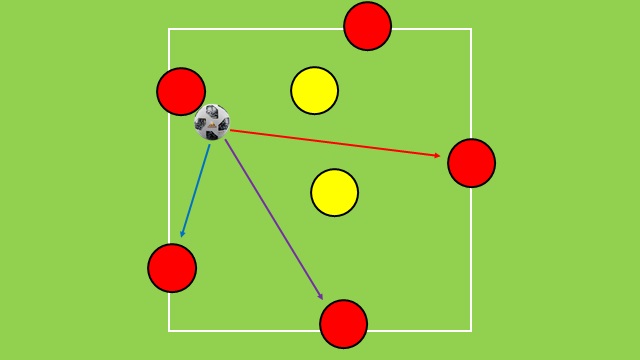
Within this basic 4v1, there are three passing choices for the player with the ball. That player has to consider where the defender is, the angles available, the type of pass required to transfer the ball, and then where to go next to support. The yellow defender is showing one side, which becomes the easy pass, the blue option. The blue option is the easiest pass to make, but should the pass be to the receiver's right foot or left foot? To the right foot means the most likely next pass goes to the teammate on the far side. To the left foot means the pass returns to the original passer. The purple pass has a degree of risk to it, which means it would have to be disguised. Perhaps a fake and a reverse pass. Such a disguise would shift the pressing yellow defender ever so slightly to their left, opening up more of an avenue for the purple option to be successful. Due to the positioning and angle of the purple option, the ball will be going to their right foot, making a one touch pass to the far side quite difficult, although not impossible. The best option for the purple receiver is to play back in the direction the ball came from, to the original passer. That passing lane will be closed down by the defender, which means that the original passer now needs to move to give the purple option a viable return pass option.

A lot of people would want to play the red pass, because it's the through pass, it's up, it's across, it's down field (see how three directions have been used to explain the same pass? That's why standardised terminology is important). The red pass is the most likely to be blocked or intercepted. If we want it to be successful, how do we do it? Not only pinpoint accuracy, but magician levels of disguise. If it was me, I'd go for a fake pass right, and a knee high scoop. Get the defender to commit their weight in their left foot by buying my fake, and then flick it over their left knee, with the ball landing at the left foot of the teammate across. Others may choose a similar fake but with a nutmeg. The ball going to the left foot of the red option means their most likely pass is to the blue option player.

On a recent grassroots course I attended with the state soccer association, I was chatting to a Spanish coach from Madrid, who had played at a high level, including Oxford United. We were watching the sessions in front of us, when a coach stopped to make a point about passing. "Why are you not receiving the ball?" Asked the coach. We were expecting the answer to be something to do with support angles, body shape to receive, or even that the ball carrier does not have his head up. "Because you're not calling for it!" the coach finished. Myself and the Spanish coach looked at each other.


We then went into it on the sidelines for ten minutes, while the session continued. Two foreigners talking about American's lack of understanding of support networks and decision making is why they can't adequately coach the game. Just because you ask for it, doesn't mean you're going to get it, nor that you deserve to get it. This is not a restaurant. I tell my players that there are three types of communication. They get the first two, vocally and visually (talking and pointing) with ease. The third one eludes them, as they circle back through other methods that are derivative of the first two. Clapping? That's the same as talking. Waving? That's the same as body shape. They're stumped. I then pipe up. "If I pass the ball to you like this, what is the pass telling you to do?". Answers usually include to turn, to take a touch, to come to, to run into space etc. "Right. And if you have the ball, and I make a run like this, how do you think I want the ball?" and they explain the type of pass they would play to connect with my run. The third type of communication is the movement. It's the transfer of information via the pass or the run. The ball carries a message, and the run is an advertisement. It helps to talk, it helps to point, but nothing beats playing the pass as it should be played.

To us foreigners, the messages are obvious and for all to see. Like in the rondo example, if I know which foot my teammate is about to receive the ball with, I should then know where to go to offer my support for the next pass. It's a game of collecting and deciphering information. Americans don't know how to take in the information, and even if they did, they wouldn't know what it means. Hence why they value, speed, size, and strength. They don't understand choice and decision making.


Now we go into a 5v2 rondo. With two defenders, we have the opportunity to penetrate. Remember that we pass to move the opposition, so we pass the ball around, until we have created a gap between the defenders, and then we play through them. Get them out the way, then penetrate. This is also where standardised terminology comes into play. Before that, I would like you to look at the red at the top of the box. That possible pass is screened by the nearest yellow defender. What would you have that player do? Should they move to find a new angle? Many here in the US would suggest so. I think in Europe, the coach would ask the player to stay there. Why? Because that red player has occupied the yellow defender. It's like sacrificing one chess piece so that another can strike at a far more valuable opposition piece. By staying there and occupying that yellow defender, the gap for the penetrating pass is open.

The three passing options have colours assigned to them.
Blue - First line pass - The easy sideways pass that doesn't go forward.
Purple - Second line pass - The pass down the side that can take us forward, but does not penetrate.
Red - Third line pass - The forward pass that penetrates.

Not every pass has to be an assist. Not every ball needs to be a Hollywood ball. You can be the player who passes to the player who passes to the player who passes to the player who passes to the player who passes to the player who assists the goalscorer. Your team still receives a point. You are still beating your opposition. Rondos often require a loss of ego, which is prominent within American youth soccer.

In these small exercises, players are assessing so much information, in regards to support angles, defender positioning, and the subtle cues that effect the execution. Constant involvement requires the "what next?" movement and ideas that are not seen in the US. The large number of repetitions mean that over a long period of time, this kind of exercise is really going to draw upon these skills.

To make an exercise useful, it needs the three Rs; repetition, realism, and relevance. Do they get enough repetitions go gain mastery? Is it game realistic? Is it relevant to their developmental stage? Rondos get a big fat yes in each. In a 5v2 rondo for ten minutes, how many touches of the ball is a player likely to get? Have a look at this video to gain an idea.


The thing is though, many think that this is plain and boring. It can be. Which is why there are so many variations. Rondos are like pizza, or cake. There's a basic structure which is a key component of all, but how you dress it is down to you and your needs. Here's twenty different rondos for you.


These rondos work on many different physical, social, psychological, and technical aspects. Like any exercise, the coach manipulates the constraints to enable or restrict certain outcomes. What is it you want to achieve or experience? Change the variables to make that happen.


Here's a video I made showing teams use a variety of rondos, and then applying that within a game. This shows that there is a transference to the match. You get good at what you practice. Practice passing, moving, and making decisions in tight spaces while under pressure, and that is what you will get good at. By making quick decisions, adjusting your body, and manipulating the ball in tight spaces, think of how good players can become in larger spaces.

Todd Beane, American coach in Barcelona, and son-in-law of the great Johan Cruyff, says that rondos are just the tip of the iceberg.


Here's Portugal versus Spain from the recent World Cup match. Spain keep the ball for two minutes and finish with a shot. Obviously looks nothing like rondos.


Here's them doing a rondo. As you can see, zero transfer.


Here's another example from Brazil.

As you can see, I'm completely wrong. Rondos are pointless, don't come out in the game, have no transference, no relevance, and should never be seen in youth football ever again. Brazil, Spain, Germany are no match for the USA when it comes to international titles, domestic quality, and the conveyor belt of talent produced. Kick and run is the future, pick players based on height, and hustle, hustle, hustle.

And here's my video that proves it.

Tuesday, 26 June 2018

Life Plan

Where do your dreams take you?
Many times in the past, I have fallen into the trap of setting out plans for myself, and then seeing them fall through. Life has a funny way of keeping us humble, and we should listen to it. In a year, I turn thirty. I believe I have achieved a lot, and gone further than many could imagine. It feels good, but ambition keeps us thirsty. Each year, the world becomes smaller. Technology brings us closer together, and makes life so much easier and more comfortable. When I first set off overseas in 2009, keeping in contact with home was much easier than just a few years prior, with Skype and Facebook gaining in popularity. With internet, mobile data, Wi-Fi (even on planes) there's no reason to lose contact. The world isn't as scary as people like to tell us, and people aren't as horrible either.

Rooftop football in Tokyo.
I have personal and professional goals. There is some semblance of a plan that I have put together. I shall elaborate.

Personal: To visit every Disney. Until a year ago, there were five. I had obtained 3/5. My 60% completion was knocked back to 50% with the addition of Shanghai. My fiancee shares the same ambition. It would be amazing if we could visit all six Disneys together. We'd like our Honeymoon to be Shanghai. I am of the opinion that while we are there, we should try to hop across to Tokyo or Hong Kong too, since it is such a long trip.

We have only done Paris together, and have both done Orlando and LA separately.

Got to go see what they are doing in China.
Professional: To coach on every continent. Disney can be achieved with savings and vacation. A professional goal is a lot harder. So far, I have done North America, Europe, and Asia. That gives me 3/7.

Africa: Pretty much every country has a volunteer programme. That should be simple. Save a bit of money, head over to a country for a few weeks, job done. There's very few paying positions in African countries. That may change over the next few decades, but we will see. Six weeks in Ghana can be knocked out one summer, no problem, and this ties in with some secondary ambitions, which I will expand upon later. I did see a position in Lesotho, academy head coach, for an entire year. Such an adventure would be so tempting.

South America: Again, plenty of volunteer programmes to join. Spend a few vacation weeks somewhere like Buenos Aires, helping football in the community, swapping culture, and learning about Argentinians and how they develop players. There's tons of other choices too, but that's where I would like to start.

Oceania: Australia and New Zealand would be top choices for actually settling and getting a job. Whether I go down that path depends on what the Future Mrs. Wilson wants. Again, there's always volunteer options in places like Fiji.

Disney Tokyo.

Antarctica: Highly unlikely. The only permanent settlements are scientists, who probably have no ambition of playing football in harsh conditions just to entertain one idiot. Penguins for goalposts. Still, I reckon I have another fifty years in me. Who knows what will happen. If all else fails, I'm sure I could go somewhere like the Falkland Islands. To me, it would still count.

What does the short term look like? Next summer, I will be marrying my beautiful Mexican Princess. She's perfect. Many would strongly disagree, if she is likely to put up with me, and entertain my stupid ideas and adventures. I never said it would be easy, just fun. When it comes to relationships, we're essentially looking for someone whose mental illnesses compliment ours. There must be some flaw in her I am not seeing, because there's no way she would be with me otherwise. I'm tired of travelling alone. I want a sidekick.

After that, it should take three to six months to get her into the UK, giving me until Christmas 2019 in the US. Perfect, as that's when my next visa runs to. That ties us both down to living in the UK for the following five years while we turn her British. Hopefully that's when we can do our Disney Shanghai Honeymoon (maybe in the first few months of 2019?). That summer I will look for a decent summer job, similar to one I had before teaching English to foreign students. Fairly decent wage, all things considered. The next step there will be to begin studying at Southampton University to become a teacher. After a year of that, become a P.E. teacher, working in England for a few years.

Street football in Accra.
What about coaching? I'm hoping my qualifications and experience will help me find a job with a decent team to work weekends and evenings. I should have quite a bit of free time between January and September, and it would be great to get on the FA Advanced Youth Award. Obviously have to be working with a decent youth team to be able to get onto that, and further my coaching knowledge. While away, I always keep an eye on what's going on back home. There have been plenty of developments, and new opportunities always arising.

That gives me about five years. There are three qualifications that I want to obtain in that time: USSF A License Youth, FA Advanced Youth Award, USC Master Coach Diploma. That will be rather ambitious, adding to what I already have, which by then will also include a PGCE. There's a few others, like psychology and futsal, but these are short term, and relatively inexpensive courses.

Once the Mexican is British, it will be time to move abroad. Five years in the same country seems incredibly daunting to me. The way round it, and to feed my wanderlust, is intermittent travelling. The below table may shed some light on what that can look like.


Ambitious, yes. Can we get to a Disney per year, until we have completed all six? Being a teacher usually brings with it decent holidays, including six weeks in the summer. It's in those six weeks that I can get off to coach in these other continents. As that requires a fair bit of money, I don't anticipate being able to do it for a couple of years. The first two summers back home will likely be spent working summer jobs, bringing in some income between teacher training. Definitely won't be able to save for such trips on a part time coaching salary.

Why become a teacher? There's many reasons. If I stay in the current job I'm in, coaching in the US, one eventually begins to lose freedom and choice. You become beholden to your employer for visas, which as we all know, is a very sketchy living in America. That then ties a coach down. I like it here, and I like what I do. I am very lucky to get to do it all day, yet the quality is poor, the lifestyle superficial, and ultimately, it proves for frustrating results. American soccer is showing no real sign of progress, and I don't want to be here for the twenty years it will take. Being in England, it is hard to find a decent paying coaching job, and being a P.E. teacher is the next best thing. Every country wants teachers from the UK, thus becoming my ticket to travelling for work. Teachers also get long holidays, again, time for travel and courses. And, you know what? I wouldn't mind moving to another part of the British Isle for a year or two. Why not Northern Ireland or Scotland?
As coaches, we are perpetual students of the game. For each experience and qualification I gain, more knowledge is shown to me. It's like walking through a door, only to find there are another five, and behind each of those, is another five. Knowledge is like an inverted pyramid. So much more depth than you realise, and so many directions to go in. It has been a long held ambition of mine to go and observe some of the football hotbeds around the world, and look at what they do (apparently I'm in one, here in St. Louis... HA!). I'm talking real football hotbeds; Barcelona, Amsterdam, Marseille, Naples, Brussels, Munich, Glasgow, Sao Paulo, Buenos Aires, and even Accra in Ghana, Qatar (due to their World Cup project), and Tokyo (thanks to Tom Byer's Football Starts at Home, the Japanese have a great system of technical player development). I'd even go to China, since there are a billion people, thousands of academies, and huge investment. In a previous article, I mentioned how soccer culture for a country should be viewed in terms of CEO; Coaching, Environment, Opportunity. It would be fascinating to see up close and personal.

The South America trip, primarily has to be Buenos Aires. Brazil sounds great too, but it's the upper hand with the language. I will try some Portuguese nearer the time, just not soon. Africa would be Ghana. Nigeria, Ivory Coast, Senegal are attractive too, but it's the language, and that Nigeria is just a little crazy at the moment. There's plenty of other African nations, but that's the region that produces the best players. South Africa and Kenya are appealing, but do not have the same pedigree.

Oceania is a strange one. That would essentially be wherever the wind takes me. How does football operate on a tiny remote island? The journeys of people like Paul Watson are inspiring. Dutch Coach Thomas Rongen went to American Samoa to be their national team coach. These experiences will be better than anything money can buy. Better than any car, any house, any lawn.

Next Goal Wins.

Going somewhere like that long term probably has to wait until I am much, much older. Grown up kids, no bills, some savings. Then it doesn't matter. You can go and do it simply because it is fun. Along the way, one has to look for worthwhile learning experiences, and to take advantage of them. I have thoroughly enjoyed listening to and reading all that comes out of Tovo Academy, and Todd Beane. It would be hugely beneficial to spend time in Barcelona learning from Johan Cruyff's son-in-law. Funny that the two American coaches to escape the US and make a name for themselves overseas, who are largely shunned by the US but admired by other nations, both have the initials TB.

Street football in Buenos Aires.
After the five years are up, there's likely to be some English-Mexican hybrid creatures borne upon this world. They will require some form of care and attention. That's why I want to try and get a lot done before they show up. Nevertheless, I'll be desperate to get out after five years. It could be anywhere, I really am open. I think the Mexican likes the idea of places like Canada, Australia, and New Zealand. Somewhat safe choices. Not exactly Egypt. I do think our first stop should be in the Middle East; Dubai, Abu Dhabi, Kuwait, Qatar, Bahrain (one of the better ones) in order to make some savings. Tax free, bills paid, with fuel as cheap as chips. Why not, right? Improve the bank balance, and then look to go elsewhere. We're of a generation that will never own our own property, and we both have master's degrees, that apparently take twenty years to become profitable. Not motivated by money, but at some point, we have to go get some, and the Middle East is a good place to go for that.

Aspire Academy in Qatar.
Following that, who knows? We'll have our own little footballers to develop. Raising kids is the most important, yet scariest thing a person can do. Get it wrong, and they turn into utter arseholes that ruin it for everyone else. I don't have plans for them. Kids should be allowed to be whoever they want to be. There's just a few things that need to be laid out first; it's irresponsible not to push your kids at an early age. Don't push them into something with dreams and ambitions of them becoming a superstar at it. Just simply get them involved in social and physical activities. They will learn from it. The sport doesn't matter too much, as long as they are active, playing with others, and competing, well before seven. The love of the ball is what needs to be created. Whether it's tennis, basketball, bowling, it doesn't matter. Sport teaches winning and losing, taking and giving orders, discipline, respect, drive, self improvement, and much more. This is really important for long term character development.

The formula that everyone should know is this; outcome is driven by process, which is driven by character.

Kids in Glasgow.
Character ---->> Process ---->> Outcome 

Many judge others only on the outcome, and so that is where their focus is. Did you win or lose? What was your grade? How did you do compared to others? Irrelevant, arbitrary, unnecessary, and unhelpful. Too many variables, too little control, not the real mark of a person's worth. Those who know what they are doing, focus on the process. Goals cannot be achieved, dreams cannot be lived, if we practice, prepare, train in the wrong way. You can dream of playing in a World Cup all you like, but if all you do is run laps and shoot into an open net, you'll be going nowhere. How good is the training? How good is the structure? Apply it to any walk of life. What are the steps that need to be taken to be successful in that specific field? There's your road map.

Fijian football, sponsored by Vodafone.

Character is what is most important, though. The process is all for nothing if the person isn't right. You could have the best coach, teacher, mentor, but if you are lazy, selfish, rack-a-disiprin, you will never get anywhere. People don't learn from osmosis, but from seeing, hearing, and doing. Sport from a young age teaches kids to focus, to deal with setbacks, to self-assess. These are valuable skills for any walk of life.

Tovo Academy in Barcelona.

Next, the kids must learn an extra language. English speaking father, Spanish speaking mother, is a good start. Should give them a base to build from to gain one or two more. What are the languages of the future? Portuguese? French? German? Mandarin? Arabic? Let's help them out a little bit with a good foundation.

Finally, they have to learn an instrument. Something generic like keyboard or guitar. Again, they can branch out any way they want from there. It just gives them a good place to start from. It becomes a fantastic way to express yourself in a world that is becoming ever more superficial. It opens up so many opportunities to play, travel, explore, meet, share, understand.

In conclusion, the first seven years of the lives of my spawn will be spent learning the fundamentals of language, music, and sport. Give them a sport to play, an instrument to play, and a second language to speak. Naturally, there will be no time (or money) for iPads or Xboxes. They can get those when they are older. It shouldn't be a distraction. They are fun, and have great uses, but can also be addictive and destructive. My idea is always prevention rather than punishment, and the best way to prevent them from being lazy couch potatoes is to give them hobbies, skills, passions, and a means to perform at those. Working with kids every day for the last ten years, I see them resorting to this, primarily, because it's easy. There's nothing else to do. There's nothing else they're good at. There's no other way for parents or adults to engage with them. I'll be the type of dad that plays with them in the garden, or at the park. Being so immature, I will probably watch their TV shows and movies.

Downtown Munich.
I will engage, I will empower, I will teach them values, and judge them by their actions, not by their appearance. This also means knowing when to back off. If they get a bad grade at school, don't fight the teacher, but place the responsibility on the kid. If they get dropped from the team, don't fight the coach, but insist the child asks the coach what they need to improve at to get more game time. Modern parents fight every battle for their kids, and then use iPads as dummies (pacifiers) to calm them down and shut them up. They don't know how to teach, how to model, or how to inspire.

The path for them thereafter, is theirs. Do what they want, be what they want. Just know that you as a parent have tried your best at giving them a good start in life. Whatever their pursuit may be.

How likely this all is, I have no idea. I think it is realistic, ambitious, adventurous. Write your goals down, state your intentions. Let's see how it goes.

Thursday, 14 June 2018

If Only Our Best Athletes Played Soccer

If you enjoy my content and want to express gratitude, I would be so happy if you made a contribution towards my Argentina trip in the summer of 2021. The plan is to go there for four weeks and look at everything football, development, coaching, and culture. Any amount helps. I won't be upset if you ignore this message, as I produce this content purely for the enjoyment of it. Here is the link: http://fnd.us/c1en5f?ref=sh_98yL48


I'm not going to tackle this issue directly, as I feel it has been done well enough in the following two articles.

https://www.starsandstripesfc.com/2016/7/5/12089038/are-you-sick-of-hearing-if-only-americas-best-athletes-played-soccer

http://www.whatahowler.com/httpswhatahowler-com201603athleticism-isnt-the-issue-html/

It's more the idea of what is defined as athleticism, and the founding principles of that, which I am going to address.

Have a look at these highly successful athletes and their body type.


What do they have in common? Nothing at all. They're all good at what they do, but physically they are so different. It appears that in these sports, there is an ideal body type, and that ideal body type is specific to each sport. The more narrow the range of techniques and movements required, the more specific the body type.

Now in football, it's a little more broad. There is certainly an unwritten rule that goalkeepers have to be above six foot. Ten years ago, they were peaking at around 6'5'', and now it's closer to 6'0''. That's because the demands of the game have changed. Goalkeeping is less now about shot stopping, and more about distribution. I have talked about this a lot previously, and so won't go into massive details, but essentially what a keeper does with their feet is now more important than what they do with their hands.


How about these two specimen? Played on the same team, Stoke City, in the Premier League. Peter Crouch (the lamp post) was a Champions League runner-up with Liverpool, and Xherdan Shaqiri was on the bench for Bayern when they won the Champions League in 2013. They have represented their national teams multiple times, played at international tournaments, and won many club honours too. Physically, they couldn't really be more different.

And then we have...


Adebayo Akinfenwa. The bodybuilder. Though he never really reached the top, playing in the lower divisions in England, his size hasn't impeded him too much. It's these different types of physicalities that help players carve out a niche for themselves. Crouch is obviously a target man that was good at headers from crosses and winning knock-downs, whereas Shaqiri's low centre of gravity and strong core means that he is a good dribbler, and very agile and explosive. Akinfenwa is more of a battering ram. Use them as you see fit.


Full credit to Crouch, as he is incredibly memeable, and one of the funniest users on Twitter.


Here we have Messi, Suarez, and Neymar (MSN) who were one of the most frightening attacking lineups ever. An Argentinian, a Brazilian, and a Uruguayan. They're hardly tanks. Physicality just has no bearing when it comes to being a successful soccer player.


In 2010, Spain were the shortest team to win a World Cup. Carles Puyol, their star central defender, was 5'10''. Goalkeeper Iker Casillas was 6'1''. Andres Iniesta, who scored the winning goal, is 5'7''. The build up included Cesc Fabregas (5'11''), Jesus Navas (5'7''), Xavi Hernandez (5'6''), and Fernando Torres (6'1''). Other players involved in that game are; Sergio Ramos (6'0''), Gerard Pique (tallest at 6'4''), Joan Capdevila (6'0''), Sergio Busquets (6'2''), Xabi Alonso (6'0''), Pedro (5'7''), and David Villa (5'9''). These are hardly giants.

What even is athleticism? It's apparently a noun, that means the physical attributes that are qualities of athletes, such as strength, fitness, and agility.

What is an athlete? An athlete is a person who is proficient in sports and other physical activities.

Interesting definitions. It doesn't mention anything about being 6'8'' and full of muscle. I wonder why that is. Let's first look at the physical attributes required to be a footballer.

I'm going to copy and paste directly from another article. Lazy writing, but I don't care.

https://www.livestrong.com/article/481514-physical-description-traits-of-a-soccer-player/

Body Type

Field players in the top soccer leagues of Europe tend to be around 5 feet, 11 inches, with goalkeepers around 6 feet, 2 inches. They display lean, defined physiques, reflecting the fact that 200 lbs. may be the realistic upper limit of a soccer player given the demands of running six miles or more in a typical game. Messi is significantly smaller than a defender such as Manchester United’s Rio Ferdinand, who stands 6 feet, 3 inches, but has a compensating weapon to use against taller players: his agility.

Agility

While body type may not matter so much in soccer, agility is paramount. In a sport that relies heavily on agility and its allied trait, speed, players make nearly a thousand changes of direction per game. Agility depends on three factors, says athletic performance specialist Craig Friedman. He cites explosiveness and power, stability from the ankles through the torso and the technique to deliver power to the ground while taking a quick stride. Though small, Messi’s strength-to-weight ratio “is just ridiculous,” Friedman told ESPN’s John Dorsey.

Fitness

Soccer players work hard to stay in shape. Kristine Lilly, who has participated in more international matches than any other player, calls fitness the “backbone” of her game and key to her confidence on the field. Her focus on fitness, typical of soccer players at all levels, allowed her to compete in 352 international games, to play every minute of the 2009 Women’s Professional Soccer season and to appear in five Women’s World Cups.

Mental Toughness

Players need talent and a good attitude, but the real factor in advancement is not physical ability but rather mental toughness, writes sports psychologist Bill Beswick in “Focused for Soccer.” Many players at the top level would not score an “A” on talent, “but their A attitude drives them to success,” he writes. Mental toughness includes having a competitive and optimistic attitude, bouncing back with resiliency from setbacks, taking risks and being single-minded. Messi brings tremendous confidence, an allied trait, to the game, which is on display when he steals balls from opponents and weaves through them “like traffic cones on a DMV road course,” writes Erik Malinowski for the online site, Wired.
The website My Personal Football Coach has a similar take.
https://mypersonalfootballcoach.com/top-5-soccer-player-attributes-needed-to-be-a-great-footballer/
They list five attributes needed to be a great footballer; technique, mindset, game intelligence, team player, and physique. Mindset and team player will be common across many sports that American athletes play. Technique and game intelligence are probably what's missing most from the understanding of most American observers. They don't see it, nor do they get it, so it can't be appreciated or valued. People only place value in that which they understand. We are also in a culture here where pretty much everything in every sport is measured and recorded. It's all about speed, distance, height, strength etc. It's not like those aren't possible advantages, it's just that such attributes are dwarfed by a player's ability to execute technical skills, and to quickly identify correct decisions. The range of techniques necessary to play football is far wider than any other sport played in the US, apart from perhaps ice hockey, but only because that is three sports merged into one; skating, boxing, and hockey.
In terms of physique, MPFC list these elements;
  • ABC’s – Agility, Balance & Coordination are vital because there are so many movements that happen in a soccer match. This is with and without a football as you dribble, jump, turn and place your body into a variety of positions.
  • Power & Strength – This is not the size of the individual but is more about how effectively you use your body to win a physical battle.
  • Speed – This is not only straight line speed but it is the speed at which you accelerate, decelerate and how quickly you can change directions with and without a football at your feet.
  • Stamina – As your body fatigues, your control, focus & decision making becomes impaired which are all critical in a match situation. The ability for a player to deal with the constant stop, start nature as well as endurance during a game to keep moving will be examined.
Does it say anything about being big and tall? No. It quite clearly states... not the size of the individual, but how you use your body to win a physical battle. 10k run per game, 1000 changes of speed and direction, 800m sprinted at full speed per game. In what way is being built like an outhouse going to be an advantage for that?


Check out these tiki taka goals from Barcelona. In what way will these players having an extra twelve inches of height and 20lbs of muscle helped them perform these tasks any better? Football is like a combination of chess and ballet. Americans don't see that. They take a bull in a china shop approach to everything. We've got to make it bigger, and faster, and give it thirteen cupholders! I see it in their cars. Everyone needs a huge truck despite never doing anything that requires a vehicle that transports large objects, or a minivan for their two kids. You may think you look cool, but I can park in more easily accessible spaces, get through average sized gaps, and waste less fuel, in my normal sized car.

Essentially, you're telling us that this guy is not an athlete, or that this is not athletic...


Nothing athletic about that, right? Americans would rather have a player that looked like Akinfenwa than Messi. It's this strange delusion. If you think Messi is not athletic, you're an idiot. Observe his agility, his balance, his coordination. Look at the acceleration, his ability to change direction, how he ducks and dives to avoid challenges, his explosive pace, how he fends off physical assaults from opponents, and how he does all this while keeping the ball attached to his left foot using an invisible piece of string.

This athlete theory has been tested at least once, to my knowledge, with Usain Bolt. He loves football, and was begging Manchester United for a trial for years. Eventually, Borussia Dortmund invited him to train. The idea may have been that his speed would be useful for their gegenpress. They didn't sign him. He couldn't trap a bag of sand. He was tactically unaware. His passes went astray. Ironically, he couldn't keep up with the pace of the game. That's the key difference here. That is what needs to be understood. I have been bigger, stronger, fitter than many opponents, yet still been outplayed. Their passing and moving was too good, I couldn't get near them. Their first touch so perfect, I couldn't take the ball away. Their decision making so quick, I couldn't read them.

The way the game is viewed here for Americans, is that you find a big guy, get him in the team, and his size will take care of everything. Let's bring in LeBron, Odell, Brady etc. and watch them Jason Roberts their way into the goal.


How about then, as the suggestions go, we get an entire team of big guys, and play a style that makes use of the height and strength advantage? How could all these other countries defend at corners and free kicks if they have to mark 6'8'' opponents. You'd still need one player, like Morten Gamst Pedersen, to be an expert deliverer of set-pieces. So ten brutes, and one tiny Norwegian. Again, it's been tested, by many teams, with mixed results. Bolton, Stoke, and Blackburn all did it, and eventually went on a long cup run, or qualified for UEFA Cup/Europa League playing that way. It didn't bring any real success, only relative success. It's a way of staying in the division, not winning it. When it was pointed out to Johan Cruyff that his Barcelona team were terrible at conceding corners, his response was "Well, let's not concede any corners then."

If your entire game relies on set pieces, what happens when you are starved of set pieces? Rovers, Stoke, and Bolton would often pick up good results against Arsenal, but couldn't go much further than that. You see, when they played good teams, as much as they fought, and fought, and fought, they just weren't good enough when it came to actually playing football. They may have scored from free kicks and corners, but there weren't enough free kicks and corners for them to win every game. And that's the problem. The objective of these teams was to pick up enough points to remain in the division, with the ambition of finishing maybe tenth. Points would come from Portsmouth, West Ham, Aston Villa, Everton, Sunderland, but would not come from Liverpool, Manchester United, Manchester City, Chelsea. When playing against opponents of lower quality, you can beat them with your physicality. When playing against teams of higher quality, you won't be able to beat them if you can't take the ball off them.


How about an entire team of Chris Sambas? To any Americans watching, Samba is the ideal player. 6'4'', 220lbs, fearless, aggressive, tough. Look at his highlights. He must easily be one of the best players ever, right? Unleash the Samba Beast, and all Hell breaks loose. Sadly, that wasn't the case. The video shows him scoring important goals against awful opponents (including Arsenal), and a consolation against Manchester United in a 7-1 defeat. It's like Luke versus the rancor. It's big, scary, and has large, sharp teeth. What the punters at Jabba's Palace neglected was Luke's cunning and skill.


It's no surprise that a society that doesn't value intelligence does not recognise or value intelligence within sport. In pretty much every other sport, they are running plays, or following orders to the letter. That's not how it works in football. It's impossible to micromanage every interaction in the game, so we train them well to give them the tools to do it effectively without our input or help.

Is anti-intellectualism killing America? https://www.psychologytoday.com/us/blog/our-humanity-naturally/201506/anti-intellectualism-is-killing-america

America hits peak anti-intellectualism as a majority of Republicans think college is bad - https://www.salon.com/2017/07/11/america-hits-peak-anti-intellectualism-majority-of-republicans-now-think-college-is-bad/

American idiot - https://www.opendemocracy.net/transformation/nicholas-baer/american-idiot-rethinking-anti-intellectualism-in-age-of-trump

We prefer comforting lies that fit with our narrative, rather than harsh truths.


America, after the news about the 2026 World Cup bid, you have eight years to stop being such an embarrassment. Start calling it football.