.

.

Sunday, 26 March 2017

Flakiness in Football: Blame the Parents


It takes a village to raise a child. Let me first share a Facebook post of mine to let you know where this sparked from:

In today's edition of Mexico:
We have a friendly game at a venue just around the corner. I'm expecting twelve players. Some negotiations took place as some players were not going to attend. The best excuse ever being, and I am paraphrasing, my daughters can't play because of the big tournament at the club. Well, they are not playing in that tournament, and neither is your wife, so I fail to understand that one.
 I get to the venue, and we have no players there. Eventually I find one, then another. The second player there was brought by the aforementioned wife, but that girl is not her daughter. Her two were at a party last night. They are twelve and fourteen, they don't have hangovers, so a party is no excuse. We're then waiting for others to arrive, which they do at Mexican speed. Fortunately, we're not the only ones running late, and the game is delayed by half an hour. We have eight players. The parents are all contacting the ones who are not there, asking where they are. One mum claims not to have known about the game. I sent two emails. Included in that list is also the father and the daughter. Not knowing is not an excuse.
We then go to warm up on the field. There is no coaches etiquette here. No handshake before the game, no good morning how's it going. That doesn't happen. The first interaction I have with the opposing coach is her barking at me that we are playing on a different field. We go to that field, and it is a 7v7 field with small goals. One goal doesn't have a net, the other looks like a spider was drinking oil and defecated a web. The field itself was awful. There is more grass growing in my shower than there is on that field. In between the bald patches, there are rocks, divots, ankle breaking pot holes, and even a cement drain cover. The surface is also rock hard, and covered in craters, like the Moon. The only difference is that when Neil Armstrong hit that golf ball, where it was going was far more predictable than the football in today's game.
Surprisingly, while all this is going on, I can hear the parents talking about the situation of no one showing up and starting the game with eight players. They were citing respect, discipline, commitment, compromise. Like in any group, it's always the same faces you can rely on. A few minutes into the game, the three girls who were at the party show up. Only one of them has kit on. She goes straight in to make it 9v11. Just before the break we got it to 10v11, as a girl's older sister who does not play for us got out of bed to come and join in the fun. The other two girls who do not have kit on have to now wait for their mum to drive home and get it, the aforementioned wife. We're losing 2-0 at the break.
All over the place you see girls just kicking it forward with no thought of a pass, turning their back on the ball, failing to pressure just in case their opponent shoots and it hits them, ducking out of headers, swinging to kick the ball and missing, and players who clearly could not trap a bag of sand. Clearly the field didn't help, but I have seen these players play on Earth as well as the Moon.
The referee was a barrel of fun. Like a lot of people here when they go fat, he was literally barrel shaped. He kept asking me for money before and during the game. The custom is that the home team always pays the referee for friendlies. It's what we have always done. No one has told me anything about paying him. At the end of the game we did a whip round between the parents and gave him his cash. Throughout the game he kept making these weird hand signals, unlike nothing I have seen before in football. If two players collided, he would clap his hands and then circle his arms through the air. It was reminiscent of Mickey Mouse in The Sorcerer's Apprentice. Another thing he did, which all Mexican referees do, was to stop the game every time a player took any kind of knock. I'm even talking about a ball hitting them on the body or on the head. This is football. The ball will hit you. You're either blocking it or controlling it. A lot of players still put their hands in front of their face rather than heading the ball, and handball is never called in this instance.
 A little while into the second half, we're now 3-0 down, and finally these two are dressed. I make one sub, put them both in, and now we are up to 11v11. Eventually we pull a goal back. A girl under absolutely no pressure kicks the ball out for our throw in. Following the sequence, our winger robs the defender and puts it into the net in a 1v1 with the keeper. As is customary, the referee cuts the game eight minutes short. Three in the first half, five in the second.
Throughout the game, the other coach, a short fat woman, is marching up and down the touchline, barking very useful orders. My favourite was "Throw it!" when the ball had left the field for a throw in. Other classics included "control it", and "kick it". While parading up and down, she did like to stand directly in front of me for periods of time. Perhaps she liked my cologne. Perhaps she was trying to block my view. Being so very short, I could still see the entire field over her head.
Now for the benefit of everyone involved in football who is not English, British, or from one of our former colonies, as let's face it, most of you are wusses, this is a picture of a man named Terry Butcher: http://i.dailymail.co.uk/…/article-2503094-00442C82000004B0… This is England. This is football. Stop crying like a little wuss every time you feel contact. Parents, coaches, referees, call your player a crybaby and tell them to get up. Don't rush to them, pick them up, hug them, and pamper them like a baby. Doing so creates soft kids. There's only one question you need to ask; "Can you walk?" If the answer is yes, then get up and play. If the answer is no, you may still have to play depending on the subs situation. I wouldn't be surprised to see ambulances at the side of every youth football game in the near future.
Rant over. Going to enjoy the rest of my day.
And people ask me why I'm leaving.

Right. Let's put that into context. Clearly I was rather frustrated, and definitely feeling quite British too. I had a mum telling me she didn't know about the game, despite her, her husband, and her daughter, all being included in two emails that were sent out about the game. There was also a WhatsApp group, and we would train three times a week, so it's not like we didn't talk about this stuff. What a dreadful excuse. Try harder.

Why do kids play football?

There was a dad who said that his daughters couldn't play because HE was playing in a tournament. The tournament he was playing in would mean he plays two games over a weekend, while getting drunk and eating lots of food with his friends. The tournament was taking place at our club, and we were playing around the corner. Literally a five minute walk. The mum of these two girls showed up at the game, but with someone else's daughter. So dad can't take them, as he's busy. Mum is there. She's actually at the game. Just not with her own kids. She tells me that her daughters couldn't play because they had a party the night before. At the ages of twelve and fourteen. What do kids that age do at parties that make them sufficiently incapacitated that they can't play football the next morning? Keep in mind that they didn't tell me this until the morning of the game, like I was supposed to telepathically find out they would be unavailable. A different mum, upon being informed of our predicament, brought these girls from a friend's house to our game (well after kick off). Of course, they had no kit. So then their own mum went back to the house to get them their kit, so they could eventually join the game in the second half. Not in my wildest dreams could I have come up with such a rich, layered story.

There was lateness, no-shows, and players putting in zero effort. This kind of event happened with a lot of frequency. It's not just Mexico, though I have to say that Mexico are champions of this sort of thing. Evidently, I was very annoyed. How do you think the other players felt? The few that showed up, avoided plans, most likely going to bed early the night before. THEY lost. THEY suffered. Not the ones who stayed home and didn't attend. Those players had an easy weekend. And what of the two girls that were at the party and eventually played? How would they have felt having to then face up to their teammates following the awkward situation their parents put them in? Or did they actually care?

Helpful or Hamful: Parent's Expectations

You see, when you lie, break plans, display a laissez-faire attitude towards commitment, colleagues, and authority, you can be certain that your children will do the same. If you can't commit, don't commit. Other people depend on you, and you are letting them down. It teaches them that it's okay to be a flake. Most parents won't want their children to become like that, which is why they must lead by example. People follow what you do, not what you say.

Parents are the root of all evil. It's not just your parents. Your parents are probably only 30% responsible for the person you become. The rest is the neighbourhood. The sad fact is that the rest of the neighbourhood is made up of other parents. They say that the only time you should look in your neighbour's bowl is to check if they have enough. Unfortunately we're all too obsessed with social currency these days that we are constantly comparing ourselves against others. Think of the kids at school comparing bed times. There's always a seven year old who says he gets to stay up past eleven. All the other kids are jealous. Sadly, they have good parents that enforce rules and structure, unlike the other kid who has crap parents.

Look, I understand. It is difficult. I don't want to have kids. People describe that as selfish. I can't think of anything more selfish than having something you don't want. There is no book, course, or guide on how to parent. All we have is tips and opinions. Science teaches us a lot, but most people can't be arsed with facts based on research and study. Right now, I am too focused on me. I want free time. I am not where I want to be in my career. I don't want dependants. I can barely keep my plants alive.

When it comes to football, in a club sense, the coach is the parent, and the other coaches make up the village. Now throw in the parents of the kid and all the other parents, authority figures and role models. I was having a conversation with a father of one of my players, and we were talking about role models, authority figures, and what coaches represent. He said "When he comes to football, you become his other dad." And it's true. The younger the player, the more impressionable, and the more they need that guidance. We know as coaches that if the kids have terrible parenting at home, there's nothing we can do as coaches in our one hour per week to change that. We can manage it, sure, but we won't be having a profound impact on their outlook on life. We need to shift the balance of positive role models that the child is exposed to.

One good coach at a club full of idiots will be like a drop in the ocean. I've felt like that before. I'm not talking about talent, but about discipline and attitude. Sure, it largely goes hand in hand, as the correlation shows decent coaches are usually better role models. If you're the only coach that insists on punctuality, respect, handshakes, shinpads, and whatever else it may be, you will be ineffective, and easily become frustrated. "Why should we do it? Coach Lazy Bones doesn't make his players do it!" We have definitely moved away from the world where the coach is an unquestionable deity. For the better, as authority and knowledge should be questioned, but it would be nice sometimes to have people just accept that you know best without having to go through an entire spiel.

It's the same with parents though. If you have some hard working, committed, respectful players, and some that aren't, the kids who are prim and proper will be wondering why the others are allowed to get away with murder. Why does she always turn up late? Why is she wearing the wrong kit? Why does she keep messing about? It's because the parents haven't taught them that it's not okay, and the culture of both the club and the team, enables it.

Here is an excerpt from a book called Feel The Fear And Do It Anyway by Susan Jeffers:
"I've often been asked to explain why we have so little trust in ourselves. I don't really know the answer to that. I know that some fear is instinctual and healthy and keeps us alert to trouble. The rest - the part that holds us back from personal growth - is inappropriate and destructive, and can perhaps be blamed on our conditioning.
In all my life I have never heard a mother call out to her child as she goes off to school, "Take a lot of risks today, Darling". She is more likely to convey to her child, "Be careful, Darling. This "Be careful" carries with it a double message: "The world is really dangerous out there"... and... "you won't be able to handle it". What Mom is really saying, of course, is , "If something happens to you, I won't be able to handle it". You see, she is only passing on her lack of trust in HER ability to handle what comes her way".
Examples of this are rife in youth football, but not just in football, in everyday life. Due to our own insecurities and not knowing how to handle situations, we sometimes do more harm than good. The mother in this situation is right to be worried and has the best of intentions, but creates a fear in her child and a reluctance on the kid's part to experiment, explore, and be creative. Of course we need to anticipate mistakes and danger, but don't put unnecessary fear into other people, especially when we don't even know what challenges are likely to be faced. Children learn best kinaesthetically through trial and error. With unnecessary fear, they become just as limited and bland as the rest of us.

At what age is it no longer the fault of the parents? It's debatable. By a certain age, even by law, people become entirely responsible for their own actions. Along the way they pick up the customs and values of their environment. They learn what is acceptable, what isn't, and what the rewards and punishments are for certain actions and choices. If a parent never teaches their child to swim, is it their fault as an adult that they still can't swim? I'll provide an example. During school I spent years studying French in class. I achieved C at GCSE. Apart from the very basic phrases, I have no idea how to speak French. What caused me to not care? My parents? My school? My classmates? I'm not the only person to come out of that school with a French GCSE and not know how to speak French. So what affected us all? Many agree that speaking a foreign language is a skill somewhere between cool and useful. Should we have been pushed? Was there a need? Did we see a need? Now we're getting closer to the answer.

As an adult I learnt Spanish. I'm now conversational, and started learning at twenty-four. I spent three years learning it from Year 7 to Year 9 while in school, the same as all the other French learners. That really was a wasted three years of classes. It had no effect on learning as an adult. Amazing. Was I pushed to learn Spanish? Not at all. If anything I was discouraged. It was expensive, time consuming, and none of my colleagues wanted to do it. Was there a need? Not really. We were encouraged to coach in English, every Mexican we interacted with spoke English. We only really needed basic phrases for food shopping. That can be mastered in half an hour. Did I see a need to learn Spanish? Absolutely. I was in their country, wanted to be able to broaden my horizons, understand more people, absorb more ideas, improve my communication skills, and improve my employability. I felt obliged, but also as if it would be too good an opportunity to miss. Compared to Chinese or Arabic, it's an easy language for an Englishman to learn. I always thought it would be cool and useful. I had the time, I had the opportunity, but most importantly, I had the intrinsic motivation.

Intrinsic drives everything we do. We didn't care at school. We didn't value it. "I'm never going to go to France, so what's the point?" How do you teach value? In the early years. People follow your example, not your advice. Structure, boundaries, punishment, reward. You can tell very early on with kids how they are likely to be when they grow up. It's sad because as they get older, it gets harder to reverse the damage. We will examine how this manifests itself, but also what the cause is, which is far more important.

Many coaches, when lacking enthusiasm, care, or ideas, revert to the ultimate line drill. It's called lightning. The kids love it. You can waste about three hours playing this game. Put all of your kids in a line outside the penalty area. Put one kid in goal. Choose another kid to feed passes to the edge of the penalty area to be struck first time. If they score, they go to the back of the line. If they miss, they go in goal. Once goalkeeper, they face one shot. If they concede it, they are eliminated from the game. The line eventually dwindles to the inevitable small group of players that actually had a realistic chance of winning the game. Eliminated players wait behind the goal to see if they can catch any balls before the hit the ground. Doing so would allow that individual to join the line once more. If the ball cleanly strikes the crossbar and does not go in the goal, all players that were previously eliminated come back into the game. Simple rules, easy to manage, and the kids can do it themselves. The coach, sometimes sat nearby in the shade, will bring out his mobile and start scrolling through Tinder. Thus stuff genuinely happens, and it happens all over the world.

Lloyd Percival, a coach in Canada during the 50's and 60's who published "The Hockey Handbook" came up with his 10 Rules for Parents of Athletes in 1974. Still great stuff even today!.
Ten Rules For Parents of Athletes
1. Make sure your child knows that win or lose, scared or heroic, you love them, appreciate their efforts and are not disappointed in them.
2. Try to be completely honest with yourself about your child's athletic capability, competitive attitude, sportsmanship and actual level of skill.
3. Be helpful, but don't "coach" them on the way to the track, diamond or court ... on the way back ... at breakfast ... and so on.
4. Teach your child to enjoy the thrill of competition, to be "out there trying" to be working to improve their skills and attitudes ... to take physical bumps and come back for more.
5. Try not to re-live your athletic life through your child in a way that it creates pressure; you fumbled too, you lost as well as you won. You were frightened, you backed off at times, and you were not always heroic. Don't pressure your child because of your pride.
6. Don't compete with the coach.
7. Don't compare the skill, courage or attitudes of your child with other members of the squad or team, at least in range of him/her hearing
8. You should also get to know the coach so that you can be assured that their philosophy, attitudes , and ethics and knowledge are such that you are comfortable with them taking a prominent role in the development of your child.
9. Always remember that children tend to exaggerate, both when praised and when criticized.
10. Make a point of understanding courage and the fact that it is relative.

Kids like the game, so it's not entirely bad. If it's really hot, it's a great game to play as it requires little physical exertion. It's genuinely fun to play. The thing is that it is unrealistic to football (the ball, passed from the goal approaches the player slowly, while unopposed) as it is like the goalkeeper rolling the ball gently to the opposition striker and telling him to shoot with no one around to stop him. Secondly, the repetitions are so very slow. I've seen groups of forty or fifty kids playing this game. You have to wait for everyone else to have a turn before you do, and if you miss, you're out, waiting for an eternity to come back in and play.

We can liken this to ice cream. We love ice cream. The texture, the flavours, the sprinkles, and that it is just so soft and perfect. As adults, we can choose to eat ice cream any time we want. I have, on a number of occasions, had it for breakfast. There's no law to say I can't, and no one around who can stop me. For kids, ice cream is often used as a treat. A way to make that great day even more special. A dessert to have once a week, or for special celebrations. That's using ice cream responsibly. If it were down to the kids, they'd be having it every day. Even every meal. It's what they want, so what's the harm? We all know that any parent letting their kid have ice cream for breakfast, lunch, and dinner would be catastrophically neglectful. Occasionally as a treat, and never in place of a real meal.

As mentioned before, parents are only 30% of the influence of a child. For single parents, it's even tougher. You owe it to them to take them to a good place. You leave them at school all day, so make sure the teachers have your child's best interests at heart. When you take them to sports, you're better off with a coach that is tough on them than a people pleaser. Bad parents in a good environment is actually better for the kid than good parents in a bad environment. Be thorough in the role models you expose your children to. Look for a coach with standards and conviction, that doesn't let them get away with minor infringements, and sticks to their principles.

And it's not just the one coach. It's the club. At time's I've felt like the bad guy because I've been working with Coach Idiot, Coach Lazy, Coach Appeasement, Coach Bored, Coach Hates Kids, and Coach Tinder. "Why is Coach Willy so hot on kids wearing shinpads?" So they don't get a nasty kick in the shin. So that they can go into tackles in training without fear of hurting themselves, thus making it more intense and realistic. So that they compete in training like they do during the matches, because they're wearing all the same equipment that they would do on a weekend. It's respect. It's standards. It's safety. "Oh, but it's not such a big deal. Coach Lazy doesn't make his team wear their shinpads and they're all having a great time." I've never known shinpads to be linked to enjoyment or lack thereof of football training, but hey ho.

Another thing that we learn from our parents, and from the communities that they expose us to is blame. Blaming the referee has never made anyone become a better player. Blaming your teammates creates disharmony. Never blame uncontrollable factors that are the same for both teams. I've mentioned it before many times, and we all know that a referee can make one call, which decides the closest of games. We get that. We also know, when we're not being angry and stupid, that players have thousands of chances to influence the game, before the referee even gets the opportunity to make a bad decision. Players in 11v11 are 4.5% responsible for the outcome of the match, and thus can't really go blaming individuals, unless they do something ridiculous like score ten own goals. One player may have missed an important pass which lead to a goal for the opposition, which gets highlighted as it caused a goal. Another player may miss four important passes, but none of them lead to goals due to either terrible shooting, or great goalkeeping. This does not result in a goal, so is not highlighted.

There are some parents and coaches that are far too harsh on their kids. I like criticism, if it is measured, balanced, can be acted upon, and comes with advice for the future. Otherwise, it's just moaning. Encourage your kids to reflect, honestly. What went well, and what would you do differently? Don't blame. Don't moan. Blaming is deflecting. We're all a little responsible. Very rarely, unless you are Roque Santa Cruz scoring a hat-trick for Rovers in a 5-3 loss away to Wigan, were you at zero fault. If we blame others, we don't look at ourselves and what we could have done better. Perhaps one of the biggest problems of the adult world is that it is all someone else's fault.


Blame also manifests itself in other ways that affect commitment. People blame traffic, and all sorts of things for not showing up. When you say you're going to do something, commitment is actually doing that thing. People break commitments far too easily, and it is scary. Coaches regularly talk about the worst excuses we've ever heard, and yes, we do mock people for it. We know life happens. A dad was late getting his kid to our game last weekend because his car key had been bent. He was deeply apologetic and had a photo. I once had to miss a CPD event I had signed up for because I fell down the stairs on my way to the car and twisted my ankle. Stupid things do happen, just not all the time, and not to an exclusive group of people.

Parents, coaches, and the clubs teach our younglings about responsibility. Someday, our little ones will be parents themselves. They will be bill payers. They will be bosses. They will be in charge of budgets. They will be public figures. Responsibility is not something you're just going to learn eventually when you're older by chance. It has to be taught, shown, and demanded, from a very young age.

Time Keeping is a difficult issue. We have a duty to those we serve and to those who serve us to be there when we say we will be. Good coaches like to be at their sessions well in advance. Half an hour, usually. That's because, if that awful car crash does happen, you've still got thirty minutes to play with. For that one time you may show up as the session starts, chuck some cones out, and begin with haste, but since you've been half an hour early for ten weeks in a row, most will understand it's not characteristic of you to be late. If you're always showing up at five or ten minutes after start time, and always using the same two or three excuses, people will not take you seriously. It's the same for players.

Where it becomes difficult is when it's the parents that make the kids late. It's not the kid's fault... until a certain age. Chances are though, that the damage has been done early on. There's a difference between a single mum rushing around after school driving three kids to three different sessions, and a parent with time, taking one kid to one session, and repeatedly being late. Where do we draw the line for responsibility, and where do we draw this second line; I have kids that consistently show up after the session starts. Due to school and the distance their parents have to travel, it's not actually possible to arrive on time. What do we do here? There's an obvious commitment to attendance, but the one about time-keeping is hard, as it can affect the session. Do we as coaches plan for their late arrival? There is a difference in what they do when they show up, though. Some are changed and ready to go, with shinpads and boots on. Others still need to take five minutes to sort themselves out.

According to Dan Gould at the Michigan State University Institute for the Study of Youth Sports, kids want to have fun, to get better, and to be with their friends. They want parental support and encouragement. They want you to watch them play and praise them for their effort. They want you to be realistic about their ability. They want you to be present and interested in what they are doing. This is the path to high performance. Yelling at their coach, the officials, and them is not. Being overly critical and putting extreme pressure on them is not. They want the game to be theirs!

The next issue is pressure. Parents absolutely should push their kids, but not towards the things they think they should. A parent may believe that by shouting instructions at a kid during a game, and being aggressive towards them when they lose, that they are applying helpful pressure upon them. That's absolutely not true. Where parents should be pushing their kids is towards respect, etiquette, perseverance, dedication, and effort. Try your hardest, shake hands, don't argue, don't blame your teammates, take responsibility. That's where parents need to apply pressure, and be tough on their kids.

This directly impacts the amount of effort the player will expend during games and training. If they are told they, and they alone, are responsible for how they play, then they will be working harder than if they were allowed to blame others. Effort gets results. Those with the flaky parents can sometimes be technically decent players, but are often let down psychologically by losing their heads, or becoming passengers during matches. When things are going wrong, they give up. That's a terrible life skill.

We also need to encourage an environment of creativity. There's a time and a place for it. Creativity is a way to solve problems. The players have to value the work that they are doing. If they don't possess the intrinsic motivation required to keep working, then they will not be operating at a game realistic level, thus meaning that their creative efforts are unrealistic. We see plenty of kids that can beat six players and score in training, but can't do it in a match. That's because a lot of the players they would have beaten in training, did not tackle like they would have done in a real game. Thus the player with the skills develops a false sense of confidence. They believe they have skills they actually don't.

All of this helps to build character. One way to measure character is to see how people treat those that are below them. An obvious example is how people treat waiters. One is meant to serve the other. They can be stressed, overworked, and will get something wrong. It may be your meal, or it may be someone else's. Don't take it personally, and politely ask for it to me corrected. Some patrons are rude from the moment they walk in, before the waiting staff has even had a chance to make a mistake. If you're a parent and you do that, your kids will see it, and they will think it's okay to do the same.

Character can also be tested under extreme pressure. That's when the real you comes out. When you're losing, not playing well, feel that the referee or luck is against you. How will you respond? What will you do? Will you dig in and fight, or will you roll over and die? Have you, as a parent or coach, enabled your child to give up, or encouraged them to persevere? Did you blame others for their failure or did you remind them of their commitment to their teammates?

People have three faces; public, intimate, secret. In public, I am the polished version of myself that I am expected to be for work, and to represent myself by doing what is polite, and abiding by social norms. Intimate is for those that are close to me, such as friends and family. They get to know more of the real you. Then we all have the secret self. What you really think, feel, and want. That can often be a dark place we don't let others venture to. This is where integrity comes into account, which is from our set of values. And where do we learn this from?

Leadership. Simply, those role models, and influential people, the ones that guide us, inspire us, and resonate with us. Many kids, sadly, don't have their parents as a role model, or even a leader. That's why the other 70% of a child's environment is so important. Everything mentioned thus far contributes to that 70%, from leaders and role models, to club culture and peers.

Pay great attention to what your kids are exposed to. There will be good examples and there will be bad examples. Guide them, help them, give them the tools, and make sure they're in environments that are going to challenge them and prepare them for the life that they will lead when you're gone.

In football, particularly grassroots, we often have the case where highly unqualified or inexperienced people are given access to children. Volunteers are the backbone of a country's football. If all the football volunteers decided to now show up, the nation's football would collapse overnight. Not everyone has the time or resources to better themselves through educational experiences, and so mostly will operate on conventional wisdom, such as "we've always done it this way" or "that's how it was done when I was a kid". This means they can often not truly appreciate the real implications of their words and actions.

A dad that helps out his son's U7 team does so with the best intentions, and his time and effort is invaluable. It is a noble cause only served to benefit others. What we sometimes find is that the Dad wants to play Barcelona style football with a group of kids that can't actually kick properly. If they can't kick properly, why is that? Obviously they're weak and need to toughen up. The best way to do that is through fitness training. Very quickly, we see six and seven year olds performing laps and completing circuits, because they possess improper passing technique, and thus cannot execute a model of juego de posicion. Or the team can't shoot very well, leading the coach to have them lineup, and served a pass, one by one, to shoot unopposed at goal, with a very low level of repetitions, and practically zero technical input or corrections.

The best will in the world, though misguided. The volunteer Dad understands football and can recognise the symptoms, but doesn't know how to treat them. It's like treating a headache with bengay. And this can put kids off. Following a loss at the weekend "they just don't want it enough" which is followed by extra laps. It's not beneficial, it's not fun, and it's not even relevant. Can you see how that puts kids off? How it destroys their intrinsic motivation? They don't gain mastery, nor do they truly love what they do. This leads to them not actually being that bothered about it as they grow older.

Not all grassroots coaches are like this. There are some exceptionally knowledgeable and wonderful coaches who have not even obtained licenses. There are some UEFA B and Youth Award coaches that work for free with their local U12s because they love it. They give their heart and soul to the club, and always put the kids first. When England does eventually win that second World Cup, it will be these people that deserve the most credit.

First 90 days - What I have learnt and what I would do differently.

As someone that has changed club and changed country many, many times in my short eight year coaching career, I have had to become far more adept at making first impressions. A new start is refreshing, and allows you to reassess and to grow, while trying new things and compartmentalising new knowledge. It's also a chance to start again, wipe the slate clean, and have another go.

It is absolutely false that you should be nice to win their respect. Nice people respect nice people for being nice. Not everyone is nice. Those that are not will take advantage of your niceness. You can be both polite and firm at the same time. If you only have the capacity to be one, be firm.

Set your standards straight away. After ninety days, you are no longer the new guy. Get your standards and procedures in place straight away. Those standards are not malleable. Players and parents must adapt and adjust to the new regime. Be clear on how you want them to respond to you, and what is acceptable behaviour. How do you respond to lateness, no-shows, lack of communication, lack of training intensity, homework tasks, and what is your selection policy? Are you going to exclude players that don't appear at training? Tell them straight away so there's no surprises.

Very soon, you'll notice through their consistent behaviour, who is likely to disappoint you. You'll find out which parents are helpful and trustworthy, and which parents forget to tell you they're going away for the weekend, or decide their kid can't train because they have exams the next day, but don't tell you that until after they didn't show up for training. Every few weeks you'll hear the most amazing excuse that you never thought you'd hear. And people try to tell you these stories with a straight face. You'll also worry about the kids and how this will shape their development.

Another issue worth touching on is is the role of a coach when they are new to the attention. It's a mistake many make, and I believe to be a bigger issue among younger people that become coaches, and especially an issue when males coach the female game for the first time. It happens when going abroad too. As coaches, we are often public figures. We hold power, authority, and influence. Some people will naturally detest you. Others will try to suck up to you. Either way, your role will warrant plenty of attention. Your role. Not you. The attention you get is because of the position you hold, not because you yourself are remarkable.

For example, a group of U16 American girls are going to be all over a young British male coach. It's someone interesting, with an accent, who knows about the game, and has built their knowledge in another country. They will ask stupid questions, and they will mimic the way you say things, Some of them will look at you with absolute awe. About 95% of that is due to your role. If you're good looking, charismatic, funny, interesting etc. then you're probably used to attention anyway. You may be more equipped to deal with it. For everyone else, it's not for you. If you were working in McDonald's, or passing by them in the street in civilian clothing, you would not turn any heads. Attention can go to people's heads, and make them rather deluded. The attention is not for you, the attention is for the role. If that attention does go to your head and influences your behaviour, you may have dug yourself a very deep hole after those first ninety days.

Do you want kids that flake out of their commitments?

You probably don't. Teach kids values, commitment, ethics, and resilience when they are young. If not, they will have no desire, no staying power, and no real motivation. They may want to achieve things, but will lack the conviction to either pursue those desires, or to finish their pursuit of those desires. It manifests itself into dropping out of college because they want to party, or quitting their mundane jobs because they're boring or too hard, not realising that at eighteen, we don't have much choice, and should do any job we can find while studying in order to earn money and gain experience.

There's a large difference between the things we say we're going to do, and the things we're actually going to do. How many marathons were never ran, pounds were lost, or cigarettes never smoked. How many times was "this is the year" not the year or "today is the day" not the day? Sometimes it's not even because we don't finish, but because we don't actually start. If your kid wants to do something, hold them to it.Make sure they see it through. It will be one of the best things you ever teach them to do.

To recap, this is not an assault on parents or volunteer coaches. It's a reminder to all of us that kids follow what we do, not what we say. Help create within them the courage and conviction to stick with what they want to do, and what they want to achieve. Give them skills for life.


Keep scrolling for some mildly offensive comedy relating to the subject.


In my search for parent memes, I found these classics. They're a little rude, and since the article is finished, you don't need to keep reading if you are easily offended.


Tuesday, 21 March 2017

Theoretical Training Ideas

Before I begin, it's entirely possible that coaches are already doing this, and I am just unaware. These are thoughts that I have from time to time. It would be hard to do at a club without a decent level of resources. For that reason, we're going to put these into the context of a decent college soccer team in the United States.

Heavy Metal Training

What I'm going to start with is if we bombard our players with music. I don't mean having some music playing while players train to lighten the mood. I mean something loud and angry that obliterates them and attacks their senses from all angles. Upbeat music at a decent tempo can make sessions seem a bit more fun, and everyone has a good time. Is that how competitive games feel? Absolutely not. It's war. Ninety minutes of concentration, running, fighting. It can be a slog.


Take this basic three team possession rondo. Simple enough to understand. There are hundreds of exercises like this. Play is continuous. It is exhausting for the oranges, challenging for the yellows, and can be a bit tedious for the blues. It's sounding like a wet Tuesday night at Stoke. Players are working through the exercise technically, improving their understanding of patterns. If we play these types of games in complete silence, it forces players to keep their heads up, continuously scan, and make more exaggerated movements to provide cues to their teammates. With that in mind, we know that top players are doing this already, while constantly talking. The stream of information they give each other is continuous. They use verbal and non-verbal communication.

Now, for our experiment. A lot of teams that use music in training use non-offensive, bland, repetitive, generic, room temperature dance music. I find that stuff just awful. It's used because it's upbeat, has a steady rhythm to it, and is repetitive. I don't think that creates the right environment. That's chillin' in the club with your homies, celebrating the weekend. I propose that we place large speakers around the perimeter and blast heavy metal at the players. This is not due to a personal preference, as I will continue with my logic.


The above video is 2 Minutes To Midnight by Iron Maiden. The riff at the start is excellent. I'm getting side tracked. This is loud, angry, and fast paced. It makes you want to fight. That's a reasonable reaction, and here's why. Heavy metal has been shown to have a detrimental effect on some listeners when compared to other music because it can make the listener neurotic and paranoid. Isn't that how one might feel on matchday in front of a large crowd? When listening to music, our hearts often change to match the beat of the rhythm. The tones used can create emotions inside. As a lot of rock and metal uses the pentatonic scale, it's often neither happy nor sad. That's where neurotic and paranoid come in. After listening to that song, how do you feel? Probably not cheerful, probably not depressed, perhaps more angry.

With an increased heart rate, and potential negative thoughts entering the mind, we're putting our players into a mental and physical state similar to playing a tough away game. For possession games, we're often asking them to relax, calm it down, and play easy. That's hard to do when you're heart is racing and you want to fight everyone. Thus creating the juxtaposition that players face during big games. "How can I calm down and play it simple when so much is at stake?" They begin to learn the coping mechanisms of trying to relax and think clearly.

The next part is that the music would be so loud and hostile, players will struggle to communicate. We get the added non-verbal communication of silent football, but players are still allowed to communicate verbally, only they have to shout. Shouting, exaggerated movements, and being surrounded by hostile sounds, we begin to create a more aggressive atmosphere. Can you fight like an Allardyce team and yet play with the coolness in possession of the Spanish? Maybe this idea has been tainted by my own views on life, as I'm always calm, yet incredibly determined and resilient. Because I'm polite and relatively quiet, I must be a push over, right? If I truly were determined, I'd be gritting my teeth and shouting at people. It takes a lot of self-control to go flying into a big challenge, and to then play a smooth pass once you've won possession.

What's the point? It improves emotional control and communication by placing them in an environment where that is tested.


 And for good measure, enjoy some Motorhead.

P.S. Here's a version of Motorhead covering Metallica's Enter Sandman. One of the comments reads "This song makes me want to break stuff." These are not songs you listen to in order to relax.

Eleven Versus More

The concept was for this comes from a Japanese team playing against 100 school kids. Here's a video of Real Madrid doing something similar.


You could play around with the number based on the challenge and the quality. Let's take the example of a US college side. Advertise for players from around campus to come and help out. They won't be as good as your players, but will most likely be decent. If your eleven were to play eleven of them, it would be rather one sided. Essentially we're looking at creating the stresses and pressures of a match day. When playing against our mates in training, it's not always 100%. Bringing in different opponents gets us closer to the match day experience. And now, if we make the challenge harder than what is experienced on match days, won't match days feel a tad easier?

That's why I'd be interested in playing against more than eleven players. Blackburn Rovers could not beat Barcelona in an 11v11. But what if Rovers were allowed three extra players? Or four? Or five? Barcelona would absolutely have the quality to win such a game, it would just be a lot harder. Would playing against fifteen Blackburn players be as hard as playing against Real Madrid?


Football is all about the creation and exploitation of space. By overloading one team, it means that this team will never have a weak side. Catching them out of position, and manipulating them so that gaps and pockets appear, would be incredibly difficult. And when they do get the ball, we'll have to defend like hell because they will have so many players able to go forward and counter. This teaches us not to be lazy and neglect our tracking back. That's usually how weaker teams score against stronger teams, by capitalising on a mistake, and punishing on the counter. The danger is clear when you're playing against fifteen or so players.

Won't that encourage your team to be exceptionally defensive? No, and for two reasons. The first is that it's training, so we don't care so much about the score, but about the process. The second is that my college team would be technically superior to the ringers we bring in off campus. Therefore we'd be able to look after the ball pretty well, it would just be a task to cut open the opposition with so many numbers behind the ball.

Some coaches like to do 10v11 to simulate a team having a man sent off. There's validity in that. The difficult part is choosing who misses out and why. We could do it if there were an issue with attendance, or a player was injured or fatigued. It's training though, and we shouldn't just be tested with only ten players, but also with our eleven. Run them ragged.

An extension of this, though not extreme, is to give the opposition an extra player so that they can double up in certain positions. Imagine if your right midfield is tricky, fast, and experiencing a lot of success, why not give the opposition two left backs? They'll still play a 4-4-2 or whatever formation you choose, just one position is covered by two players. With rules and conditions we can inhibit players. So if we say something to the right winger like "you can only take three touches" or "your second touch needs to be a cross" we inhibit how they play and the choices they make. Against two opponents they can still do all the amazing things they want to do, but it will now be more challenging.

What's the point? It makes it very difficult to find and create space. Players have to be much better with their quality of passing and first touch, and make more intelligent and better timed runs. Upon transition, there is no hiding or slacking. All hands on deck for the defence.

Eleven Versus Eleven With No Outs

Next up follows a similar theme, but provides a different type of stress. There will be more freedom within the pitch, as we're looking at even number teams. The rule is that those reds stood around the side play for the orange team. If the ball is going out of play, they do their best to keep it in, and they give it to an orange. They can also be used for switches, recycles, and long balls forward. Why not just punt it into the corner where there's a red, and then move forward to flood the box? There's also the added bonus that every throw will be an orange throw, providing the reds don't keep it in.


Huge emotional stress will be weighed upon the blues. It will seem incredibly unfair. It is. It will feel like they can't catch a break. Ever feel like that during games? The other team seems to get the decisions or the luck of the bounce. No matter how hard you try, it's not going right for you. The reds aren't allowed to come in and tackle the blues. They stay within four yards of the line. So if the blues have it, and keep it. it's not a problem. Just don't be sloppy with the ball because it will be a real pain having to work and win it back. I think that presents a valuable lesson. We're really hammering home the point of attention and care when in possession. Next time we play a real 11v11 match, imagine how relieved we'll be to find that we have throw-ins, and no one on the side keeping the ball in and giving it to the opposition.

There's actually little difference between these awful 11+ challenges detailed above, and the kind of things that teams often do in training. It's just done on a smaller scale. Any players or coaches that have been with me before will recognise these, or elements of them, if they just reduce the area size and the number of players involved. I've done 11v4 with the 11 only having one touch. I've done types of rondos where the outside players only pass to one team. Why can't this be a practice technique that is useful in an 11v11 scenario?

What's the point? The ball will rarely go out of play, and when it does, or when it is about to, it will go to the opposition. The team will have to work harder physically because the ball will be in play for long periods of time without stopping. The team will also be incentivised to look after the ball better due to the risk factor involved with losing it.

Training With A View


This last one is something I know that actually happens. There's many clubs in the US that train in environments where they have some form of elevated seating, be it aluminium bleachers, or a proper stand. There's quite a few coaches that hook themselves up to microphones when coaching. This means their voices can be heard all over the field. The idea with an elevated view is that you gain some kind of perspective that is not given at the touchline. This is the best view, in the picture above. It's the president's seat at Malaga's La Roselda. Perfect height, distance, and angle. Imagine the players playing their practice match down there, you're able to see the whole thing, and you can give easy instructions and advice. You wouldn't have to stop the session. You probably would have done that in a phase or function type exercise anyway. Now, you get to watch and assess.

Some high profile managers have preferred to watch from the stands, or at least link up with a scout or analyst who sits high up. If you're trying to play a diagonal to exploit their left back, it's hard to tell from the touchline if that was the correct time and place to do it. We see the game in two dimensions from ground level. Elevate ourselves, and we can view it from three dimensions.


The above video was analysis from my Saints side last season as we played Brighton at home. There was a stand at the side of the pitch that allowed us to film games from a higher vantage point. As long as the video wasn't zoomed in too far, the footage was quite useful. It's where I prefer to watch games from when I go to stadiums, and it's where I'd rather be as a manager than in a pitch side dugout.

Players hate the constant stopping of some of the UEFA B type sessions. They'd prefer to be left to get on with it. At the same time, they do want that advice and guidance. From the stand with a microphone, the coach can provide that.


Look at how the microphone works from a coach education point of view. This is the great coach educator Wayne Harrison. His microphone is for the benefit of the coaches in the audience. Imagine having the same view that the camera has, and yet all your players can hear you.

What's the point? The coach sees more, the players hear more, the players play more.


We'd all like the top job with the resources and the responsibility. What would we actually do when we got there? Here are some of my ideas.

Monday, 20 March 2017

Teaching Games For Understanding: Football

The concept of teaching games for understanding is an idea that attempts to promote physical literacy among young athletes. It is defined as the ability to move with competence in a variety of physical activities.

I'm going to focus on football. Surprise. The reason for that is because football is quite an open, random game, with so many factors, variables, competitors, and techniques. Bowling is a sport that is constant. There are obviously different techniques necessary to apply spin, power, or accuracy on the throw, and the scenarios come down to the distances and angles of the remaining pins. A lot of the variation in the sport comes from the subtle movements in the same wrist, following the same run up, along the same lane, in the same order of contestants. The pins don't become bigger or smaller, there is no one blocking you, and your performance is entirely down to your ability to execute effectively.

In a game such as bowling, is there really a need for tactics? Surely the objective is the same every time, right? Knock down all ten pins? So we're merely considering the appropriate technique to use each time we step up to bowl. If there is a split, we are stuck between guaranteeing nine points, or risking it for a spare. That comes down to your ability, not what the opposition is doing. In football, the closest thing to bowling is perhaps taking a penalty. Same distance and angle every time, with one player choosing the correct technique to use. The difference is that there is a goalkeeper that will be attempting to block the shot. Now it becomes a bit more strategic. What was his last penalty like? What was your last penalty like? What are his weaknesses? What are your weaknesses? Could you disguise your shot? If you did disguise it, what's the likelihood of successful skill execution? Simply by adding a direct opponent, we're now becoming tactical.


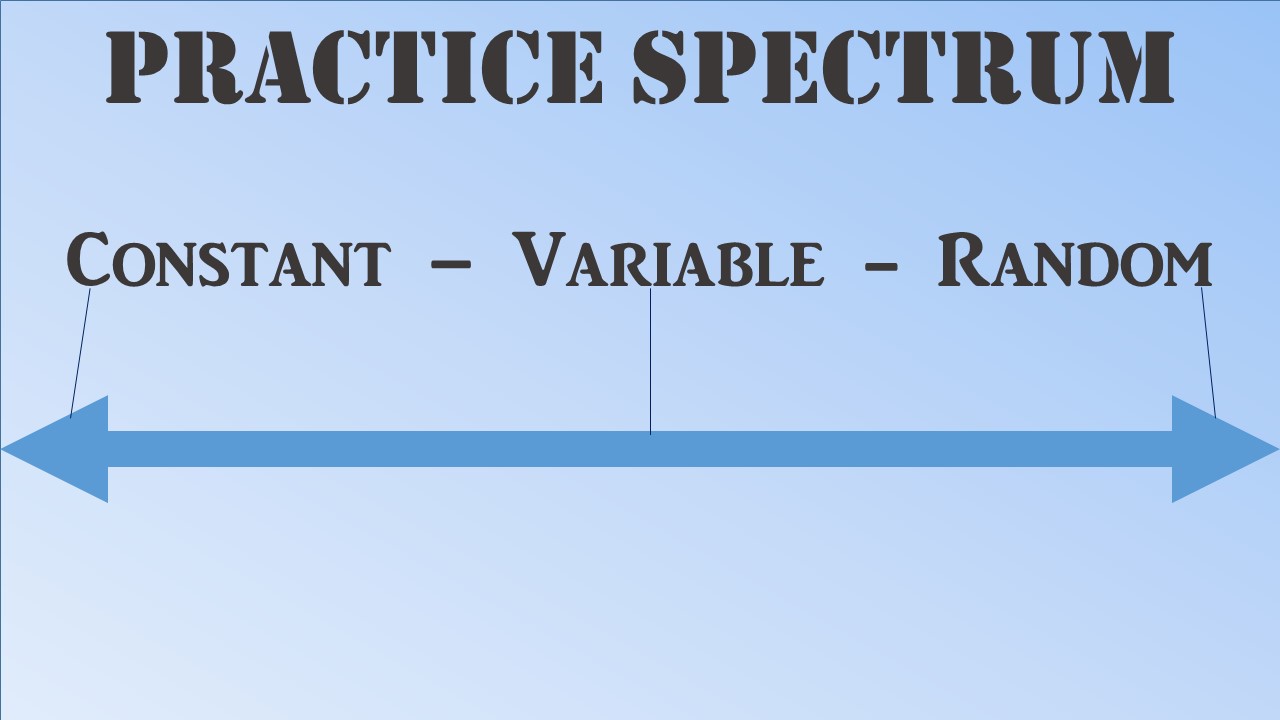
When selecting practice type, it will fall somewhere along this spectrum. Constant is doing the exact same thing over and over again, such as right-footed side-foot passing, one touch, in pairs, over a distance of eight yards. Or hitting a tennis ball against a wall. Or Squats. Random is the full game itself, where anything can happen. Along the way from constant to random, we can add players, manipulate spaces, and add rules, conditions, and challenges. Think of it in terms of variety of techniques that can be used, and variety of decisions that can be made.


A clear example of a constant would be the above Coerver video, which shows a young girl demonstrating the toe role technique. She's doing it over and over again. Practice makes permanent. You may wonder what is she learning there? Agility, balance, coordination. Her left hip in particular is going to feel the burn after doing this for a minute. Switch legs, and if she is very one footed, like a lot of us are, then she's going to do the same on her weak side, which will very rarely be utilised in a match. Remember that footballers are not arm wrestlers, and need to have equal strength on both sides. These kinds of ball manipulation skills are great for teaching players how to control and move the ball around their body, whilst also keeping their head up. Eventually, they gain enough competence that they only need to have the ball in their peripheral vision, and thus will be better equipped at scanning and evaluating the play around them.

Does it teach you how to play football? Absolutely not.


This clip comes from the Nike Academy. We've moved ever so slightly away from constant. It's not just the technique of passing, but also receiving. Both passing and receiving need consideration of angles and distances, so we now have a decision to be made. Sure, the player has to be aware of which of his three teammates doesn't have a ball, as the free man, but that becomes autonomous when you realise there is a pattern to it. The player in the middle is opening up their body to receive, and playing the ball out. Due to the high proficiency of the players on the outside, most of the passes are very good, meaning the player in the middle can expect the same type of pass pretty much every time. Although the players on the outside are passing, it's still annoying to see them standing there and not doing much.

Does it teach you how to play football? Not really. Just by learning to pass and receive doesn't mean you understand its value, nor do you understand where and when to do it. Or how to shoot. Or how to tackle.


This rondo by Barcelona is moving slightly further up the scale as we're adding in choices. There are decisions to be made. It's certainly more random, but is still very constant. All passing is one touch, the players do not move, and the only technique being worked is the different types of one touch passes. There was a flick, a roll, a poke, as well as side foot passes. The decision making is which teammate to pass to, which is influenced based on where the defenders are. With teammates around, it also incorporates communication and the reading of triggers, which are two sources of input players need to be aware of when making their decisions.

Does it teach you how to play football? It teaches players how to play one touch passes when in tight situations, with a support network already in place.


We move further along the spectrum again for this 8v3 type rondo. The players on the outside have two touches, meaning they have a decision about their first touch, as well as the pass. There's also the support angles that one has to make to receive, as well as receiving the ball. With three defenders, we'v not just got pressure, but pressure and cover, with perhaps a bit of balance. The objective is to split the defence by playing that through ball. This provides more variety of decisions, considering where the defenders are, scanning for gaps, analysing the ability for the teammate to receive, and then weighing up all those factors against what type of pass to make. And if you can't split them? Retain. Play the easy ball. As for the defenders, no longer are they just bodies, but actually get some use out of the session. They'll be reading triggers, in addition to assessing how to press and cover based on the position of the ball, and the relation of the players around it. Still, it's lacking a transitional element. Drills like this see the mistake made, the game stop, and the defence give the ball back.

Does it teach you how to play football? A little bit. We're now starting to exploit space. There's a little bit about what to do off the ball too.


Not really a Man City 3v3 Shooting Game when none of the players or coaches are Man City, and the coach labels the two teams competing as Manchester United and Newcastle United. Nevertheless, we take another step along that spectrum. We now have attacking and defending within the same drill, and both of them are allowed to score points. There's shooting, tackling, passing, dribbling, and goalkeeping. There's now a larger tactical element, with the coach encouraging players to attack quickly rather than maintain possession. The key for me, which has been missing all along is the transitional element. Before, if the ball was lost, the game stops, we might change round, and we start again. That doesn't happen in football. If we lose the ball, we have to now win it back. It's pressure v counter. This is a very coach centred drill, but that's more down to the coach than the drill design. If the ball goes out, play should be restarted by the players, not the coach. That encourages them to switch on and remain focused. Some people would have a gripe about two teams attacking the same goal, and it's a point I get. We could quite easily add a second goal behind where the coach is stood, and play 3v3 with teams attacking each end like a normal invasion game, rather than a glorified version of knock-out Wembley. In the previous Nike Academy video I moaned about players stood on the side doing very little. It's it bit similar here. If it wasn't for the coach restarting play all the time, they'd be more involved. I think it's great to have players on the outside as wall passers for two reasons; there's always the option to switch play, and it keeps the ball in play more, making the game in the middle far more intense. Having to stop, even if for a couple seconds to get the next ball, slows it down. It's the difference between playing five-a-side indoor with walls, and playing five-a-side in the park with no walls. It's a pain in the arse having to retrieve the football all the time. Also with two goals, the game wouldn't end when the keeper catches it. Instead, he'd be able to start a counter-attack. Yes, there's a transitional element within this drill, but it's not a true transitional element. This is also the first drill we don't see an overload.

Does it teach you how to play football? It does cover many of the required ideas and techniques fundamental to the game. The only problem is repetition v realism. There was a realistic tempo, with many football themes coming out, which is great, yet for a shooting drill, players may not be satisfied with the amount of shots they're getting. A player good on the ball can fake or dribble to create their own shot. A player not so good on the ball requires help from his teammates to create sufficient space to be able to shoot. It is he who may feel he's not had enough opportunity to practise his shooting technique. The question is though; are we teaching technique or decisions? Shooting technique is laces, head over the ball, plant your standing foot, strike through the ball etc. Decisions are first touch direction, weight and direction of pass to set up the shot, assessment of distance and angle to goal, positioning of defenders, whether to shoot, dribble, or pass, and what type of shot to execute based on all the relevant info. It's a lot more random, that's for sure.


This example comes from a UEFA B type session. It's a phase of play working on defending from the front. He uses a large area of the pitch with realistic distances and angles, as well as clear and specific formations and positions. It's very coach centred, again, but this is more down to assessment than anything else. The early parts of this type of session can be slow and clunky as we look to embed a lot of the information in the players. The coach will talk and point a lot. Once it gets going, it starts to look a lot like a portion of an 11v11 game. Why is there no goalkeeper? One can only assume he's been stitched up with numbers, and was expecting more, since this looks like an assessment, or at least an observation. You also don't bring a camera if it's not important. In this drill, we're looking less at technique and more at decisions. We assume that the players are already competent enough technically for the tactical demands of the session. We're coaching distances, angles, awareness, understanding, and response to certain scenarios. There's a lot of realism here due to the numbers and the size of the area. Is there much repetition? Not really. Maybe for the more important players. He mentioned he wants to work more with the two strikers of the team that is pressing the goal. That means one team has priority over the other, and players within that team will be more important too. These types of sessions are for preparing to play against your next opponent, or helping players understand your playing philosophy. If you did this with kids they'd be bored out of their minds. It bores most adults. It's seen as a necessary evil. I need to spend twenty minutes going over a specific type of run that the two forwards have to make as it is key to our victory on Saturday. The rest of you are just bodies. Sounds insulting when put like that, so let's look at it from another angle. You are managing the game at the weekend. Imagine if you had a remote so could stop, pause, rewind play, and also a headset that allowed you to talk exclusively to specific players. That's how it works.

Does it teach you how to play football? You should already know a fair amount of football before being in this type of session. It's very advanced, and the technical element is largely ignored. If you can't do things like pass, shoot, or tackle, and don't understand positioning and formations, a phase of play will not help you at all. Just imagine trying to do this with five year old beginners. Sadly though, that does actually happen.


This is actually an 11v11 practice. The information is more B license level, whereas the setup is more A license. It's a full game, and yet the coach can stop and start wherever he wants. There are no conditions here to manipulate the game. No rules, no areas, just straight football. The coach can provide challenges to players to achieve during the game, as well as feedback, triggers, and clues. When working like this, much like when working within a phase of play, you lose the repetition. In order for your topic to come out, you need to ensure that what you want to happen, does actually happen. Dick Bate is looking at counter-attack. Can he do that if the opposition sit deep, play long, are compact, narrow, don't commit numbers forward? And within his own team, if players can't hit accurate passes in behind the defence, that limits the counters his team can do. There is obviously room for coaching, but the situation is very nuanced, and so much hangs in the balance. In 11v11, it cannot be forced. The opportunities to counter have to be produced organically, or else you lose the realism, which is what you gain sometimes while sacrificing repetition. To play 4v4, starting on the halfway line, with the attackers being able to play behind and go to attack, then reset and start again, provides plenty of repetitions, but how many of those will actually be realistic? There are opponents, they are matched up, rules are normal, both teams can score, there is a transitional element, and teams can switch the play.

Does it teach you how to play football? Twenty-two players and one ball means that only one layer can kick at a time. The rest simply have to wait for the ball to come their way. If you don't already know how to play football, do not go into an 11v11. It will do you no good. Play 3v3 with players of a similar ability. You'll get so many more touches of the ball. That will be far more beneficial to skill development.

None of this means that one is better than the other, and there is no idea place along the spectrum. As coaches we should be looking for the best way to educate our players about a given topic. We must also consider the hidden curriculum. Take for example the Man City 3v3 Shooting Game. Were the players only learning how to shoot? No. There was passing, dribbling, tackling, communication, and goalkeeping. For the very first Coerver Video, there was no hidden curriculum. The player was only learning how to do that specific move. There will have been physical elements that will have been of benefit, but then we have those every time we move.

This also does not mean we should be critical of Coerver or of unopposed technical practices. They are great. In fact, I wish I had done a lot more as a kid. The unopposed technical practice I got as a child was alone in the back garden, smashing shots at a goal from a distance of about twenty yards. That's why I have a rocket shot, through consistent development of that technique. What I don't have is a first touch, or many ball manipulation skills. Those were never taught to us. Perhaps if I'd have been exposed to Coerver type training, I would have done that in the garden as well.


For instance, this video is an absolute favourite of mine. I should have done a lot more of that as a kid. There's no decision making, I get it, that's learnt in games and opposed practices. What it does teach is ability, balance, and coordination, as well as the very important ball manipulation skills. You can't be shown a stepover or a Cruyff turn a couple times, practise it for ten minutes, and then be expected to do it competently. It takes relentless, repetitive practise to get it right. Organisations like Beast Mode Soccer, Coerver, and Brazilian Soccer Schools focus exclusively on technique. It used to be that kids spent ages in the streets and in parks, so would get in the required number of attempts to master such skills. Take that time away from the kids, and it won't happen. The middle class has robbed us of footballers for two reasons; kids from working class families struggle to afford the fees for decent training as teams and organisation compete for middle class dollars and pounds, and those kids with the access to the better facilities and coaches, will also have homework, study, Xbox, and plenty of other classes to go to. The parents will put more emphasis on becoming a lawyer than a footballer. The chances of becoming a lawyer are greater. Before this, and as is still the case in the poorer nations, those kids don't have such distractions or divided time, and also football is their only option as a career, so they better make it.

Let's try to attach numbers to it. Play 5v5 in the street. Ten players, one ball. If all players are equal, one player will have six minutes contact time with that ball in one hour. Go to a Coerver session for an hour, and it's a ball each. The Coerver kid gets 60 minutes from every hour, and goes once per week. The street kid gets 6 minutes per hour, so has to play for ten hours to get as many touches as the Coerver kid. The Coerver kid will also have a coach to correct, challenge, instruct, and guide, whereas the street kid will rely solely on the feedback of trial and error. Seems like the Coerver kid has the advantage over the street kid, but these are not the only relevant factors.

The street kid from Brazil will play football probably four or five hours per day. If he does go to school, it's not like he would go home and do homework. What's the point? He lives in a favela. Education is not important here. The Coerver kid from the middle class family in a Western country will go to Coerver once per week. They may play for a club team, which would mean another game and training session per week. Let's call that four hours per week. The street kid is getting that per day. If that street kid wants more than his share of six minutes of the ball per hour, he has to go out and fight for it. This could mean against bigger, stronger, faster kids. There are no rules in street football. How is he going to win the ball? How is he going to keep it? How is he going to ensure his teammates pass to him? The Coerver kid is given a ball, and performs a series of unopposed skills. Sometimes there will be a bit of opposition, but the focus is more on the muscle memory of reproducing those skills.

You can already see the difference in motivation. The street kid has to play in order to survive. He won't have much in the way of job prospects or education, and the other alternative to football is gangs. He's poor so has no distractions. He doesn't have school holidays, or long summer vacations. His mum isn't forcing him to learn the violin, speak French, and do his geography homework. The Coerver kid will miss training due to birthday parties and conflicts with other extra-curricular activities. When they have finished their hour of training, the Coerver kid will have to go upstairs and write an essay or read a book. Time spent not playing football.

Unopposed technical practices are a great addition to playing and training. Perhaps dedicate the first ten minutes of the session to it. If you have two or three sessions per week with your young players, maybe you can devote more time to it. If you're a kid lucky enough to have access to a park or a back garden, go out there and practise it. YouTube is a great resource for the young footballer. They can also help a lot even at older ages. I've said many times how much I improved as a player when I began learning how to coach this stuff.

Let's also remember the hidden curriculum when comparing the plight of the street kid v the Coerver kid. While that street kid doesn't have the ball, he will be tracking, marking, supporting, so will still be developing tactically and physically. Then there's the benefits of having ownership and responsibility of your game. The street kids make their own rules and play because they love it. It's how they socialise. The Coerver kids are always told what to do. Sure, they will be challenged and guided, something the street kid won't get, but do they have an intrinsic love for the game? It's not actually life and death for them.

Now to analyse each of the sessions above and see what the players actually get out of them. For reference, we will use the FA Four Corner Model, which looks like this.

Each session will be evaluated with this in mind, but also with some other elements that I feel are necessary. In coaching we talk about the three Rs (Say it out loud, it sounds like three arse). These are repetition, realism, and relevance. Only through repetition do we gain mastery of technique, only through realism does that technique become something that can be done at game speed, and only through relevance does it actually become something worth doing. This is relevance in the sense compared to the topic, not compared to football. Hitting tennis balls against a wall has no relevance to football. That's not the issue. Imagine being told you were doing a defending topic, and instead find yourself dribbling unopposed through a maze of cones. How relevant is that to defending?

With this I like to include three other factors.
Transition; does the other team actually have anything to do when they get the ball or does the game just stop? Typical pub team style attack v defence training. The attackers try to score, and when the defence steal it, the game stops and we go back to the halfway line.
Switch: is there the opportunity to switch the play? To change the point of the attack? To tilt or unbalance the opposition with a horizontal or diagonal pass?
Competitive: is it actually competitive? Do BOTH teams have a means of scoring points? If they don't, then one team won't try as hard. What's the point? It can also come down to the coach and the challenges that are set, or how the teams are picked. For a weak team versus a strong team, very soon both will lose interest as the competitive element becomes non-existent.
 

For the Coerver drill, just the girl on her own with a ball, it scores high on technical and repetition. It doesn't get full marks for technical because we'd like her to be able to do it in a game, or against somebody. It's very repetitive as it's the same skills over and over, and there are no breaks, waiting, or sharing. It manages a little for psychological because it will create mental toughness in the right players. A player that truly wants to improve and work hard here will persevere through the boredom. It's not competitive because there is no opponent, so your opponent becomes your previous score (psychological). It also scores a bit on the physical side as these repetitions will be working on her agility, balance, and coordination. This strengthens the muscles and the joints as they are always being used, and will have the heart pumping. There's not much in the way of stamina or acceleration, which is why physical is still quite low. And there is no hidden curriculum for this drill. She is exclusively working on the skills listed.
________________________________________________________________________________


Within the Nike Academy drill, this again scores high for technical development and repetition. It's the same few components executed again and again, although now the player is working with others, there will be slight variations in the passes coming to him. This is not exact repetitions like a weights machine at the gym, because some passes will be harder, higher, further from the player. It does what it says on the tin though. The player in the middle is working on his passing and receiving, quite clearly. If they rotate and take turns, each player will spend 25% of the time in the middle. The rest of the time they will be the server. This still works the passing, but not as much as being in the middle. There's no opposition, the picture never changes, and the player has no decisions to make, so there is nothing tactical happening. It's more physically demanding than the previous drill, and with teammates now out there, it does become a little social. Psychologically, this drill is not challenging, and will be incredibly boring. If you can still operate at 100% despite making the same unopposed pass one hundred times, you will improve your concentration and resilience. Two words that anecdotally are known to be important for success in the Premier League. There's a tad more realism as the player is working off of a get-it give-it instruction, and has to move to find a passing lane. It's not competitive, there are no transitions, and no ability to switch the play. There's not really anything else happening here the player would be unaware of that could go into the hidden curriculum.
________________________________________________________________________________


This Barcelona rondo is quite high on the technical side if you are looking at one touch passing in congested areas. There are certainly plenty of repetitions. There is a small tactical element as we're now looking at a split, and will be deciding when to play a first, second, or third line pass. It's still low on the psychological because it doesn't really push anyone emotionally nor does it require a great range of decisions to be made. The decisions have to be quick, but are limited in variety. Any transition is immediately followed by the exercise stopping. There is competition, and the actions of the defenders do impact the decisions of the players on the ball, though the defenders are so outmatched. There's plenty of repetition involved, and the picture does change, adding more realism, but this is only a little, due to the overload, restricted space, and lack of possible outcomes.
________________________________________________________________________________


This is still a rondo, and a lot of the previous remarks apply, but with one key difference. There is a third defender. The players also appear to be taking more touches, and there is perhaps more movement, but for me it's the third defender that makes the pressure, cover, balance a lot more realistic. That balance and compactness that can be provided means that the passing decisions become more complex. It's still annoying that the exercise stops when the ball is won. I give the defenders a task, even if it is something simple like trying to keep the ball or dribble out of the box when they intercept the pass. I've said it before but it's just bad practise to build the habit of stopping when you lose the ball. Games are won and lost by which team responds best to transitions. We are what we repeatedly do, and we get good at what we do in practice. If you practise stopping when you lose the ball, you'll be very good at doing that in games. It's a bit more physical in this exercise as players are working harder to find passing lanes to support their teammates. The repetition is going down as now there are eleven players and only one football, but this adds to the realism.
________________________________________________________________________________


Suddenly we have two teams competing equally, and a goal. There's attack, defence, transitions, and a whole range of decisions to make that are impacted by the numbers, space, distances, and angles, including shooting, dribbling, tackling, passing, movement, defending etc. Remember the hidden curriculum? It's a shooting drill that includes so much more than shooting. Repetition is still high because plenty of shots are coming, and the realism is increasing now that there are more decisions. It's clearly demanding physically due to the intensity and tempo. I mentioned before that it was coach centred and based around one goal when it would be easy to incorporate a second. As it is, we're now getting much closer to a proper game of football, and we see that the bars are beginning to level off. The exercise is focussed around a specific component of football, shooting, but includes enough of everything else that it has become quite generic. Generic enough to teach a whole variety of topics. I'm just going to mention one more time that chucking a goal in where the coach is stood, and playing 3v3 with wall passers, with both teams attacking and defending a separate goal would give it a much higher score on the realism.
________________________________________________________________________________


At full width and about two thirds length, we've now got something that is about 60-70% the real thing. This is almost a proper game of football. Each player is going to get a lot less touches, and as it is not manipulated in anyway to force certain outcomes, this cannot be a technical session. If we wanted to work on the shooting of the two strikers from outside the box, realistically they're achieving about two shots each in twenty minutes. This type of session is a phase of play. The coach in the video was working on defending from the front, so essentially where and when to press or organise when possession is lost in the attacking third. The game will play as normal. Then, when there are specific pictures or mistakes that the coach wants to address, he will step in and give instructions, move players around, and aid understanding of the specific tactic he wishes to improve. As we're playing in only two thirds of the pitch, it's quite likely that the blue team will lose the ball plenty of times in the attacking third. How they respond, whether it's a counter-press, whether they target one specific player, let the opposition have the ball in certain areas, or drop to organise, will depend on the team's strategy. Although the blues will likely lose possession plenty of times, thus turning attack into defence, few situations will be the same. There will be similarities, but due to the randomness of football, and the amount of variables to consider in a phase of play, the same exact situation will not happen twice. It's competitive enough as the yellows need to score in the end zone. And as this type of exercise is usually used with more mature teams and players, they will have longer attention spans and more narrow focus, keeping intensity real. Many players hate these exercises when coaches spend too long in there making points. Go in, pausing for no more than thirty seconds, get out.
________________________________________________________________________________


Finally we have a full match. Not many players actually enjoy this in training. They prefer 7v7 games. There's not enough touches on the ball, and too long between each time they are involved. That's why repetition and technical score so low. 11v11 football is pretty much a tactical exposition. How do we best utilise our eleven versus your eleven? When working with another coach, I have always tried to make it as competitive as possible, by having challenges, half time, and encouraging players to make their own decisions in relation to what we want to achieve in the game. Both teams have a goal, the ball can be switched, there will be many transitions. It's as real as you can get, just in bibs rather than your match kit (which actually does have an effect).
________________________________________________________________________________

Now with these factors in mind when planning sessions, we can move forward. It is important, at any level, to create a learning environment. To not do so is simply irresponsible. Yes, I mean even with top level senior players. Just because you're good or old doesn't mean you can't become better. Once you get to the top, you need to adapt to stay on top. What got you here, won't get you there (great book). Ever seen a team and reckoned they just seem stale or lacking ideas? It happens in all sorts of organisations. They're not pulling in the same direction, and they're not striving for better. The players don't necessarily feel valued or empowered, or can feel demotivated. We all work best when we truly believe in what it is we're doing, and with that comes a vested interest. If the players are still on a journey of self-improvement and discovery, that will directly impact how hard they train, and how receptive they are to new ideas. The best teams don't just stay good, they get better.

Reading about Guardiola at Bayern, he worked with players that were already hugely successful. Many have reported how much more they have learnt and developed as players for working under him. The journey as a player is never complete, and it is our responsibility as coaches to instil this hunger for learning in them. Considering all the factors that have been discussed so far, there's two more that I would add to it that are incredibly important for creating a learning environment:

Question and answer - Ask questions to your players to check for understanding, and even pose some theoretical questions. What would happen if? What could you do next? How would this affect the defender? Which is the bigger danger? It gets them thinking and analysing. Kids love to show what they can do and what they know. It also gives you the coach an idea of whether they have a clue what you're on about.

Incentivisation - More of a novice mistake, and something that is still fairly prominent among the old school thinkers, we forget to give an incentive to everyone involved. Always keep in mind the hidden curriculum, and consider would you actually enjoy or understand the task if you were a player. If we're working on an attacking topic, what the defenders have to do must still be realistic, relevant, challenging, and interesting. Never should it be just stop the attack and then restart the exercise. That transitional element is so important, and without it, the practice is largely useless. Counter-attack is massive, and should be allowed to be cultivated. If the defenders win it, can they begin an attack? Whether it be to dribble, hit a target, score a goal, go to an end zone etc.

Don't just teach your players the thing, teach them to do the thing in the context of the other things. The context depends on their age, ability, and understanding. Football is not just a strict set of motor skills that operate in isolation. Coerver and other skill programmes are brilliant, and kids should be out with a ball every day gaining thousands of touches. Even keep-ups or ball against a wall, just gaining those touches, working on the agility, balance, and coordination. They should also be playing all sorts of games, be it at the park or at school, as well as with their team. And just football? Absolutely not. Other team and individual sports. Invasion games, athletics, endurance, racket sports. Be in a place where you're the best, be in a place where you're the worst, be in a place where you're average. Play for good teams and bad teams. Aggressive coaches and passive coaches. Gain a whole range of experiences that provide a multitude of successes and failures. All of this will be compartmentalised by the child, and will help them become a well rounded adult, as well as a competent athlete.

Don't worry so much about trying to make it fun. Giving them a challenge and a way to compete will do that for you. And there will be times it has to be boring. Pattern drills and the like are sometimes a necessary evil because either they are the most effective way to get across that specific point, or the coach just cannot fathom to do it a better way. That's the coach's equivalent of a trivela; hitting it with the outside of your strong foot because you can't kick with your weak foot. Fair enough. As long as it gets the job done. We owe it to our players to give them the best that we can give. That comes from constantly striving to touch upon all the relevant areas, but as we've seen, as you gain more of one factor, you sacrifice another area.

Some like to say "let the game be the teacher", which is relatively vague. Some interpret it as a hippy slogan that means let the kids do what they want. That's irresponsible. What it really means is don't worry so much about chucking tons of information at the players. Instead, come up with a game, one that hits all the aforementioned areas, with rules, areas, challenges etc. that manipulate certain outcomes. Now as the coach, you're not forcing yourself upon them. The repetitions you wish for the players to experience are occurring naturally within the session simply due to the session design. That frees up your cognitive processing to focus more on what the players are actually doing, rather than how to get them to do what you want. You are free to coach, instruct, guide, ask, and challenge. It also aids reflection from the players. Design the session so that the session can be the teacher. It becomes like a video game you have crafted to challenge specific areas of their skill arsenal. You then monitor their progress and step in when necessary.

Finally, remember, no laps, no lines, no lectures. We're here to serve our players. Give them something that they will enjoy, that will challenge them, and that will help them work on what's needed. We don't score extra points for amount of cones. Use games to aid their understanding of football.