Within this blog I discuss everything from session design to social issues within the sport of football. Occasionally with a sense of humour, often in bad taste.
My views are entirely my own, and not those of the clubs or organisations I have represented. I do discuss adult themes and do have strong opinions on sensitive topics.
If you find yourself enjoying what you see, do come back and see us again.
If you enjoy my content and want to express gratitude, I would be so happy if you made a contribution towards my Argentina trip in the summer of 2021. The plan is to go there for four weeks and look at everything football, development, coaching, and culture. Any amount helps. I won't be upset if you ignore this message, as I produce this content purely for the enjoyment of it. Here is the link: http://fnd.us/c1en5f?ref=sh_98yL48
Good evening. Thanks for joining us. Here's some ideas I've had, and many of which have been played out in real life. If you're looking for new and exciting ways to do competitions, engage players, and add a bit of incentive or ingenuity, maybe these could be of use.
Football Threesome
This one came from talking to my dad about a session I did the other day. Many people have tried some way to get three teams to compete in a game of football. The pitch usually is a weird shape, with three goals, and the team in possession is always overloaded. That doesn't look too fun. So let me draw what I've come up with.
Picture your typical British 5v5 game. Indoor, or on turf. Walls. Small goals. Similar size to a futsal court. So not a typical American 6v6 pitch which is a converted ice hockey rink, where the game becomes about running. No. We want to do football, not athletics.
Nevertheless, these leagues usually have a lot of restrictions in their games. This would be no overhead height, only keepers allowed in the box. For me, the game should be as similar to football, and as simple as possible. The keeper can come out of the area, and everyone else can go in. You can pass to the keeper as often as you want, but like in football, they cannot pick it up.
How do we make it a threesome? Three teams, play for one hour, winner stays on. The games are a maximum of five minutes. You have to win to stay on. As soon as a goal is scored, the waiting team enters, and restarts the match. If there have been no goals after five minutes, the team which has been on the pitch for longest leaves.
Simple. One goal, winner stays on. Max five minute games.
Can this be turned into a league? Absolutely. Here's how.
One league of twelve teams. Those three teams play each other for an hour. Every win is worth one point. Let's take Pitch 1.
Wednesday get 7 wins City get 4 wins Arsenal get 2 wins
That makes Wednesday the winner. They won that game, with City and Arsenal being losers. What happens if two teams get the same number of wins in a night? The winner is decided by who won the first game between those two teams. That's the decider. These one hour fixtures happen every week, and then we apply weekly promotion and relegation. This is done so teams are always grouped with those they can compete with. To demonstrate, I will apply some results.
The teams in red have been promoted to the next bracket, while the teams in blue have been relegated. The league is separated into four brackets; gold, silver, bronze, and wooden spoon. The league will change every week. After these results, next week's games will look like this...
These are next week's games. Do a ten week season or whatever. How do you decide the two teams that start the game? The two bottom teams in each bracket. It will almost work like a ladder. The team who wins the gold bracket on the final day of the season is the team who wins the league.
When it comes to working with kids, I like them to have more wider age brackets. Like 13-16. Great mix up, and fantastic for the social and physical corners. I like kids making their own teams, being inclusive, mixing boys and girls, being relaxed with registration so we don't waste time with cards and forms, so we can get kids in playing quicker. As for kit, provide the league with two colours, and the league will see if there's a clash each week. As demonstrated below.
Simple enough. What's your team name? What two colours are you wearing? Great. We'll highlight your colour each week. It's not about making money. It's not about looking flash. Keep it simple, and get them out there playing.
Futsal Tournament
This was an idea I had for a futsal tournament to use in Missouri. It was supposed to be the last thing I was doing before leaving, and then some FBI raids happened in some offices in Boston, and they asked all the visa staff to leave a little earlier. But I can still share the slides and the concepts I had. Even bought trophies for this, and everything.
Cool poster, bro! Six teams compete over three hours. Kids sign up and are assigned a team. It's wide age ranges, and for girls and boys. Most of the kids signing up, we would have known fairly well, so would have been able to make somewhat even teams.
Kids register and are randomly assigned a team. Their team is named after a country, and they have to wear the colours of that country. That already, to a kid, makes it interesting and exiting. Futsal rules have been simplified, and we added in some random intervals of music, in which goals count double, to add more excitement, and another dynamic of gameplay. This tournament never happened, but the template is a good one. Six teams, over three hours, play one game against each team.
I really believe in mixing ages and genders. I also like the image conveyed of representing teams. Kids get to play for France or Brazil. Some of them had the shirts of these countries, and were excited to be able to wear them. Assigning what colours to wear ahead of time also allows the kids to personalise their experience. You may not have a red spain shirt, but you have a red Manchester United shirt you want to wear. Too much of the US experience is uniformed, literally, as we sell them endless amounts of training kit. Rarely do we see them in their own skin (Fortnite reference), being who they are, showing us who they want to be.
The idea of random music meaning two goals are scored adds an element of panic and excitement. It could be thirty seconds. It could be two minutes. Picture being a goal down, and hearing music. How might you then play? Or being ahead by two goals, with only a minute remaining? Quick sub and change of strategy? Kids would have to figure this out, and will learn from the trial and error. Another benefit was that all the games were on the same pitch, one after the other. When we had done similar things on camp, in the form of tournaments, the kids not playing got really into it. They watched attentively, and cheered for the teams they needed to win, because it affected their own chances of winning, as were shown on the live table.
3v3
This one I actually got to do for real, and it was a great success.
This is how the pitch looked. If there's a wall, play off the wall. If the ball goes over the line, then put the ball on the ground, and either kick or dribble in. Every restart is direct. Just make the rules as simple as possible, to stop wasting time and remove arguments. Play for three minutes, and the winners move up, the losers move down. You want to get to pitch one and stay there. The team to win the final game on pitch one is the winner of the tournament. That's how ladders work. In one hour, of three minute games (with one minute rest after three games, so nine minutes playing, one minute drink from every ten minutes), that makes for eighteen matches. In theory, a team could lose the first fourteen games, win the final four in succession, and be champions. If there's a draw for any game, it was the team who scored first that would be seen as the winner. In the event of a rare 0-0, it was one of rock paper scissors (essentially sudden death).
It was great to watch. Some teams moved all the way up and all the way down multiple times. A real rollercoaster of emotions. We didn't anticipate just how popular it would be. It's an hour 3v3 tournament in a shed. I should have known. Americans bring everyone. There were probably three other people per kid, all crammed into this small viewing area, moving up and down to try and view their kids as they ascended or descended the ladder. The parents got really into it, and the noise was deafening. It was crazy how seriously people took it, but it was a really fun and interesting concept. Different to the usual money grabbing nonsense. This was $20 per team. We didn't make much money on it, because that wasn't the point. Just cover the field and trophy costs, and get kids out there having a great time.
I wish there were more space for this kind of event. It was a bit of a hard sell at first, particularly as Americans view cheap as inferior, and fun as a luxury when it comes to the sporting experience and general mental wellbeing of children. 3v3 tournaments are not uncommon, but their format is completely different to how I structured this one. It costs upwards of $100 per team. You're guaranteed three or four games, that are usually fifteen or twenty minutes. And the games are spread across the weekend. Like how they do normal tournaments. Mine was quick. One and done. All at the same location, one after the other. Show up at 8:45, you're back home by 10:30. Youth sport has a monopoly on families' time. I want to give them that time back. Parents with reduced time become stressy. Stressy parents should at their kids on the field, because they expect a performance for their donation of time and money. The kids play with fear and without joy. The coaches then pander to the parents because it's the path of least resistance. The clubs and organisations love it, because they will play on the fear of missing out. They FOMO these parents to death. "Well, if you're kid's a serious baller, you'll sign up for this incredibly expensive, incredibly time consuming tournament..."
Bollocks. The kids at our 3v3 had way more fun, way cheaper, the parents were considerably less inconvenienced, and the atmosphere was one of fun and creativity, but still taken seriously. Adults forget that kids are naturally competitive. Give them a way to score points, and kids will go to war. All we need to do is to facilitate that. We don't need to be on top of them telling them to knuckle down and take it seriously. Incentivise their performance, and they will take it seriously. And that's how you facilitate fun.
The kids got to make teams with their friends, pick their own names, and choose their own colours. So much autonomy. Yet most parents are of the opinion their kids can't wipe their own arses. Or the lives of the kids are so busy, the parents end up waiting on them hand and foot.
Two Games Simultaneously
I've talked about this kind of thing before. First, I will explain the idea of the game. Then, how to turn it into a tournament.
It's one 9v9 game divided into two pitches, or two separate games. The players can cross into the other game at any moment. You can put all defenders or all attackers on one side. You can run across to defend a free kick and then come back. You can assign more players to the pitch in which you are losing, in order to bring the score back, or more players on the pitch you are winning to consolidate the win. The strategy is entirely up to the team. The only players who can't move pitches are the goalkeepers. In theory, you could have two games of 8v1. You choose how much you want to commit to the overload.
How does it work? Let's say it's fairly standard in terms of indoor or futsal rules. Handball, free kicks etc. Preferably it would be two indoor courts with walls, but it works just fine outdoors too. I prefer SSGs to have walls nearby so we're not forever chasing balls, and the game is continuous. The game lasts for half an hour. There are four points total available. Two for a win, one for a draw, zero for a loss. If you win both games, you are awarded four points. Win one, draw one, three points. Draw both for two points. Draw one, lose one, only one point. Lose both, and it's zero points.
More is at stake. More can be gained. If you're losing heavily on one side, should you just forget about that game and try to gain something from the other side? If you have nine players, the team cannot split evenly, so there will be plenty of overloads occurring all the time. This makes for great attacking and defending scenarios.
A league format would be pretty standard. The team with the most points at the end of the season is the champion. What I like about this and all these games is that it makes the emotions of football happen quicker. We want to expose our kids to as many different scenarios as possible, to best prepare them for the adult game, and for adult life in general. These formats encourage them to think, to analyse, to strategise, to communicate, to weigh up options. Like in video games, the consequences of your actions are rewarded or punished quickly, and there's plenty of chances for do-overs.
If we do it right, all of the decision making will be placed onto the kids. These formats create the right environment, or apply the right constraints, that now the kids have to think about how it is going to work, and they have to think on their feet and solve problems for themselves, without our interventions. The constraints have forced them into the kind of scenarios we want them to face. These are really fun, engaging, kid friendly formats. I want to take the game away from egotistical and money hungry adults and give it back to the children. We have the resources, we have the facilities, we have the know-how. We shouldn't be looking to generate profits off of their hopes and dreams. We should be providing rich experiences for them to learn, grow, discover, experiment, develop etc. These formats provide so much trial and error, in small, fast-paced environments. Having tried these kinds of games a lot over the years, I have seen how much the kids enjoy it, how seriously they take it, and the many ways it challenges them. I would love to have done stuff like this as a kid. And to me, that's the way we should be approaching how we design activities for children; "I would love to have done stuff like this as a kid."
If you enjoy my content and want to express gratitude, I would be so happy if you made a contribution towards my Argentina trip in the summer of 2021. The plan is to go there for four weeks and look at everything football, development, coaching, and culture. Any amount helps. I won't be upset if you ignore this message, as I produce this content purely for the enjoyment of it. Here is the link: http://fnd.us/c1en5f?ref=sh_98yL48
In contrast to my usual off-topic ramblings, I’m going to
try and be as helpful and matter of fact as possible.
The allure of coaching abroad is strong. There’s many
reasons why we do it, ranging from a sense of adventure, to looking for
opportunities. We can gain a lot from coaching in different countries, and I
can attest to that, having learnt another language and gained a wife.
Professionally, it has brought me new insight, qualifications, perspective, and
a whole range of coaching experiences and challenges I could not have
experienced back home.
It can be hard, but nothing worth doing comes easy. Leaving
friends and family, adapting to a new culture, a new language, new weather etc.
can be daunting. It’s worth it, even when it doesn’t work out as planned. You
can be vulnerable, and I’ll try to go into detail on how to best prepare
yourself for what’s ahead.
Know Who You’re
Working For
Technology has improved massively. This is a great advantage
to us when seeking opportunities in strange lands. Do your research on your
employers. It’s possible to check some of them out on sites like Glassdoor,
where former employees leave candid reviews, talking about all sorts of issues
from pay to atmosphere and cohesion. They’re honest, and quite telling.
LinkedIn is another good one. It allows you to see the experience of the people
you will be working with, and can allow you to contact some of them and ask
questions. A couple users on LinkedIn contacted me back in the day, and I
talked them out of signing up for a scam.
Many clubs and organisations abroad are franchises.
Facebook, Twitter, and Instagram will show you a lot of good information. Is it
a franchise in name and badge only, or do they have guidelines and a curriculum
sent from the parent club? You may think it’s great to be associated with a
large European club, but do they really follow the principles of that club, or
are they just some grafters in club tracksuits? From social media, you can
check out the facilities, the level of the players, what the training looks
like, and even what the parents think via their comments and reviews.
Living
Arrangements
Where you will live and who you will live with can often be
deal breakers. The coaching might be good, but if you’re stuck sleeping on your
boss’ sofa, or living with unpleasant housemates, this can really affect your
enjoyment. Try and get clear answers on this, and pictures if possible. Many
companies in North America have you staying with host families, and for every
dream family that spoils you rotten, you have an equal chance of being stuck
with a family you can’t stand.
You will need your freedom and your own space. The job is
stressful, and that is exacerbated by having few outlets. Back home, your
family and friends help you unwind and reset. They will not be with you abroad.
Which part of town will you live in? This impacts your social life. As coaches,
we work unsociable hours, but you still need to find ways for you to have fun.
For me, I try and join a team to play football with, I find a gym, and I buy a
guitar. Those things are what help keep me sane when working abroad and
isolated. Think about what it is for you, and if you can have access to that in
your future work environment.
Transport
How will you get to and from work? Some companies in the US
have you car sharing. They do this to save costs. If you’re stuck with a group
of non-drivers, this means you might become the default chauffeur. This adds
hours to your day, and can sometimes have you stuck with the fuel bill. Car
sharing also makes it hard to socialise, and go on errands. If four of you have
a car between you, it becomes difficult to manage things like going to the
supermarket and hanging out with friends.
Some companies won’t give you transport, and in some
countries, this severely inhibits your freedom. Anyone who has been to the
suburbs in the US knows public transport is so rare, and everything is spread
out, making walking impossible. In other countries, public transport can be
useless, unpredictable, or dangerous. Make sure to check this out. The employer
may tell you that you’ll be fine, as you will get lifts everywhere, but do
consider how much this will impact your ability to get around in your spare
time, and how many hours it will add to your day, being dependent upon others,
and not being able to move around on your own terms.
How Will You Get
Paid?
It’s not likely that working in football will make you rich,
and if you’re in it for those reasons, the kids are better off without you.
Still, we need to eat and to live. Too many companies pay peanuts, and in some
cases, keeping you poor is a way to keep you subservient, as you are not likely
to book your own flight home and get out of there.
Each country is different, and some pay monthly, weekly, or
every two weeks. Definitely find this out so that you can budget for the first
amount of time there before receiving a pay cheque. Many employers will tell
you, to help you swallow the pill of low pay, that “things are cheaper here.”
You’ll hear things like a three course meal is £4, and a taxi into town costs
£2. Sometimes that is the case, but as a coach, we should always have an eye on
the future. Ask questions to yourself like “will I be able to save enough for
the next coaching license?” A good rule of thumb will be that if you were to
spend no money whatsoever, you should be able to afford at least one return
flight home per month. Ideally, it should be closer to two. If not, I’d be
sceptical that they’re keeping you poor for a reason.
Many companies don’t just pay you, but will in some cases,
sort out certain utilities too. Find out what this is, or that monthly salary
that might originally seem decent, will quickly become depleted when you’re
paying for gas, electricity, water, phone, internet, and transport. The good
employers usually take care of most of that for you. The packages often include
a return flight for each contract, and some will even pay visa costs.
Some companies won’t tell you this, but they will expect you
to buy things related to work. They’ll talk about getting it back via expenses,
though some can deliberately make this an excruciating process. “We’ll cover
75% of your gas receipts” but will then do everything they can to delegitimise
your claim. And don’t take this for granted, but ask what equipment they will
give you. It’s sadly not uncommon for coaches to be given two shirts to last a
whole week, even in sweaty countries, and not have any balls or cones.
Philosophy
Any coach worth their salt knows that there must be some
kind of scheme of work. We’re too far progressed into our football journeys to
just be making it up on the spot. Working with others who have completely
different philosophies to you might not be something you can reconcile. Working
for someone who doesn’t even have a plan to begin with can be even worse.
Ask questions about the methodology, style of play,
curriculum etc. Ask how they ensure quality control, to make sure all coaches
are working together to achieve the same goal. If they can’t answer these
questions coherently, it might not be the best football environment for you.
I’ve made that mistake a couple of times, and you feel helpless.
All coaching experiences should have you becoming a better
coach at the end of it. Ask what they are going to do to help you improve by
the time you have finished your contract. Is it the players you’re working
with? The colleagues you have? The company resources? Will there be regular
CPD? Are there opportunities to go on courses? If none of this is happening,
you have to wonder about their values. Just as we seek to make our players
better, we too must be striving to become better as coaches.
What Does the Work
Actually Look Like?
Five hours a day sounds great, until you realise there’s a
two-hour gap in there, and an hour commute either end, with no day off. Will
you be just coaching, or will there be admin and sales too? Will it be just
football, or will you be expected to teach other sports? Imagine flying halfway
around the world, as a football coach, to only coach one hour of football a
day, and the other hours being sports you know nothing about. Some companies do
dupe you like that, so be sure you know what you’re getting into.
How much of your work will be with U5s? It’s important work,
and we all need to contribute, but sometimes your whole day can be playing cops
and robbers, Shrek and Donkey, what’s the time Mr. Wolf? And preventing kids
from running to their parents, crying, and eating grass. Is that what you want
to do? What are the levels and ages of the teams you’ll be working with? What
does the training schedule look like? What are you doing in the off-season?
Another thing to ask is in regards to vacation time. You may
miss friends and family back home, or they may want to come visit, so you don’t
want to be inundated with work when they come. Or perhaps you’re like me, and
enjoy travelling and exploring. When can you do that?
Find out what the facilities are like too. Google Maps and
Google Earth are great for showing what polished websites don’t.
What Do You Need
To Know About Culture?
Sometimes the most fascinating part of the experience
doesn’t even relate to football. It can be amazing to be in a new place that is
nothing like your own. Try to ask about what are the most different aspects in
the country when compared to back home. Are there any customs or social norms
you have to be aware of? Are there any rules regarding religion, sexuality,
different treatment of men and women?
It's also very important to know this stuff, because if you
have any strong stances about certain issues, there might be a few countries
out there that you can’t stomach. How much adapting do you have to do? How much
do their rules impact your core principles? Can you make those compromises?
Culture also affects parental expectations and how the kids
behave. Will the parents be on your case? What are the motivations of the
players? What is it that British coaches typically struggle with when engaging
the kids from X country? Football is a very social game, and we have to be
aware of our audience, and also how we may be perceived. Some countries have
very different greetings to ours, such as hugging or kissing on the cheek. Most
locals will not be offended if you get it wrong, but learning their customs
will go a long way.
What language do they speak? Are there opportunities to
learn it? Are there some key phrases that will help you? Will there be the use
of a translator? What is the level of English? Coaches deliver messages, and we
have many ways of doing so. Knowing your audience helps you better shape and broadcast
your message. Sometimes, learning a bit of the language and trying it gains
some respect, and also makes you seem humble and vulnerable, such is the
learning process. If kids see you trying and struggling with something that is
easy to them, they’ll be more open about making footballing mistakes in front
of you. If they’re open, you can help them.
Make sure to be aware of safeguarding procedures in the
country. How will you be expected to communicate with kids and parents? Will
you ever be left alone with the kids? Some countries have no laws on this, and
do not require things like waivers for liability, insurance, and even taking
photos of players below eighteen without permission. It can put you in
uncomfortable positions, that would make most Brits shudder. Be clear on the
procedures, and don’t do anything you feel uncomfortable with. As a rule of
thumb, if it would feel wrong in the UK, don’t do it abroad.
What Is The Visa
Procedure?
When can you enter the country, and when do you have to
leave? Know your rights. Many companies make millions off of visa abuse.
Working without a visa means you enter as a tourist and earn money illegally.
The employer might tell you it’s easier this way and saves a lot of hassle, but
what it does is removes a lot of protections for you, and gives them a ton of
leverage. Having the legitimate right to work in a country means that the
government will protect you, by law. You are guaranteed certain rights, making
it harder for the boss to exploit you. This is vital, as this is where most of
the employment issues arise.
A lot of countries have two main requirements, which are to
have a bachelor’s degree, and have no criminal record. It’s not impossible to
work abroad without meeting these criteria, but it does become much more
difficult. If you’re young, and starting your journey, wanting to go abroad,
three years in university to get a BA or BSc, and at least a Level 2 (C
license) will open up so many doors for you. Get it over and done with in your
late teens and early twenties, and the world becomes your oyster.
Be A Good
Ambassador
Do your country proud. Don’t be a drunken womaniser,
engaging in debauchery. Sadly, many do. Being abroad means they are given a
little anonymity, and are free of accountability. You are not better than the
locals, no matter how stupid or backwards you think their customs are. As a
foreigner in their land, you stand out. A lot of people will know who you are,
and anything reckless you might do will likely find its way to your boss, or
even worse, the parents.
If you’re not serious about coaching, please don’t go.
You’re stealing a living, taking a job from someone else, and robbing players
of a real coach. There’s plenty of opportunities to work abroad via other
means, such as Camp America. It gives the rest of us a bad name when too many
illegitimate coaches flood the market. I’ve seen too many go abroad and think
they can get away with half effort, believing there is less accountability, and
that they can just go out on jollies and do coaching on the side.
Coaching is a serious profession. You’re part of a team. Not
putting in full effort, not pulling your weight, not being on the same page,
that’s not being a good team player, and pulls everyone else down with you. If
you wouldn’t do it at home, don’t do it abroad. Would you turn up to work
drunk? Would you make excuses to skip sessions? Would you skip preparation?
Would you let your personal life interfere with your professional life? The
players deserve our absolute best, regardless of which country we’re working
in. If you’re not prepared to give it, coaching is not the job for you, at home
or abroad.
If they don’t like you asking questions, you should be
suspicious that they are trying to pull the wool over your eyes. Do your
research, find out as much as you can, and if you’re hesitant, listen to those
feelings. Going abroad isn’t all bad, but like anything, we need to be
prepared. You can meet fantastic people, learn a ton, and gain whole new
perspectives on coaching, football, and life. The experiences make you rich.
And even if you only do one term abroad, and even if it is only short, you’ll
gain so much from it.
If you enjoy my content and want to express gratitude, I would be so happy if you made a contribution towards my Argentina trip in the summer of 2021. The plan is to go there for four weeks and look at everything football, development, coaching, and culture. Any amount helps. I won't be upset if you ignore this message, as I produce this content purely for the enjoyment of it. Here is the link: http://fnd.us/c1en5f?ref=sh_98yL48
I'm probably going to waffle a little, but hope to generate a bit of discussion and maybe organise my thoughts. Perhaps by the end of it, I might come up with a template, or something useful for parents.
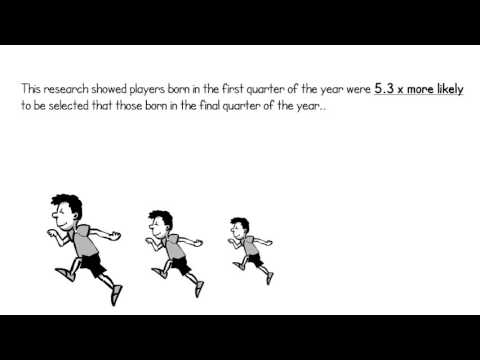
How can I tell if my child is talented? First of all, if you find yourself asking such a question, this video may provide you with some insight.
In order to understand growth and development, we first have to understand some of the models. These models have holes, of course, but are representative of our best understanding so far.
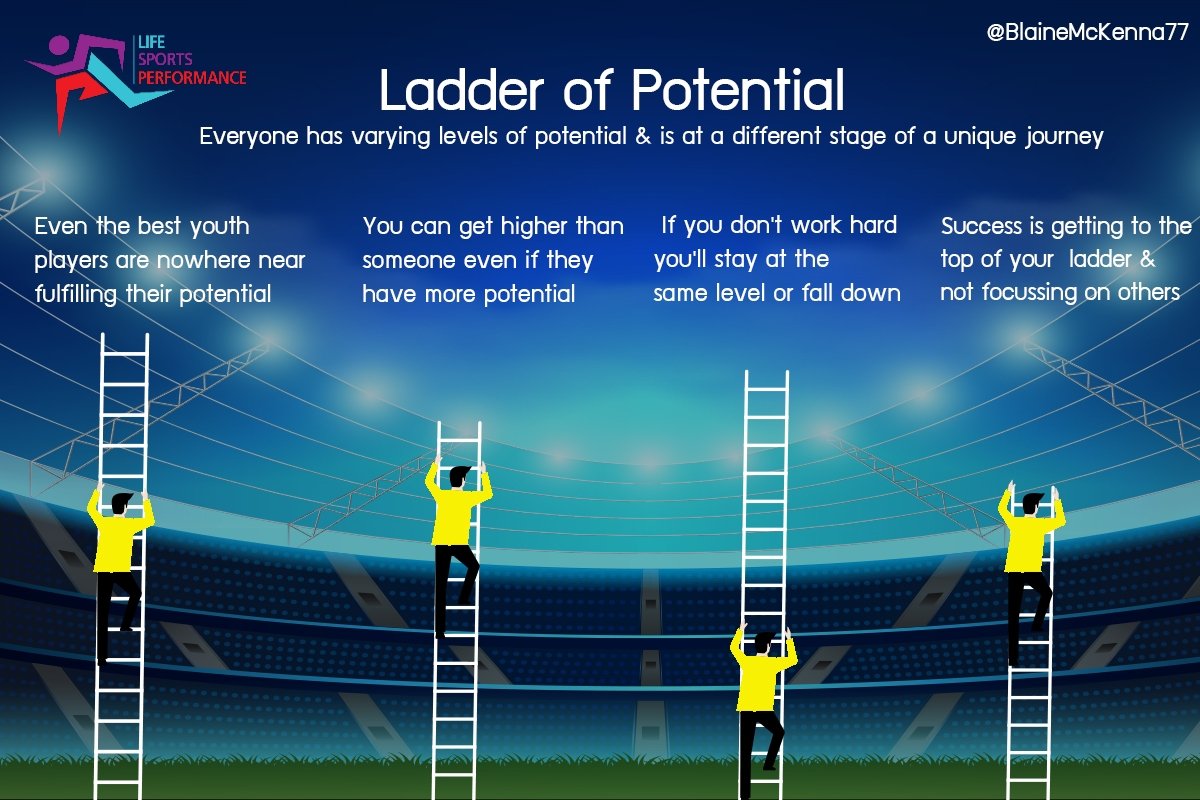
The English FA uses this model for young players. Kids will be growing in each of these areas. Most youth coaches and parents will tend to look through a physical lens first, and then a technical one. The biggest, fastest, strongest kid stands out. The kid who puts the ball in the net most frequently stands out. Remember that just because a kid is ahead now, doesn't mean they always will be. Blaine McKenna's brilliant illustration demonstrates that.
Players grow at different rates, and at different times, based on a whole range of different variables. Much of early success in sport is attributed to relative age effect (RAE), and that early success in sport has little bearing on long term sustained success.
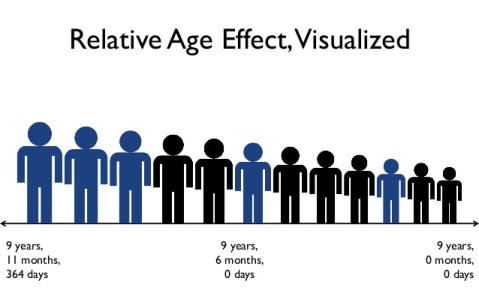
Because most schools and governing bodies play in year groups, there is an arbitrary cutoff date. In one year group, players can be eleven months apart in age, but still be grouped together. This puts the younger kid at a huge disadvantage. At those young ages particularly, those eleven months represent a large percentage of their lives, and usually manifests in large discrepancies physically. If we choose January as our start date, making January kids the oldest in the group and December kids the youngest in the group, the January kids are likely to be taller, faster, stronger, heavier, so will have the edge physically. The extra time they have had on the earth also makes them (not always) more developed mentally. They make better decisions, show better leadership qualities, handle pressure and criticism better.
If we decide to choose February instead, that January kid is bumped up and plays with older kids, and will likely lose those advantages. In the above demonstration, the kids in blue are the kids that are picked. The kids in black are the kids that are discarded. It happens this way in all sports, and even academically, that those who experience success while young are born towards the start of the year. It doesn't matter what month is selected for the start of the year, and it doesn't matter what the sport or activity is. This bias always occurs.
Part of that, from my perspective, is what attributes of players we value, and what our priorities are. Physical attributes are easy to spot, as are goals. And if we want to win games today, we pick those kids. What we struggle to do is identify potential. Going back to the ladders picture earlier, any idiot can tell you which kid is better today, but very few can identify who is going to be better when they are are adults. This pointless race for winning youth games makes us short sighted, and employ discriminatory policies, which ultimately harm the potential of a club or country's talent pool.
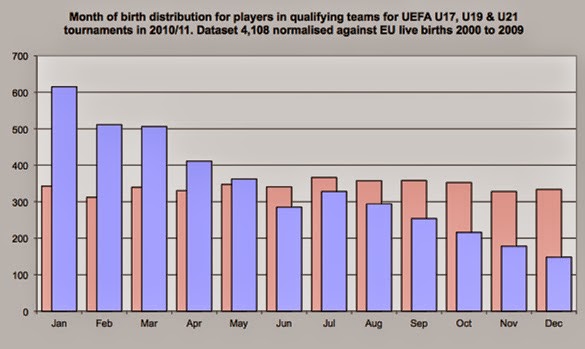
In the above graph, blue represents number of players, pink represents number of births. Births are almost evenly distributed throughout the year, but the top players congregate towards the start of the year. The exact same effect is found regardless of where you decide to begin the year.
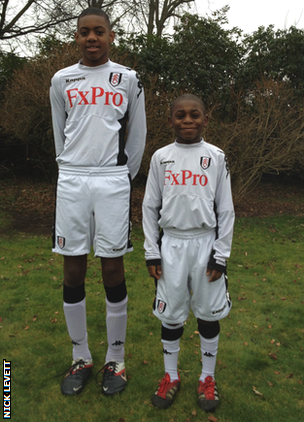
These two Fulham kids are in the same age group. Kids grow differently. I did. I was man sized at fourteen. I mention this a lot. As a kid, I always had a height and strength advantage. Not because I was stronger, but because I had grown more in the same number of years as my teammates and opponents. I don't have a propensity for growing muscle mass. I'm not naturally strong, nor do I have any innate explosive power. It's simply that my hormones allowed me to shoot up head and shoulders far quicker than average. I had body hair at ten. I was bigger than the average British adult male at twelve.
For those unfamiliar with the story, can you speculate as to what effect that had on my development? Because size and strength was such an advantage, it became a crutch. I didn't need anything else, because I could get away without having it. My first touch didn't need to be good because I could fight my opponent off the ball. Due to the English grassroots environment I grew up in, every coach wanted me to hoof the ball forward, meaning I didn't develop good short passing ability. This happened because, remember, in youth football, we have to win now and today. Booting the ball up the other end of the pitch is an effective defensive and offensive strategy. It keeps the ball away from our goal, and gets it nearer to their goal. By not making short passes to teammates, it meant I wasn't causing mistakes for my team in my half. The three biggest factors there are culture, coach education, and coach ego.
Most of the footballing world will start their year in January. Some start in September. This implicit bias is present across the globe.
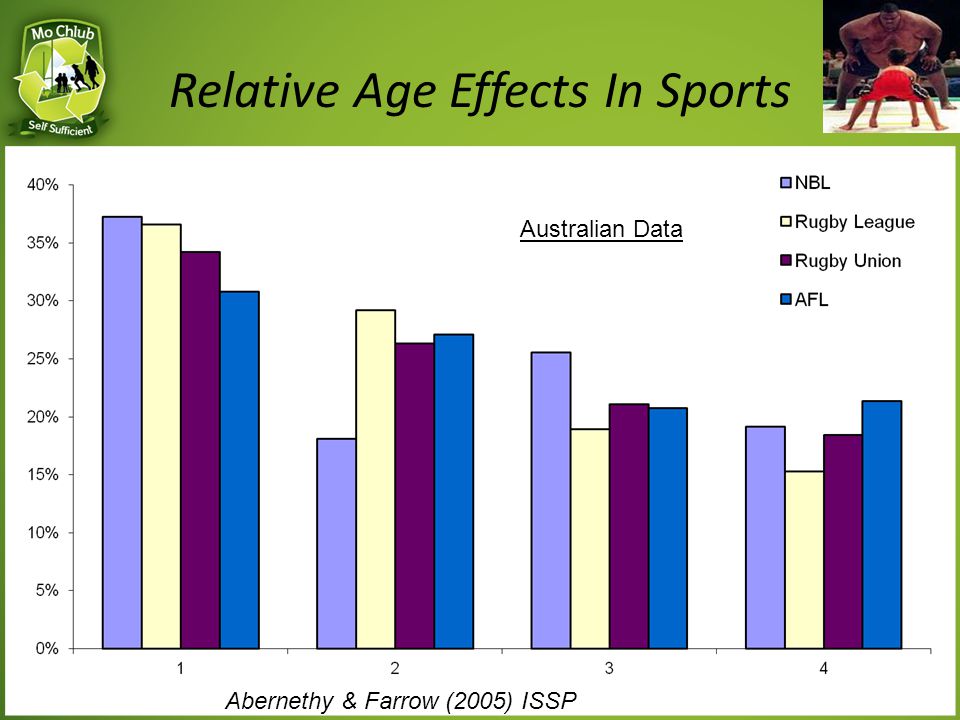
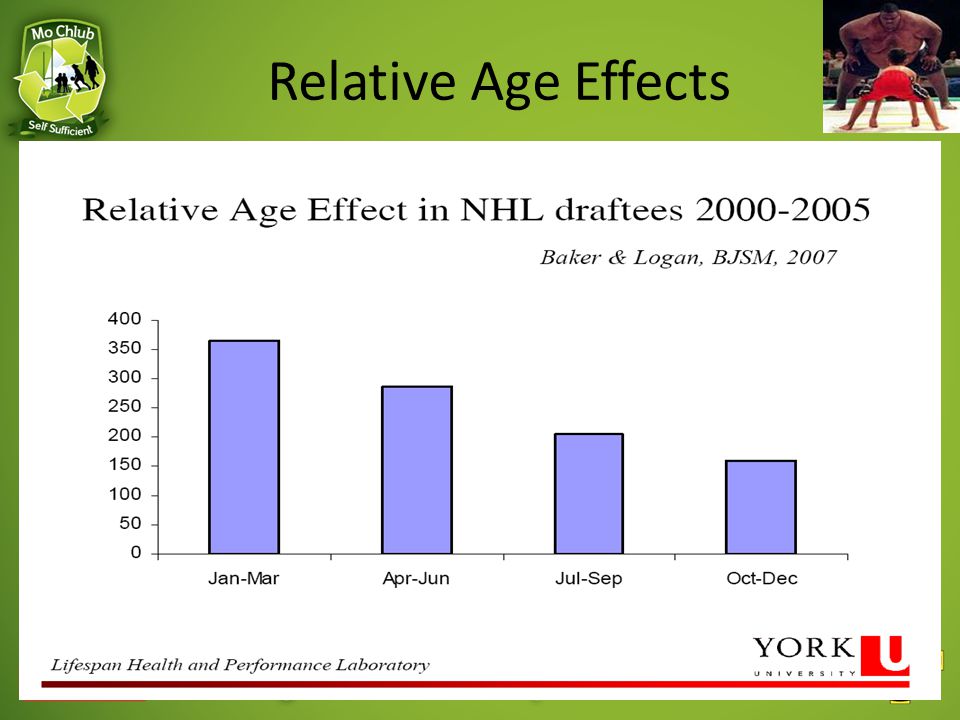
It's present in a whole range of sports.
Especially more pronounced in sports that require more strength and speed.
Now, you might be thinking that eventually all kids catch up. Height, strength, weight, speed are distributed evenly through the year in adult populations, so why is it that we see such a biased trend in sports? That's due to something called the multiplier effect. Relative age effect gets January, February, March kids in the door. What keeps them there is the multiplier effect. It's essentially a deselection process that discriminates against the rest of the birth year, and limits the talent pool to the first three months of the year.
January, February, and March kids will get more game time, play better opponents, be placed on more competitive teams, will be given extra training, will have access to better coaches, and much more. Imagine it like two snowballs rolling down a hill. One snowball begins as the size of a size five football, and the other snowball begins as a golf ball. By the time they have both reached the bottom of the hill, the size five football snowball will be much bigger than the golf ball sized snow ball.
If the two snowballs were kids, the football kid would be given far more opportunities to develop and experience than the golf ball kid. This in turn leads to way more opportunities awarded to and afforded to the football kid, while the golf ball kid keeps missing out.
So why don't we just pick the kids with big parents, who are born in the first three months of the year, and then pool all our resources into them? Design intense training programmes for those kids alone. Before I answer that, let me remind you that sport is for everyone, and there's more important things than winning.
Essentially such a question is based off of the assumption that development is linear. We know it's not. That brings us back to this.
The formular that guides me is Ability = Potential - Interference. There's lots of plateaus and forks in the road which can impact this development. And as individuals, we all respond to life events differently. What breaks one, strengthens another. I'll find the stats on number of US presidents with dead parents in childhood compared to prisoners with dead parents in childhood. The same with dyslexia.
I see American parents buying their kids all sorts of opportunities, and so many material possessions, and failing to replicate the skill and application of an African kid without shoes. It's logical, so we can't blame them. Private sessions, elite programmes, expensive equipment, basements converted into gyms etc. All that is with the aim, and the logic, of providing more to your child to help them grow. But it never replaces love and determination. What we think is an advantage is a hindrance. The kid who is handed everything never learns the perseverance and determination required to make it. Much of that is developed via having faced adversity, and many western minded parents are experts in removing adversity.
The peanut ban is a metaphor for that. In an effect to aid kids with peanut allergies, peanuts, and many nuts (even though peanuts are cashews and do not trigger allergic responses in the same way nuts do) were banned. On the surface, it was logical. It's hard to know who is allergic, so ban them publicly. What happened was, in the absence of peanut exposure, more kids developed an allergy of peanuts. It turns out that a peanut allergy isn't necessarily genetic, and more due to young children being exposed to peanuts being able to develop an immunity to them. Remove peanuts, kids don't develop immunity during that window of opportunity, and more kids develop peanut opportunities.
It's the same way we build our immune systems, by letting our kids play outside, getting cold, wet, muddy, and coming into contact with surfaces that are dirty. Keeping your kid in a bubble might prevent them from getting an illness or infection, but it will significantly weaken their immune system. When they reach adulthood, you can't protect them anymore, and they will not be prepared for the real world.
Anyway, back to the previous example about dyslexia and dead parents. It's a simplified example, made to prove a point, but I need to clarify that the reason presidents went on to be successful and prisoners not will include many factors. The largest one being privilege. Presidents, when children, had a far better chance of surviving the death of a parent (mentally, financially, educationally) than that of a prisoner when a child, due to their resources. Prisoners often come from very poor backgrounds with broken homes, so are not equipped to deal with and recover from such a blow. Presidents usually grow up in rather affluent and well connected environments. They would rather have not lost their parent, of course, but when compared to the prisoner, would have had far greater resources available to them.
When we judge kids, we often judge them from a snapshot. We fail to see the bigger picture, or fail to assess them within the context of the bigger picture. I also think we shouldn't be judging kids in the first place, and should be providing as many opportunities to as many kids as possible. The motto being all of the kids, all of the time, rather than employing discriminative selection policies.
Beckham is wrong. What kids really need is $200 cleats, three $60 private sessions per week, $300 Adidas uniform, $2000 annual fees, and to play multiple out of state tournaments per year.
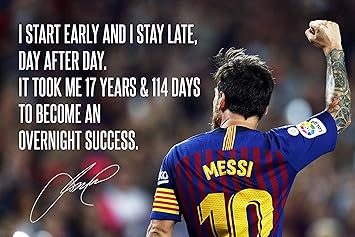
This Messi quote is one of my favourites, as it sums up what long term development is all about. Many coaches and parents are looking for shortcuts. There aren't any. Football has been around for nearly two hundred years in the modern era. The sports science available is NASA level technology. Players are worth hundreds of millions. We would have found shortcuts by now.
When it comes to identifying potential, I'll highlight three ways I look at it.
Attitude.
Intelligence.
Fun.
What about technique? I'm not that interested in it. To a point. Obviously, if a kid is horrific, there is a problem. It's more about what they decide to do rather than how they do it. I'll let these two F2 Geezas demonstrate my point.
F2 Freestylers Billy and Jezza have twelve million subscribers on YouTube. They travel the globe to do skill challenges with famous players, and engage in some top bantz along the way. Despite all their exposure to these top players and coaches, no professional club has ever signed them. Perhaps the life of making videos to impress teenagers is way better than being a pro player at a top club. If it were, I'm sure Neymar, Messi, or Suarez would have jumped at the chance.
Billy and Jezza perform amazing skills in their videos. They also compete in skill challenges against professionals. Their ability to manipulate the ball is out of this world. So why is it they're not on our TV screens? This is why.
Andres Iniesta and Xavi Hernandez. Two of the best decision makers the world has ever seen. While the rest of us are playing checkers, these two are playing 3D chess. They spot passes the rest of us can't. It's about anticipation, awareness, vision, which the F2 guys do not have.
This quote sums it up perfectly. View technique as a means to an end. It's a method to execute the plan in your head. Many coaches focus on technique with no game representation, and no decisions. Then they scream at their kids when it doesn't transfer to the real match. The US is full of kids who can do 400 juggles of the ball, but cannot play through ball with the right weight, spin, curve, timing, and angle. They can do all sorts of skills like the F2 guys, but can't see an opportunity for a third man run. That's where we fail them.
It's perception action coupling. You see a thing, so you do a thing. It's the ability to gather information, filter that information, decide on an action, and execute that action. That's how we should measure a player's ability; by seeing what they can do on the pitch. We count stuff, because it is simple and easy. It makes sense, and is easily comparable. A kid did X many juggles, can run Y distance in Z time. Those numbers going up or down demonstrates improvement, and we can compare this growth or decline with other kids, and make decisions about who we should cut. Yet it tells you nothing. Knowing how many juggles a kid can do tells you how many juggles a kid can do. It doesn't tell you if they can spot a pass, score a goal, deliver a cross, block a shot, drag an opponent away with their movement, mark or track an opponent to prevent them from receiving, and so much more. Parents don't know this, and sadly many coaches don't either.
When it comes to assessing a kid, I want you to look through this lens instead. Before that, actually ask yourself if you should be assessing kids in the first place. At their age, ability, and motivation levels, should there even be tryouts? Let them play with their friends and have fun. If they want to take it more seriously, that's their choice.
In each game of football, there's a relationship going on between the organism, the environment, and the task.
Organism - The individual, the kid, the player. It's all their strengths, weaknesses, emotions, motivations, physical attributes, and much more. Think of the four corner model from earlier; technical, physical, psychological, and social. The organism is the amalgamation of those four corners.
Environment - These are the external factors which influence performance. It's the coach, teammates, weather, mood, ambition etc.
Task - What you have to do. How do you score points? How do you score more than the opponents? Consider the time of the game, the ball, number of players, size of target, rules, and other such constraints.
In any given moment of the game, an individual filters all of that through their perception action cycle, and then decides upon a movement goal. Let me try and apply this in a realistic scenario.
Picture a kid in the penalty area, in the split second that a teammate executes a cross into the box. It looks like it might be coming to that kid. They first have to perceive the trajectory of the ball, to know if they can meet the cross. Then it first goes through the internal process. Technically, can the kid strike a ball of that delivery towards the goal? That cross might be calling for a laces shot from the side. Can they do that? Physically, do they have the balance to perform that movement? Are they able to continue moving towards the trajectory of the ball and manipulate their body in a way which allows them to make contact with the cross? Psychologically, are they brave enough to try it? Compound that with socially, are they scared of any repercussions from their coach or teammates if it goes wrong? Do they have the belief in their ability to try it? Do they have the fear of any negative consequences that might hold them back from attempting it?
Environmentally, will the wind affect the ball? Will that lead to having to monitor and reassess the trajectory of the ball? What's the surface? What shoes are they wearing? Does that impact their stride towards the cross? If the ball is likely to bounce, may it get stuck in the mud, or spring up off a hard surface? How has the ball acted all game? Is the ball pumped up like a rock, or does it bounce around like a balloon?
As for the task, is this potentially the winning goal? In that case, the player might be nervous, hesitant, or try a more safer technique. How high is the goal? What is the distance or angle to goal?
The information, mainly visual, has to be gathered, and then filtered through these decision making matrices, which are different depending on the player, their thought process, the environment, and any task constraints. It all happens in the blink of an eye. From that, the organism elects a course of action to execute, which is in the form of a movement goal.
To round it all off, let me look at the three ways I like to assess players. I haven't put too much thought into these in terms of order of priority.
Attitude - Does the kid want to learn? Are they positive? Do they help teammates and coaches? Do they show perseverance and resilience? Are they going to keep trying no matter what? Do they reflect and look inwards rather than blaming others? Do they have performance goals rather than outcome goals (playing well as an individual is more important than the team winning, although both are ideal)?
Intelligence - Does the kid understand positioning? Do they know when to take risks and when to play safe? Do they show an ability to anticipate? Can they exploit space? Do they understand principles and theory? Can they play the game in 3D (through balls and purposeful aerial passes)? Can they disguise their intentions? Can they read opponents? How good is their off the ball movement?
Fun - Does the kid truly enjoy football? Do they want to do more after practice? Do they ask for balls and football shirts for Christmas and birthdays? Do they watch games on TV? Can they be found kicking a ball and trying tricks in their spare time or when idle? Do they experience strong and deep emotions during the journey of a game or a season? Do they turn up to extra programming? Do they ask a lot of questions and have a lot of conversations about football?
Without the right attitude, the player is going nowhere. Another formular I frequently use is performance = ability + preparation. Ability is only part of it. Like the guy said in the video right at the start, we have all encountered players with bags of talent, whose undoing is themselves. We are our own worst enemies. Outcome is driven by performance, and performance is driven by character. We must select based on these attributes, and work with players on these attributes, as much, if not more, than anything technical or tactical. Players like Balotelli, with all the skill in the world, shoot themselves in the foot with their attitudes. We owe it to them as coaches to put results aside, bite the bullet, and work on any attitude problems at a young age. Don't simply ignore it, hoping it will go away, and letting it be justified by random moments of genius. That's not enough. It doesn't help the kid.
Intelligence, in my experience, is the biggest determiner in who is actually going to make a functional player when they're older. That's not to say that technique and physical attributes aren't important. It's more that at the top level, everybody has those. Many players can run faster and jump higher than Messi, and those F2 lads can probably complete as many top bins challenges, but nobody comes close to achieving Messi's output.
Fun is hugely important too. If a player doesn't love football, they won't put in the extra work required to develop their skills and understanding. And if they don't love the game, they won't have the perseverance required to keep going through adversity, because, what's the point in working hard and making sacrifices if you don't love what you do?
How do you measure this stuff? The point is that you can't. It's the eye test. There are so many variables, it's hard to quantify it. Especially with kids, where their current abilities might not reflect their future abilities. Try to look at it in basic questions;
Does the kid try to take risks?
Does the kid work hard off the ball?
Does the kid give valuable information to teammates?
What does the kid do when their team loses the ball?
How does the kid help the team to defend?
When the kid has the ball, does their team still have it five seconds later?
Does the kid find open spaces?
Does the kid keep the ball when under pressure?
There's many other questions that can be asked, and this is just the start. Ideally, I'd like to make some kind of template, and avoid making judgements based on arbitrary numbers, such as the kid is 7/10 for shooting, which is subjective nonsense. It's just a start, but I want to shift the narrative away from discriminatory selection policies, based on short termism, and a win at all costs mentality. Let's keep more kids in the game for longer, and help more of them reach their potential.
If you enjoy my content and want to express gratitude, I would be so happy if you made a contribution towards my Argentina trip in the summer of 2021. The plan is to go there for four weeks and look at everything football, development, coaching, and culture. Any amount helps. I won't be upset if you ignore this message, as I produce this content purely for the enjoyment of it. Here is the link: http://fnd.us/c1en5f?ref=sh_98yL48
Lately, with a lot of free time, I have been able to articulate a lot of my thoughts and experiences. This has included session plans, curricula, and even a game model I am currently working on. I'm making a club wide curriculum, for my own benefit, which can also benefit others. In the future, I might be in a situation where there is little help or guidance from a DOC or TD, and I will be left to fend for myself. Or maybe I will be in charge and need to provide something for the club. Nevertheless, I'm paying it forward with all this advanced planning. Thinking now, while I have the time to think, saves me from thinking in the future.
If you would like the curriculum I am making for myself, you can have a PDF for £5. Drop that money in my Argentina fund listed at the top of this page, send me your email address, and it's yours. If you would like some personalisation or customisation, then let's get talking. Pretty much anything goes. Let me first describe the structure, so we're all on the same page.
Coaching methodology.
Formations for the different ages.
Topics for the different ages.
Suggested exercises for each topic.
Session plan and coaching points for each topic.
All this for young players, 5v5, 7v7, 9v9, and 11v11, plus futsal and goalkeeping.
Each topic comes with team objectives for the weekend's game, relating to that topic.
Learning objectives and suggested questions for each topic.
Individual player challenges for different positions, at each age.
Suggested examples, session plan, and coaching points.
That's just for one 7v7 topic. I have shared stuff like this before, but this is way more in depth. What can be customised? The colours, the exercises, the topics, it can have your team's badge on there, and I can use pictures of you and your kids, rather than mine.
The objectives can change, and the photos used for the players can change.
Here's a few design examples I have played around with.
If any of this is appealing to you, get in contact on Twitter, and we can sort something out.