
This piece will be vulgar and offensive. If you are offended by it, good. That shows you're a decent human being. If you aren't offended by the content of this article, then maybe there's a problem. I'm seeking to lift the lid on this employment process, which has been going on for decades. At times, you may struggle with my descriptions or terminology. This is done on purpose. There's a lot of satire, irony, and sarcasm in here, and I often talk like the very people I am trying to make fun of. By acting like a parody of them, I feel it shows how ridiculous and crass the behaviours and practices are. I do not agree with it, nor do I condone it. I simply want people to know what really goes on. I want the parties concerned; parents and coaches, to be fully aware of the practices they will be exposed to (or what will be going on behind closed doors) so that you can make your own assessments on whether it is something you want to be a part of.
It's not all bad, and not everybody is like this. Some of the experiences are great, humbling, eye-opening, and life changing. Knowing what I know now, I would still have embarked upon these opportunities at the time in my life when I did, because it was right for my career then. I like where I am and what I have achieved. It's provided me with a great platform to be the person I want to be. But we have to acknowledge that there is a real sadistic undercurrent to all this. It's present at all times, and permeates all areas. If you don't want to know how the hotdogs are made, this is your last chance to stop reading.
The conclusion, upon reflection, is that knowing what I know now, I still would have taken the opportunities I did at the stages they were offered to me in my career. For many, the good outweighs the bad, and I can agree with that. But I feel the bad still needs talking about. It's a web of lies, tricks, full of idiots getting themselves into dangerous situations. Visa abuse, worker exploitation, and lad culture are still big issues within the version of North American soccer which is exported by the Brits. And most coaches aren't bright enough to see it, because they can be bamboozled by shiny objects. For instance, being lied to, mistreated, and neglected for four weeks is forgotten about, when the regional director sends you to Las Vegas for a camp, staying in a nice hotel. Or you are lucky enough to get a first class flight. It's like an abused wife, who has been slapped around by the husband on a regular basis, suddenly being all forgiving because he takes her out for a nice dinner. It's Stockholm Syndrome. They hold all the cards, make all the decisions, and have all of the power. It is up to the reader to decide if the ends are justified by the means.
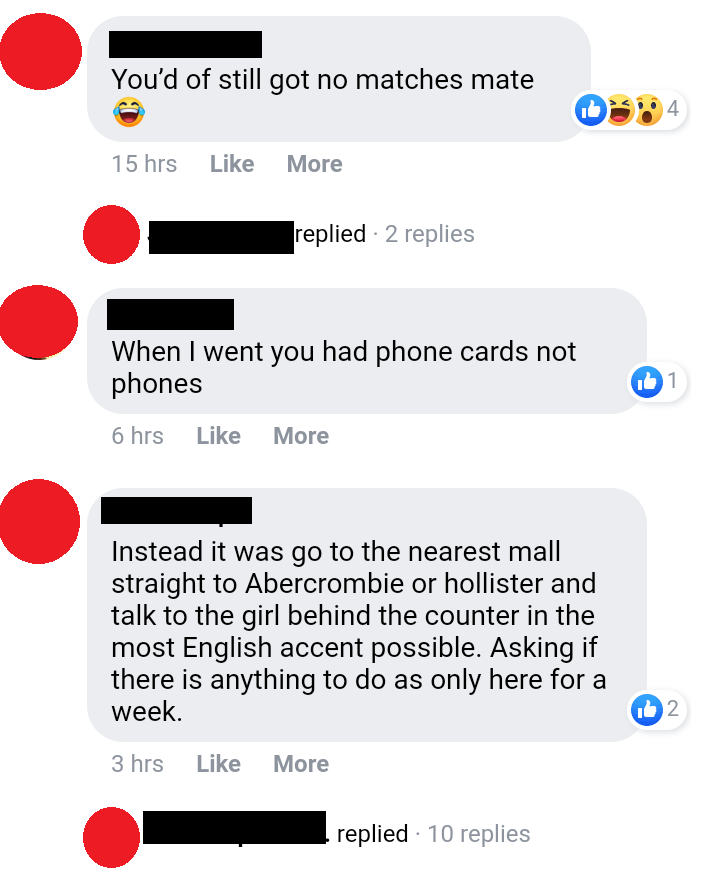
A little bit ironic that, while writing this, I was invited by a former colleague to join an alumni group on Facebook for one of these organisations. In there, former coaches reminisce about their exploits. Some of the really dodgy stuff is taken down, but there is still enough to be seen on this public forum. What is interesting is the number of coaches who no longer coach (with some expressing they had no passion or interest in coaching, and just went for the good times), and also how 90% of the memories they share within this group are not related to football. I use some screenshots to illustrate my point. I have hidden names, just to be cautious, but remember that these people are volunteering information, on a public forum, established and administered by employees. Any parent or prospective coach can go in there and see for themselves.
It doesn't sit right with me that a lot of these procedures are not open and transparent. What are you hiding, and why? If the truth were told, would that affect your business model? At the conclusion of this piece, you may agree with me that most of these coach providing organisations should not be presenting themselves as serious football providers, but providers of adventure holidays for young British students, and soccer themed daycare for parents. In reality, that is what it is, and there's not a lot wrong with that.
I feel the image presented and the contrast to the reality are indicative of many things that are wrong within American soccer culture. Nobody actually does what they say they do, and nobody says what they actually do. Young lads from England want to feel like Pep or Mourinho, not like a clown or glorified babysitter. Parents want to be assured that their kids are experiencing high level soccer training from exotic professionals, increasing their kids' chances of fame and fortune, not that their kids are playing pointless games under the supervision of hungover and horny Brits.
It's fun. That's what it is. And there's nothing wrong with that. But the image conflicts with the reality. Fun should be an important part of football. It's why we play in the first place. For some reason, though, fun doesn't market well. Fun is what stupid kids do, whereas my kid is a serious soccer player.
I will try to tell this story in four separate parts, although there will definitely be some interlinking. Everything I am going to write is 100% the truth. The stories are real.
For perspective, I have worked for four different coach provider services in North America; one in Mexico, one in Canada (which was a famous US based company), and two in the USA. Coaching in the USA is hugely alluring. Every summer, thousands of young Brits are sent across the Atlantic for two or three months to work on camps. Many are sent out for nine month contracts, from March to November, to work as club trainers during the seasons, and do camps during the summer. Let's start with recruitment.
Recruitment
 |
| The kind of flyer to be handed out at universities (can't find a higher quality version). |
Most young men operating within British football will be aware that there are opportunities to coach abroad in the USA. Type into Google Coaching in the USA and there will be hundreds of sites with similar taglines, and some even have it in their url. The websites are cool and slick, telling great stories about how amazing the opportunity is. Anyone would be enticed by what they see.
These companies do tours of the universities throughout the UK, offering presentations and seminars on what it's like to work in the US, and how they can help you with that. The guy leading the presentation is often cool, relaxed, and really relates well to young men. "Can't wait to see you stateside" he says. Months later, we'll find out he hasn't worked full time in the US for three years, and is actually based in the UK, tasked with recruiting the next generation of coaches to fly across.
The glitz and the glamour is how they get you. These companies come to our universities and do presentations. They tell us how coaching in America is the best thing ever. You begin with camps, having maybe eight weeks of fun in the sun. The presentations show pictures and videos of having great times with host families, staying in their mansions, going tubing, and watching sports from private suites. PRIVATE BOX AT LAKERS V CELTICS BRO. There's tons more videos of high fives, autograph signing, and happy cheering kids.
Then you throw in the odd US landmark or two. Mount Rushmore, Las Vegas, Times Square, Disney World, the Hollywood sign, beaches, the Grand Canyon, Niagara Falls, DC monument etc. Your time off will only enable you to see one, but most recruits have no idea how big the US is, and the presenters aren't in the game of informing you of the truth. Place names flash up on the screen; Boston, New York, DC, LA, Orlando, Chicago, but you're more likely to be sent to Arse End, Montana. Rarely does one get to see the big and important cities. Most assignments are four hours away from civilisation, in a small hick town of four thousand people. In my Canada cohort, one guy quit when he found out we were being sent to Calgary. The guy clearly hadn't seen Cool Runnings.
Recruits are told that soccer in the US is huge, and that passion and enthusiasm are off the charts. They use pictures of teams (that you'll never work with) lifting trophies (that you'll never win) at tournaments (that you'll never go to) that are always sunny, and this is interspersed with MLS stars like Henry and Zlatan, playing in cool uniforms in modern stadiums. They'll show clips of their U14 DA team playing great football, scoring great goals, and travelling all over the country. The closest you'll get to that is to coach a U8 rec team, with one of the players having an older sibling on that team.
Testimonials from staff who have been out there before come up on the screen. "Yeah, it's great. The kids are brilliant, and the host families spoil you rotten." These people talk about still being in contact with host families years later. In reality, they mean they still have them on Facebook. These aren't long lasting friendships, where you visit each other at Christmas. In eight weeks, there will be two families you like, two families you don't like, and four that you're not bothered about. The ratio of how they feel about you is similar.
The recruitment days happen around October or November time. They will travel around the UK, meeting university students, and treat it like an informal interview. The successful candidates attend a UK based training weekend, in February. This is where they continue the propaganda, and really lay it on thick. If you're lucky, you'll get a special guest, in for form of someone who was semi famous twenty years ago. They make you feel special, like you're going out to change the world. Inevitably, some idiots will slip through the initial recruitment process, and make it to the training weekend. I have been on four, and at least one candidate will lose their job there and then for being a complete dick. But those are the obvious ones. Some still make it across to the USA.
One could be significantly challenged if participating in a game called "Coaches Night Out in USA or Lads Night Out in Ibiza" having to determine from which location the picture of the story originated.


Training weekend sessions consist of fun games for kids, high fives, ball work, and how to be super enthusiastic. That's all they teach you. Although at one, I did gain a lot of notoriety. The weekend was full of long and boring presentations, and it was an all day affair. After the day finished in the Saturday, four of us shared two beds in a hotel room. This was my first involvement with the company, so I was unaware such practice was common. The other three guys just got on with it, as they were used to sharing beds with strangers by now.
All weekend, the common message was that they are looking for people who stand out. "If you want to go far in this industry, you have to stand out." What they meant was eccentricity, confidence, and risk taking. Sunday morning comes, and we all wake up super early, with little rest and recovery from the day before. 150 of us drag ourselves into the conference rooms, and sit down, still half asleep. The day begun. "We realise that we're in for another long day here, and many of you are still tired, so we're going to try and lighten things up, and get you in the mood for another long day." They put us into groups of about fifteen or twenty, and told us to interact with each other to see who had; the best hair, the funniest accent, the biggest hands, the best joke, and all sorts of other weird characteristics. We were then going to go around the room, one by one, and demonstrate our selection, so we could all get a good laugh out of it.
Nobody in my group spoke. We all looked at the floor. Being socially awkward, a technique I had learned was to remember jokes. It was a good way of getting to know somebody. I have loads committed to memory. I spoke up and said "I've got some good jokes." Saved me from being picked for being ugly or stupid, as each nomination had to be different. After our selections were made, the director, with his microphone, began going around the room. One by one, we laughed at people. Eventually, it got to the joke round. Our group was third to go. In only a few short seconds, the director would be in front of me with the microphone, and 150 people would be looking at me, including top brass.
I had a joke selected, because I thought it was funny. It was daring. It would have made me stand out, like they were asking for. I looked up at the table on the stage, with the top brass on it. They didn't look too entertained. Any one of them could have torn up my contract there and then. I began to have second thoughts. I thought of a less risky joke. But then that would make me look like a chode. "Hey guys, I have a joke" and then a pointless, inoffensive knock knock joke? No. I can't do that.
The joke from group 2 was terrible, and didn't get a laugh. Now it was down to me. The director, in good spirits, for having been roasting people for a good fifteen minutes, now came to me with the microphone. "And what's your joke?"
I said it with confidence. I looked at him and said "What's the difference between jam and jelly?"
A real joke, unlike that of group 2. He looked excited, as he hadn't heard this one before. "I don't know. What is the difference between jam and jelly?"
Now I panicked. I had committed. Everyone was looking at me. I couldn't back down now. I decided that if I were to lose my contract over this epic joke, then I would go down in legend.
I build up the courage, calmed my nerves, and looked at him straight in the eyes. Smile half building, eyes wide open, he looked at me with great expectation. Without breaking eye contact, I spoke slowly and clearly into the microphone, held by a top member of the organisation that was about to send me on a life changing journey.
"I can't jelly my cock down your throat."
The audience gasped. Everyone was in stunned silence. Oh crap. What had I done? The director had a confused look on his face, as he tried to figure out what it meant. In what seemed like an eternity, he quietly repeated the joke and the punchline to himself.
And then...
He fell to the floor in fits of laughter, rolling around like he had been stabbed in the stomach. Red faced, and tears coming from his eyes. As soon as he hit the deck, the whole place erupted with laughter, some nervous and glad the tension had dissipated, some genuinely having found it funny, but everyone having waited to see that it was okay to laugh.
That's how I stood out. That's how everyone then got to know who I was. That's why everyone viewed me favourably, and wanted me involved in what they were doing. Wow. I took a gamble, and it worked.
I used that joke because a mate of mine in England would use it as a pick up line when he got drunk. It never worked for him.
The joke had such a profound impact that even months later, it was the first thing, even the only thing, that colleagues remembered about me. A large group of us went to see Seattle Sounders v LA Galaxy, and bumped into a group of other coaches from the company, also enjoying 4th of July week in the city. "Hey, you're the guy that told that joke!" At another presentation, for the same company, we were assigned groups and had to give a presentation. It was simply an exercise in regurgitating information they had delivered to us, but I filled my delivery with jokes and one liners. This again lead to my reputation growing. They all told me it was hilarious, and asked if I had ever considered being a comedian. I say this not to passively aggressively demonstrate that to my wife, despite her complaints, that I am funny, it's more that I was known for this more than for anything related to football. Because, as you will see, it's not about football. I had proven to them that I was an entertainer, and this bought their trust.
Visa Abuse
The visa process for entering the US is a daunting one. The embassy in London is scary. We can't take in anything with us that isn't our application. This means that either you leave your personal belongings in a locker in some tube station, or you bring somebody with you to hang around outside for several hours, with your phone, wallet, and keys. It's a boring and stressful process.
Before going in, we are given scripts on what to tell the interviewer. Most of them want proof that we will be coming home at the end of our visa, which is easy to do if you are a student only going out for the summer, as you have a degree course to come back to. Other items used to convince them are car ownerships, jobs, property, and even girlfriends. I have had six or seven US visas, obtained from Belfast, London, and Guadalajara. Belfast is treated like a backdoor for UK applicants, because they are far friendlier and much more lenient with applications. In London, they will send you home for a spelling mistake, whereas in Belfast, I have forgotten entire forms, and all that has happened is I have waited a tad longer while they looked up my details on their computer.
Each company recruiting into the US has a limit of the amount of visas is can hand out, based upon its size. I've had visas under Bush, Obama, and Trump. It got significantly tougher as the years went by. It was easy to get in under Bush. What Obama did was make it harder, by annually decreasing the percentage of visas allowed based on company size. It was meant to protect the American workers, but in a lot of these industries, there aren't the required number of Americans capable or willing to do the job. Every year, tons of Mexicans come in legally on H2B visas, to pick fruit for nine months. Thousands of Brits come in on H2B or J1 to coach soccer. The football companies liked to grow year on year, but had their growth stifled by Obama policies. They still managed creative ways to get around it.
One company that was nationwide had us apply as if we were scouts to the professional soccer indoor teams. Myself and about five others were pretending to be scouts for the Syracuse Silver Knights. Our scouting duties would allow us to run camps, and also be guest coaches at local soccer clubs. Years later, I managed to see a game involving Utica City, the team which the Silver Knights later rebranded to. One of the top brass in the country had relationships with several of the MASL clubs, who were willing to be a front for visa entry. When I tried it, we never got in. Trump had just become president, and everything changed.

What a lot of politicians the world over run on is controlling immigration. These countries have a far better grasp on immigration than their constituents believe. Listen to Nigel Farage, and you'll think that immigrants are bursting out of cracks in the walls, that we are so overrun with them. What everyone agrees on, regardless of politics, is the stopping of illegal immigration. This is hard to do, for that very nature. What can be controlled is legal immigration, and politicians do this via the form of quotas and increased specifications. Inevitably, the number of immigrants drops, then the politician can point to those statistics as proof of a successful campaign, yet nothing has been done to stop illegal immigration.
When I explain this to Midwesterners, supposedly the friendliest of Americans, the response is always "What? We want your kind coming here!" I might be wrong here, but I'm interpreting my "kind" not as skilled or educated, but as "white." For many, though, immigration simply means less brown people. Under a Trump presidency, this approach didn't work, and I never worked for the Silver Knights. It was this year that the company lost many new recruits, because they couldn't get the visas. We were trying to get in on P1 visas, which are for "aliens with extraordinary ability." Makes me think of ET. I can do this wobbly thing with my thumb, because it is double jointed, but I don't feel that I deserve the title of "extraordinary ability." It's always struck me as weird how the USA uses the term alien to describe people from other countries. It feels like a way to "other" people, and maybe dehumanise them, so we have less sympathy when they are put in cages.
The P1 visas had stopped being dished out. I was the second of our cohort to attempt to get one. I quit my jobs in April, because we were told that's when we would be out. Many of my cohort quit their jobs. As time went by and the P1s weren't coming, my potential colleagues were told to give up and find other jobs. I was one of the lucky ones, apparently, as I was told to hang in there. Eventually in August, with all those months unemployed, always "probably next week, just be patient," the company got me out on a different visa, which lasted four months until Christmas.
The Trump administration, at that time, was woefully understaffed. Only about a third of governmental positions were occupied. This severely affected immigration. Our applications were being left on shelves, with no intention of ever completing them. This was in part due to the short staffing, and in part due to wanting to lower immigration numbers. Trump ran heavily on immigration. In order to reject our applications, the immigration staff would have to do actual work, and they didn't have the manpower to do that, so they just left them. To reject a visa requires time, effort, and research. Cut those hours out by not doing it. It's the difference between failing your assignment, and never submitting your essay in the first place. Ironic to me that tourism to the US has declined significantly over the last few years due to this anti-immigrant rhetoric.
These football organisations for years have been innovative in their ways to get past immigration. We can't just enter the country and find work. There needs to be a sponsor the other end, and our visa is entirely dependent upon there being a job. If you complete your contract, you can get a week or a month to travel, depending upon the visa you had. You earned your money here, so spend it here before you go home. Some of the sponsors in the past have been law firms. Many of the young Brits coming across for summer camps are students, and there will always be someone who knows a lawyer that works for the organisation. This leads to an attorney's office employing eight young Brits as assistants. This is a front, simply a way to get them into the country legally.
This is obviously very shady. There are other techniques which are equally as desperate. In the first summer of Trump, a lot of places simply gave up trying to get visas, and brought in their camp staff on tourist visas. Three months in the country, don't tell anyone you are working, get paid into your UK account. Most of these companies have a branch back in the UK, so are able to funnel money through there. For my final visa, which lasted for 18 months, I was hired as an "intern." This meant I could only receive a measly amount in salary, supposed to be like a stipend, because interns aren't supposed to be getting paid. This was roughly 25% of my wage, with the other 75% being paid into my English account. Funnily enough, both wages were too low to be taxed, so I wasn't paying tax either side of the Atlantic.
And yes, the companies love to benefit from not having to pay tax. One of them is currently under investigation from the FBI for tax evasion, fraud, and money laundering.
The 18 month "internship" I did was very sketchy indeed. I had already been working in the US for a year for that organisation. The script was that I was an entrepreneur, brought in to study US Soccer and the business practices, and then take them back home to implement in the UK. I can't lie, so I was bricking it for the interview. What happens if they ask me what about the US England can learn? My only truthful answer would have been about how to generate large profits from selling expensive and inessential items to gullible parents. I went for this interview in Guadalajara, and stood out like a sore thumb.
The lady there, American, was nice, friendly, and helpful. Very different to what we experience in London. Most of the Mexicans in there (everyone but me, really) were going for tourist visas to "visit family." were looking for student or exchange visas, or were going to work in manual labour. She didn't ask me too much about the job or any profound details. She got straight to the point and processed my papers. The line behind me was hundreds long, and I had already been in there for about four or five hours, with no food, drink, or toilet break. My dad outside having the time of his life chilling across the road in a well shaded bar with a cold drink.
There was one hiccup though. We have to write on our application every country we have visited within the last few years. This process usually takes me quite a while. She received a notification on her computer, looked up at me, and asked if I have ever been to Liberia. I had to think. Liberia. West African country, known for George Weah. Do I even know a Liberian person? Where's the closest I have been? Morocco? Hard to have accidentally wandered into Liberia during a day trip to Tangiers. "Er... no... I haven't been to Liberia."
"Well it's just that your name has been flagged up because there is a man in Liberia with the same name as you, who has been recruiting child soldiers for the civil war."
"Oh. It's not me."
"I don't think so, but we have to check anyway."
She then took details of two people she could contact to verify that I wasn't recruiting child soldiers to fight in Liberia. I gave her two contact details of people I was not related to, who had known me my entire life. Later, upon reflection, I realised that one of them was a mistake. I gave details of one of my best mates, who I had known since I was three, and he is the kind of person that would have told the US government that I had been recruiting child soldiers, just for a laugh.
All it did was delay the process by a few days. As someone with a criminal record for playing a practical joke on a friend when we were teenagers, I'm used to this. Every time I enter the country, regardless of where, when, or for what purpose, I get detained. It's always great fun. After a long international flight, sweaty, hungry, tired, having spent several hours trapped in an aluminium tube of people's farts, it's really hard to function in these situations. These detentions regularly lead me to miss my connecting flights, even having to spend one night in Miami airport because there were no flights left that day. It meant we had to cancel a camp the next day. We didn't tell the parents why, and the boss never knew, as we kept the money, and offered the parents a refund or opportunity for an hour of private training. Only a couple asked for a refund, which is about normal for a camp.
What is concerning to me is a lot of the behaviour exhibited by customs officials in these situations. They very much have the mall cop attitude, shouting at tired people who struggle with English. When I go into detention, 90% of the time, they are jovial and friendly with me. Looking around, I'm always the only white guy, and the only native English speaker. One night in Boston, the official spent an hour asking me questions about British and Irish history. My entry had already been approved. He just wanted a chat. Yet another guy, from the Dominican Republic, was abused, threatened, and dragged out. A few of his answers weren't consistent, but that's the same with anyone who is tired and scared, being intimidated by Paul Blart types.
Some of the Paul Blarts pretend they don't speak Spanish, so they can intimidate the foreigners, and then later use it against them in a kind of "gotcha!" moment. It's real small dicked stuff. When stuck in Miami, in the detention room, I was listening to conversations, and even talking to a woman from Venezuela. They were saying things like "I don't know why I am detained. All I'm doing is visiting my brother. I have my tourist visa." There were others with legitimate work visas, and even a green card holder in that room. My name was called, and I went up to the officer. He smiled, and began sharing jokes with me. "See all these other people in this room? None of them are coming in. You're the last one we're letting in tonight." There must have been about thirty people in there. As far as I could tell, they had visas, no criminal records. The difference between me and them was skin colour and native tongue.
Many staff continue to work after their visa expires, either using the vacation period at the end of the visa, or staying illegally for longer than they should. This is incredibly dangerous, as it can lead to barred entry for up to five years. The companies pressure the staff into doing so, and assure them it will be alright. Nobody knows that for sure, but the employees are expendable cheap labour. If one camp worker can't come back next year due to visa refusal, there's hundreds more applicants ready to come over and do the same.
Most of the time, your visa enables you to work in a particular state. I kept getting visas for states I have never even been to. Luckily, they never asked for proof that we were going where we said we were, although I always had a script prepared. Tournament, course, or visiting friends. One benefit of the size of the country is that your port of entry is rarely your final destination. I enter Texas, with a visa for New Hampshire, yet my flight is via Missouri? Nobody cares. What we have to do is write down our address for the duration of our stay. Hundreds of us are told the same address, which is usually the home address of a regional director. A little while ago, ICE infamously caught onto the scam, and raided the offices of a large coaching company. They took computers and loads of documents. The FBI got involved, and lots of the top brass are being charged for visa abuse, fraud, money laundering, and tax evasion.
These companies make millions, while in some case, the employees sleep on the floors of the offices. No apartment, no host family. This lead to some of the disgruntled employees leaking what was happening, first in a company wide email, and then to the press. The whole thing imploded, and even now, so much more is being uncovered. Corrupt directors and DOCs have been siphoning off money for themselves. Some left the company to join other clubs, but kept access to the company resources and documents, to convince parents to come with them. We complain about the greed of Americans in youth soccer, charging $2000 per kid, yet most of the people involved in these scandals are Brits.
You have to remember that we are completely expendable. The company wide email from the abused employees which was leaked details human rights abuse. Many thought the term was unfair and misrepresented the issues, but when you look into it, it does match up with the government's description of human rights abuses in regards to visa staff. They hold all the cards. If you don't like it, you're out of a job, and on the next flight home. Having been sacked, it's hard to get a visa in the future. Some of these companies won't release their staff until their time is up, and the staff do not make enough money to be able to fly home on their own accord.
The coronavirus hasn't helped. Recently, the entire Canada branch were sacked. This was about fifteen staff. How were they told? By the payroll company. The company didn't tell them. The payroll company simply informed the employees that their next payment would be their last. This included one employee who had worked for them in various different roles for fifteen years. There is no loyalty. What they've also been doing is furloughing staff and keeping the money. A lot of the clubs and franchises are about to go under, yet they are still taking fees from parents, with no intention of refunding them when it all comes crashing down.
It's a dangerous scam, and the employee can be held captive. The company has all the leverage, and are driven by profit. They bring us in with enticements like pay raise, yet it will never happen. Your wage is determined by your visa type. There's no way they can pay you more. Many companies even tell you that you have to forfeit any extra money to them. For instance, if you receive money from parents for your birthday, or they chip in for an end of season bonus, or even tips after camp. The company tells you you're not allowed to have this money, and you have to give it to them.
Depending upon the director, and how far from HQ you might be, some will turn a blind eye to things. It's illegal to earn a second source of income while on a visa. If the director was once on the front line like the rest of you, they may even help you get side gigs coaching in high schools. I was allowed to referee while an "intern" because refereeing, unless at the professional level, is classed as a hobby. The companies always encouraged us to arrange private training hours. It was extra income, but not for us, as we weren't allowed to earn it. $60 an hour, which would go to the company. Extra work and no reward? Sounds great! If ever we arranged them, we did so at a much cheaper rate, because that price is extortionate. Cash in hand, never tell the company. I felt justified in doing so, as at one place, I wasn't supplied with equipment. Had to buy all my balls, bibs, and cones myself.
The companies will always put a positive spin on things. There's always a laugh, a smile, and a flash presentation. They make you feel like you are going to change the world. And then they hang you out to dry. They prey on our ignorance. How many Brits in their early twenties understand the delicacies of geopolitics and visa processes? I didn't. I still don't, even after all this time.
In other countries, it can be different. Canada gave us year long visas that weren't dependent upon a sponsor. Anyone under thirty can come to Canada and work for a year. This takes away some of their leverage. In Kuwait, Singapore, and Mexico, I entered as a tourist. After six months in Mexico, they eventually sent three of us to obtain a work permit at the embassy in Costa Rica. It made no difference to us as employees, because we were still in the exact same situation. All it did was give the boss protection, so he wouldn't be caught paying foreign workers illegally.
My advice to anyone wanting to do this is to really do your research. Anything you don't know is an advantage to your employer. Ask too many questions, though, and you won't get the job. They want compliance and obedience. Know what you're getting into, and really ask yourself if it is worth it.
Worker Exploitation
There's no doubt about it. You are overworked and underpaid. This isn't just true of the US, but pretty much most places that hire younger staff to coach abroad. Workers are expendable, and the customer is always right. If a parent complains, the employee gets sacked. They would rather send an employee back to their country than lose a customer. I was put on final warning (and later sacked) because something vague happened at a location, and the person the angry mum described looked like me. What she said happened, either didn't happen that way, or didn't include me. My disciplinary is based off one phone call from a mum. The only interaction I had with a parent that day was a woman coming up to me while I was coaching, and asking "Where is Coach X?" and me answering "He's over there" while pointing to him. Apparently I was rude, offensive, and made her feel like crap.
It's not just me. This stuff happens frequently, and the companies never side with the employees, and never do any kind of investigation. You get moved, taken off the team, sent to a different location, and even sent packing back to where you came from.
Unfortunately the success isn't measured by football metrics, but by profit margins. That's all these companies care about. Foreign coaches on short term visas are cheap labour. Cheap labour that can be abused and easily replaced. And they're always on the lookout for more money making schemes, like Ed, Edd, and Eddy. They will try and sell anything to the parents. Anything like extra uniforms or merchandise (view it as free advertising), and all sorts of extra curricular programmes like tournaments, tours, private training, "elite teams." The biggest drivers for parents are college scholarships, and the marketing there is college recruitment services, college ID camps, and even an app to be used by players to be identified by college recruiters.
One company even plans on selling heart rate monitors and GPS trackers to grassroots kids. About $300 a pop. Who needs that kind of information? Nobody at that level needs it, but the shiny object to fool the parents is the app which shows you things like how far your kid ran during a game, and allows you to compare it to top players in the country. How far a player ran during the game is not a metric for measuring success. How far a player runs during the game is based on the demands of the game. If you play against a low block team and have the majority of the possession, you won't run very far. If you play in a game full of counter attacks, you will run far. American parents don't understand this. The app provides flashing lights and numbers, justifying the parents' ability to yell at their kids for not hustling enough. "The app says you're 2km down from last week!" "That's because I played a different position, had less game time, and played a stronger opponent." "Don't you talk back to me, boy!"
Your job as an employee is to sell this stuff. Even if you don't agree with it. Even if you think it is inferior. Many will make it part of your contract, giving you a lower wage, and saying you can make it up on commission. If you want to be able to take part in the green card hunt at the weekend, you better sell some private training!
Have a brief read through of these screenshots from the alumni group for some insight into perhaps how isolated ad underprepared many of the coaches are.


The summer camp staff are the lowest of the low, and are treated as such. The requirements are really that you aren't too weird, and can blow a whistle. It's only for a couple of months, and the sense of adventure doesn't disappear in that time, so they put up with it, always thinking next week will be better. What it results in is staff sleeping on the floor in the office, and if they get a hotel room, it's often two to a bed. "Hi, nice to meet you. We're on camp together this week. Would you like to sleep window side?"
Summer camp excursions usually mean staying with a host family, but sometimes nobody would come forward in advance. This would lead to a group of coaches having to beg parents after the first day of camp. Suitcases in the car, just in case, otherwise it's back to bed sharing in the hotel again. The company doesn't like that, as it means spending money. It's such a degrading and humiliating process.
Too many of the summer camp staff have hardly been driving, can't drive, and have not travelled alone before. It was quite common to be assigned an eight hour drive with just a printed map, for someone who had been driving two months and never driven abroad. Young men and women, hardly known for their intelligence, being dropped off in middle of nowhere towns. It's not like an urban metropolis, we're talking towns that don't even have cinemas, where the people sit on their porches and stare at you. It puts us in some incredibly vulnerable situations. There were locations where we would not leave each other alone. Even if we had separate rooms, we would sleep together.
Camp staff aren't really coaches, and many lack the motivation and the actual coaching knowledge. Hence the post above about doing foot golf for three hours. It's far easier than doing real coaching and paying attention to the kids. Lightning was also a great time waster. Motivated by the adventure, told the fun happens on the weekends, it would be crushing to be told that your weekend would consist of an eight hour drive to another camp. Dejected, the camp staff resort to a bar, trying to make up for the good time they feel they have lost.
Each visa states on it the number of hours a week an employee can work. Companies would see this more as a suggestion, forcing employees to work well over the amount. This has effects on the mental and physical health of the staff. Most are immature, barely out of their teens, away from home for the first time, in a country different to their own. This leads to some really destructive behaviours. Resorting to drink, drugs, and sex, is more of a coping mechanism at this point.
If you are brought in for camps, you are a clown, and the only thing that matters is the entertainment of the kids. The coach is a pawn, and you don't matter. On the camps in Mexico, every lunch we would do a coaches challenge. The loser was to be egged and floured at the end of the week by all the kids. As you can imagine, such an unpleasant experience motivated us to exact some truly shameful behaviour. Why is anyone being egged at work? The challenges ended up taking ages. We neglected the kids. We would cheat, swear, and nearly break out into fights. The boss would say "oh come on, it's only a bit of fun!" without realising the damage it was doing to us.
Absolutely everyone is told beforehand that it won't be long until they have an improved salary, and a place of their own. "You're on the right track, keep it up" they'll tell you. Less than 5% of visa staff ever get to that point. That's because the vast majority of staff are seen as expendable, and then treated as such. The only visa staff to achieve that are the ones who came into the company via non traditional methods. While the rest of us were recruited on entry level terms through the website or university seminars, some of these guys have A licenses and have extensive experience in pro academies in Europe. They get the wage and the place to live, while the rest of us have that carrot perpetually dangled in front of our faces. But they're also on different visas, so a higher pay grade.
The only way to escape such tyranny is to to for you to shack up with one of the locals, and get your green card. The whole time you are a visa worker, you rely on the company for employment. They are the visa sponsor, and the visa sponsor controls you. You cannot leave them to work for another country, because your right to be in the country is entirely down to them. If they decide to fire you, you have to leave the country that very same day.
Becoming a green card worker means that your wife is now your sponsor to be in the country, taking all the power away from the company, as they no longer have you under their thumb. This is a great way to suddenly get a decent wage, and better job responsibilities. The company can't abuse you anymore, as you will simply leave and work for a rival. The danger for them is that you will take your teams and contacts with you to the rival, so they pay more to keep you, while still treating the visa staff like filth.

It does come at a price, though. Green card staff, or visa staff that have returned for many years to be with the company, do eventually get given the better teams. The good football shown in the clips during university presentations are from those teams. You will never see those teams. Not unless you sell your soul to the company. Being appointed coach of the more advanced teams is your reward for loyalty. You have proven yourself trustworthy, and not likely to take this advanced team to a rival organisation (so it's not necessarily the best coaches getting these teams, more the best sycophants). The price, though, is that it means more office work. You'll spend 9-3 in the office each day, and 4-8 on the field each evening. It means no more kiddy sessions, playing Pirates of the Caribbean with four year olds in long grass. The coaching is a bit more serious and enjoyable, but you'll be sat at a desk all day.
The desk jockeys work in sales and admin. They have to take registrations for camps, organise events, and spend the rest of their time doing cold calls. At this point, the loyal visa staff who have become desk jockeys will have their own car, and their own room. The visa staff scum, like I was, will be sharing a room, a minimum of six to a house, with a car between three or four of us. Our days would also be 9-8, and we would be paid hourly. That's a lot of hours, right? You'd think so, but they have a great way of making you work all those hours, while only giving you five or six hours of work. How?
9:00 You are designated as driver. You have to take you and one mate to pick up two other guys at two other houses. It takes fifteen minutes to get to each house, and then twenty minutes to get to your session. The company rule is nobody can hand over another employee a car, with a tank less than a quarter full. It's customary to receive cars that already have the orange fuel light illuminated. Always make sure to account for this, by having enough cash, and allowing for a trip to the gas station in the planning of your route. Always better to go to the first one you see, just in case.
10:00 The four of you do a one hour juniors session. You each have a group of disinterested four-year-olds, and play Spongebob and Patrick games with them. The real task is to keep them from running off to their parents. There's at least two in each group, who will always randomly decide to bolt. Do you chase after the one kid running away and neglect the seven who are behaving themselves? Or do you keep your eye on the majority, and let the runner suffer, as they have decided their own fate? The company wants you to do both. Go retrieve the runner, without touching them, and also keep the session going. This is your first hour of work.
11:00 Pack up and drive half an hour to your next session. Begin setting up the equipment.
12:00 Same as before. Each of you has a group of disinterested four-year-olds. In this group, you have a boy that likes to hit others. The company doesn't want you to discipline him, as he cries, the mother calls the office to complain, and they lose money. Instead, they want you to manage it, without telling you how. Three weeks later, and they'll probably replace you on this session, messing up their entire schedule, because they're too scared to lose $100 from one angry mum. This is your second hour of work.
13:00 Lunch time, and you're all forty minutes away from your houses, with only an hour until the next session, which is twenty minutes in the other direction. You go past a McDonald's for lunch, spending your hourly wage on junk food. You eat it far quicker than you'd like, and get to your next session early, to set up.
14:00 This is a school session. You're given thirty unfit ten year olds. None of them want to play soccer. This is a multi sport session, and baseball is easy to set up and administer. The kids know the rules better than you, so you cannot really coach or guide them in any way. Most kids are okay with doing baseball because it is easy and they don't have to move. At some point the fat kid is going to say something nasty to one of the girls, and you're going to have to deal with tears. There's no school staff around, so you don't know how to report the behaviour. The fat kid denies he said anything, although you can tell he is certainly the type to do so. He then claims he will tell the school staff on you, if you tell on him. This is your third hour of work, having been out of the house for six hours, and spent one hour's salary on lunch.
15:00 It's time for club sessions. The four of you pack up after your school sessions, and put all the equipment back in the car. It's so comfortable to have four of you in a hatchback, full of plastic sports equipment. Two guys have their session at a place half an hour away from yours. As the driver, you race across town to get them to their location, drop them off, and race to yours, arriving at five minutes to the hour. If there's any traffic, you're in serious trouble.
16:00 Now you have two club sessions in a row, but have to set up quickly. The fields are a free for all, meaning first come first serve. Other coaches can get there earlier than you, so get the good grass or the shade. You have the patch furthest from the car, which means carrying all your equipment about three hundred yards. Not in a straight line, of course, as you have to weave and meander around the already arranged sessions, that have started five minutes before yours. Eventually you get to your patch, a few minutes after four o'clock. The parents look at you disapprovingly. It won't be long before one of them complains, and you are taken off that team. Because you're late, and only a club trainer, not the coach, the kids are already hyper and messing around. They have no respect for you, as you're not the one who picks the team, and you're not with them on gamedays. You set up as quick as you can, and try to calm them down long enough so they can listen to you explain the exercise. This takes three times as long as it should, because there is always talking and back chatting. The session is on turning, and the kids have no interest in your dragback, inside hook, or Cruyff. All they want to do is the scrimmage at the end, and even then, most only last for five minutes. Often, you'll have no goals, so if anyone shoots, you won't get the ball back for two minutes, allowing more time for the kids to lose focus and begin misbehaving. If you do have goals, you have Puggs, and no means to attach them to the ground, meaning they regularly fly away during your sessions. This is your fourth hour of work.
17:00 This is your second club session, and is typically better than the first. All your equipment is already there, and you are there before the kids. You've just done the exact same session with the group before, so know what to adjust to make it work. It's going better than the last one, and some of the parents of this group seem to like you, because you appear more competent than you did at four o'clock. It's about now that you desperately need a dump. You've been holding it in all day. As the session goes on, you become less animated and energetic. One or two kids misbehave, but you let it slide, as they have been mostly good, and the session is nearly complete. You weigh up your chances, doing the mental arithmetic. Distance to the bathroom, time it takes to get there, how much time you could shave off this session and the next, while still keeping everyone happy. Can you make an excuse? "Sorry, just need to get some documents from my car." How big is the turd? Will it come out in one go, or are you having triplets? What is the composition like, meaning how much time will be assigned to wiping? This is your fifth hour of work.
18:00 You decide to hold it. There's too much at stake. This final session is the worst one. It turns to chaos. The kids take over. You can't move much, as turtleage levels are dangerously high. Your energy has dropped significantly. You are sunburnt, dehydrated, and mosquitoes are attacking you. You zone out briefly. A little girl tugs on your shorts. You look down. "Sophie is being mean to me." For a moment, you empathise with Sophie. You do your best to not let out an audible sigh. "Keep playing, and if she's still bothering you, I will have a word with her." The session ends, and the kids leg it. None of them have any inclination to help pack equipment away. One of the dads tries to talk to you, preventing you from gathering your equipment. "Yeah, I'm a coach too. Baseball." Is that a question? What does he want me to say? "Oh that's cool." He smiles. Oh great, now we're bonding. This asshat is going to try and talk to me every week now, like we're bros. You despise everything you feel this man represents. This is your sixth hour of work.
19:00 Your colleague has been waiting for you for ten minutes. You've had to dodge the minefield of sessions and parents, carrying your equipment three hundred yards, while touching cloth. He's annoyed at you. Says you should have fobbed that dad off. "That's what I do. If any of them try to talk to me, I just tell them I have another session to go to." You contemplate going for your dump now, but your colleague is already annoyed, and you still have to drive half an hour to pick up the other two guys. Their session will have ended forty minutes before you get to pick them up. They'll be in a great mood by the time you get there. At least you get to sit down, so can hold onto the turd for a little longer.
20:00 You arrive "home" well after eight. Too tired and too poor to do anything like go to the gym, cinema, or go out to eight. On the way back, the car needed more gas. The others claimed to have no money, so you end up paying. Congratulations on being out of the house for more than eleven hours, driving over a hundred miles, coaching for six hours, and making a net profit of $30. After a lukewarm shower in a mouldy bath tub, you go into the kitchen to microwave some processed food. All the dishes are in the sink. Filthy. Nobody has done any washing up for four days, and it's the same three culprits (I once solved this problem by purchasing my own set of plastic plates and cutlery, letting the other idiots fight over dishwashing responsibilities). The only thing keeping you going is an event you wanted to attend at the weekend. Your favourite team or show is in town, and it's part of the American culture you dreamt of experiencing when you first thought of coming over to work. Your last session finishes at five, and the event is at seven. It takes an hour to get there from the field, so you'll be fine. You fantasise about how great it will be to finally experience something on your bucket list. Tomorrow morning you will receive an email. That email will say after Saturday's session, you are to drive to another venue to pick up two more staff, and take them back to their house. It means you'll miss the event you were so looking forward to. But right now, you drift off on your hard mattress with a single blanket, dreaming of the weekend, interspersed kindly by the gentle snoring of your roommate.
Some of these issues, and more, are regularly brought up by staff during staff meetings, and in the least confrontational way possible. The powers that be always say something along the lines of "Yeah, I know it's tough, but we all had to do it when we first started, and it's what you've got to do if you want to be successful in this business." That seems to work. Even though your job title is football coach, and 80% of your work is either babysitting or baseball, understand that you have to do it in order to maintain the facade.
One staff meeting, after my cohort had been there for a week, many of us had turned up to sessions late. Going to five or six different locations in a day increases the chances that at one point or another, we will be late. If we were the designated driver, we would sometimes have to choose whether it was us or our colleague that was to be late to a session. Being new to the area, we didn't know the roads, let alone the shortcuts. This was at a period in time where there were extensive roadworks on some of the main highways. One morning, about ten of us were late, getting caught in the same traffic jam. We were scolded. We were told we should know our way around by now, that we're wasting time, and being irresponsible. I was one of the lucky ones, with my own GPS navigation system. But it didn't have traffic updates.
We often felt stuck, like there was nothing we could do. We were either being blamed by the parents, or punished by our employers. The customer is always right is the biggest load of bollocks there is. Staff come first. Treat your staff right, and they will do a good job. The employers know that parents are crazy, as they would often tell us stories from their own experiences, but would never back us in similar situations. Because they had sold their soul to the man, and now worship the dollar.
Lad Culture

Found it ironic that while writing this segment on lad culture, this popped up as an advertisement on my Facebook feed.
Before I look into why, I'm simply going to start with a series of stories. This might go some way to providing insight where there currently is little understanding from Americans.
These are clips from The Inbetweeners.
It's rather realistic. And these are the types who end up coaching abroad for camp companies and coach providers in the US. Imagine sending your kid to these idiots five days a week from nine in the morning until three in the afternoon. Or, even worse, this being your kid's coach for nine months throughout the club season.
The above is the real life version of it. A TV show back home called Sun, Sex, and Suspicious Parents. Young Brits go to some of Europe's best party islands, and the parents secretly watch them. This is the kind of culture, sadly, the English are known for throughout Europe. Their beautiful beaches are full of our drunk youths, rotting in the sun, covered in bodily fluids. It's almost seen as a rite of passage for many. I can't stand twats like this, and stay as far away from them as possible. It is what happens from 18-22 in university, and for many, they want to continue that lifestyle, and coaching in the US gives them the opportunity to do so.
Once in Canada, a group of lads were walking past a cafe. They spotted a bunch of fitties enjoying a coffee. One of the lads retrieved a piece of paper and a pen. On the paper, he wrote "I'm English" in big letters, with his phone number just below, and held it up against the window until they saw.

In Mexico, while driving through the neighbourhood with the windows down, a colleague, acting DOC at the time, spotted a woman in the car driving alongside of us. She also had her windows down. While we were moving, he leant out of the window, and in English, said to her "I'm going to fuck you in the arse." It's not a nice thing to do at the best of times, but especially not in Mexico, where kidnappings, rapes, and the murder of women are a frequent event, with it being viewed as a national crisis.
At the time, the aforementioned colleague was going through a divorce. English, his Mexican wife had kicked him out. Apparently he was lazy, misogynistic, and had been using online services to interact with other women. He eventually left Mexico after I had gone, having knocked up a girl from the Barrio, attempting to force her to get an abortion, and then fleeing the country. The time I spent living with him was Hell. He and another colleague spent every waking moment on Tinder, even during coaching hours. The other guy was the worst. They both talked about having used the services of prostitutes, and would plan to hire strippers, but would run out of money the first Friday following each payday, going to the bars and clubs, getting completely wasted.

The other guy used to talk openly and unprovoked about his exploits. "Last night, while you were out, this milf from Tinder came over. She's married, with husband and kids at home. Ten minutes later, I was doing her up the arse. She only stayed for about twenty minutes, and was gone." This kind of story, with this kind of detail, would be told multiple times per week. Terms like "gagging for it" and "knee deep in clunge" were used frequently, and unironically.
I had a world map on the wall. That was turned into dropping a pin into every country where you had experienced sexual relations with a woman from that country. And then began the alphabet challenge. "Hey lads, while in Mexico, let's see who can be the first to shag a girl with a name from each letter of the alphabet."
The legacy of our first DOC, also English, was continued. A great coach, but perhaps the worst womaniser I had ever seen. He was thirty-one at the time, the age I am turning at the time of writing. He would have five or six on the go. It always impressed me how he could remember their names. We were introduced to two girls, and started dating them. For me, she was the only one, as always. I am not morally inclined to juggle. He was dating the other (they were cousins) while maintaining several other side pieces. It put me in an awkward position professionally and personally, as we lived together. Every night, some different woman would come over. Who could I tell?
One day, I was typing an email on the computer. It was getting late, and he was drunk. "'Ere, Dave!" he said, an Only Fools and Horses reference. "Have a look at this." Before I could do anything, he had leant over me from behind, as I was sat in a chair, and put his phone screen right in my face. It was a video he had recorded of him a few nights ago, going at this woman from behind. It was close up and quite detailed.
It started during my first session with U15 girls. He had been there six months prior to my arrival, and had done good work establishing the club and its teams. Towards the end of the session, I put them into an SSG, and observed the play from the side. We began talking about the players, with him sharing his insight, having worked with them for a few months. "What do you think of her?" "Have a look at that one!" "She's got a great attitude." We were talking purely football. It was very helpful. He then turns to me with a grin, and says "So, do you think any of them are shagging yet?" How am I supposed to answer that question? "I don't know, I can't tell." He then goes into detail of what he reckons the more attractive players are getting upto in their spare time.
Yet another English colleague in Mexico, very young, naive, and stupid, got very close to blurring some lines. I don't think he was dangerous and perhaps predatory like the others, but he was weird, and put himself into vulnerable situations.
Everything in Mexico is a big party, and everyone is invited. One of the girls was turning fifteen, which is the biggest birthday celebration going. About twenty girls had been invited to this girl's house, with all their parents, myself, and the weird colleague. The weird colleague looked like Sheldon from the Big Bang Theory, so I will refer to him as that. It started around five or so. I arrived with my new girlfriend (my now wife). We stayed for an hour or two, and then left to go to the cinema. I've always been very cautious about socialising too much with parents and kids, for the blurred lines. We stayed outside in the garden, with the barbecue, talking to the parents. Before we left, we went upstairs to see the girls. They were in the bedroom, watching romantic comedies. I popped my head round the door to say hello. They tried to ask one or two embarrassing questions about me and my girlfriend, which I deflected. Sheldon was in there with them. He wasn't spending his time with the parents, but with the teenage girls.
My girlfriend and I left, and went on a proper date. Movie and a dinner. I later find out, the next day, that Sheldon had been with the girls in the bedroom until around midnight, playing truth or dare, and talking about kissing. This guy had psychological problems. And like many young men not exposed to women's football before, they act kind of creepy. As coach, you naturally get a lot of attention, but this is because of your role, not because of your personality. People calling you, texting you, always talking to you at training and games. Because you're coach. He fell victim of thinking the attention was for him, because of who he was, not because of the role he had. Suddenly, he was the centre of attention of lots of teenage girls, and he didn't know how to handle it.
One game, he turned up to coach in chinos and a Lacoste polo. Very different from our mandatory uniform. He claimed it was in the wash. So instead of wearing any other pair of sports shorts, football socks, trainers, and a football shirt, he dressed like he was on a night out with the lads.
In Mexico, the players have player cards, much like in the US. These are shown to the referee before a game. It's a bit novel for us English, as we don't do that back home. We went to the league to get the cards, and stopped at a McDonald's on our way back. We got the cards out and each started creating lineups, like one might with Panini stickers. "How would you play a 4-4-2?" "What's the best eleven?" After a few footballing discussions, Sheldon then challenged us to rank the players in order of attractiveness. I'm certainly not stupid enough to talk about which fourteen year olds I think are attractive. Me and the other guy both looked at each other, trying to conceal our shock. "Er... why don't you go first, mate?" Sheldon then proceeded to place the cards in order of which girl he found most attractive, and went into detail as to why, citing face, hair, tits, hips, and bum. We sat there speechless as he provided great insight into his ranking methods.
In Canada, coaches used the term "green bananas" to describe a young girl with "potential," stating that a certain girl should be placed on the "Advanced Development Programme." "Oi, mate, look! She's a bit ADP!"
Sheldon spent a year in Mexico, and continued his weirdness. He once told me how he found Mexican girls so attractive, talking about their tanned skin, dark eyes, and hair. "Yeah, mate, anyway, are you ready for the game today?" trying anything to change the subject. There was one girl, who at fourteen was incredibly developed. Had the features that could easily have passed for much older. She was on my team, but the other coaches would regularly watch our warm ups, making out like they were busy, while making sure they had a glimpse of her arse as she bent over. Later on, they would talk about how they couldn't wait for her to be legal age. They gave her a nickname, but if I stated it, it would reveal who she is, and that's not fair.
Once on a camp I was working with Sheldon and another coach, three U17 girls showed up to help. It was like a work experience thing for them. Not every kid spoke English, and they were going to help us coach and translate where needed. Three assistants, three coaches. Except Sheldon hoarded them. He made them stay with him the whole time. We operated in a small area, about a third the size of a full 11v11 pitch. I kept quite close to Sheldon while running my session, so I could hear what he was blathering on about. He wasn't coaching, letting the kids scrimmage for hours, while he stood in the shade with the three U17s. Polite and respectful girls, they had to endure listening to him talk about periods (he's telling teenage girls about periods!) and also talking about what it's like during your "first time." How do I rescue these kids without causing a scene? Experience has told me, if I were to inform the boss, I would get into more trouble than my colleague, and would be seen as a rat or a traitor, breaking the Lad Code.
Sheldon pushed the limits further. Mexican parents are very relaxed, and there don't seem to be many child protection statutes. When their kids get to their adolescence, parents want them to take more control of their lives. Every kid has a phone. The parents would insist that we communicate electronically with the kids, not the with parents. "It's their games and practices, not mine, so talk to them" was the response. We set up WhatsApp groups. I had the group of 14-16 year-old girls, Sheldon had 12-14. I set very clear rules. I stated I was uncomfortable with it, and that this group was not to be used for chat, but only communication relevant to our team events. Sheldon did the opposite with his group. It became a chat. He would frequently tell us what was happening in it, and show us the photos too. He would talk about the girls and their conversations like an eighteen-year-old would, talking about girls of the same age, to his mates of the same age. They would share selfies in the group, of them at home, in their rooms, doing their homework, sometimes in their pyjamas. He told us this, showed us some excerpts from conversations he thought were funny, and showed us some of the photos.
Before going to Canada or the US, we attend training weekends. There's at least one person each time that acts like a dick, and has their contract terminated immediately. The recruitment events and initial job interviews don't do much to filter these idiots out. All they're really looking for is people who will follow orders, blow a whistle, and can operate a line drill. Some even fail at that. If ever the company brought a female staff member with them to the UK training events, there would always be stories about her. "Mate, I heard that every year, she invites one of the new recruits up to her hotel room. Apparently, she loves it, mate. Proper nymph. Will ride you about three or four times, before kicking you out before everyone wakes up for breakfast. She's loud too. Look, you can see her now, absolutely gagging for it." These conversations are very Jay from the Inbetweeners. He has turned into the Lad Idol, which shows you how intelligent these idiots are, as Jay never succeeds, and the story ark often starts with him telling a lie, being found out for telling a lie, and never ever having success with a woman. But they emulate his behaviour anyway.

At these training weekends, we are told extensively about how we are not allowed to touch the mums or the local girls. The weekend may have been lighthearted and jovial until that point, when suddenly the tone changes, and they become deadly serious. Whispering occurs between the recruits. "My mate was out here last year, and he got with one of the host mums. He tells me they all love cock." "That's wicked, mate. Can't wait." The handful of token female recruits are taken into another room, and given a lecture about not becoming pregnant while away with the company. They are told they company cannot help them, and is not able to support them in any way.


Once when going to the US, at a training weekend, one of the female recruits was particularly attractive. When she wasn't within earshot, one lad gathered the guys around. "Lads, I'll tell you now, I am going to fuck her." Going to Canada, there was a female recruit with large tits. This was a regular topic of conversation among the lads, detailing their schemes of how she could "whip her baps out" so they could "motorboat" them. The lads used to just hang around her, without doing or saying anything, or even interacting with her, like they were just hoping for them to magically pop out or something.

South Park frequently nails its parodies of human behaviour.
In Canada, during one camp, we were comparing host families. One colleague was telling us how attractive he found the host daughter, and that he had been given her bedroom for the week. This was often customary, and made me feel really awkward. Someone else's bed, while they're in the house, sleeping somewhere else. Honestly, I don't like to impose, and would feel far more comfortable on a sofa or a sleeping bag. This colleague was really excited to be in this girl's room, and told us he had been wanking in her bed while thinking of her.
Another two idiots got married in BC. They didn't realise gay marriage was legal, and thought it was a joke. They were obviously rather drunk.
One colleague that I worked with extensively got into serious trouble, several times. We spent two months together working in a small Mormon town in Southern Alberta. I got myself a girlfriend almost right away. Eight years ago today, at the time of writing, is when I met her. She was in Calgary, so two hours away from where we were, and, that meant she wasn't a local girl, like the company had insisted. My colleague was a little jealous, and could not match my success, no matter how hard he tried.
We used to go to the local National Park, Waterton. There was a bar there to socialise, and women working there from all over the world. We made some friends, and would visit regularly. The first time we were in there, it was quite crowded. I started talking to an Australian woman of Uruguayan descent. We hit it off right away, talking football and culture. It was a friendly conversation, nothing more. She introduced us to her colleagues and housemates. During my initial conversation with her, my colleague kept popping up, trying to muscle in on our conversation, laughing at her jokes, and agreeing with anything she said. The next day, he recounted the story to me "Mate, she was well into me. Proper gagging for it. Frothing at the gash. Probably spent all night strumming herself over me." Nothing could be further from the truth, as she was repulsed by him.
We went back several times, and he tried his luck with a Kiwi. The whole group began to hate him. One night in the bar, there were two stuck up, but attractive girls from Montreal. At one point, he had cornered one of them. I took the Australian to a safe vantage point, and we observed his methods. He did what a lot of drunk guys do, which is to almost make a barrier around the woman, using his arms and a table. That meant escape was difficult. He would also lean in way too close, invading personal space. This is sometimes tolerated in a loud bar or club, but it was easy to see she wasn't comfortable with it. She would fake laugh at his stories, and then glance around for her friend, broadcasting SOS microgestures from her face. My colleague's lines were essentially to make fun of the woman he was talking to, and tell her how good his brother was at football. It's amazing how he so often struck out.
One evening in Waterton, he had met another group of friends. A passive aggressive English guy, who offered weed, and an attractive woman, who was kind of with him. My colleague insisted upon staying the night there, telling me he was going to score. I would be back the next morning to pick him up. He never told me the truth, but from what I could piece together, the English guy kicked him out for trying to hit on his girlfriend, in his apartment, when there was only four or five of them there, smoking weed. Where he actually spent the night, I have no idea. This place was full of bears, and even had active cougar warnings. To say he would have risked his life by sleeping on a park bench is not an understatement.
On our weekend trips to Calgary, he would regularly try his luck in the bars and clubs. My then girlfriend didn't really have many friends he could try it on with. On our first night there, we met a great guy called Lee. One of the nicest people you could ever meet, and he loved English football. We would hang out, talk football, and then he would let us stay at his place. I've been back to visit him several times since. In one bar, my colleague spotted a blonde girl that he became obsessed with. He tried to dance with her, but it was more dancing at her. Her friends kept making barriers around her to prevent him from getting close. As a non drinker, I see this stuff all the time, and wonder if drunk guys can't see it, or if they are just ignoring it.
It was time to leave. He insisted he was staying out all night, as he had a feeling he could make it with this girl, who he kept referring to as "Ellie Goulding." Around six or seven the next morning, with Lee passed out on his bed, there's a knock on the door the wakes me. I go upstairs (Canadians have upside down houses) and it's my colleague. A taxi had dropped him off. He had a grin on his face. "Well done, mate" I said "Ellie Goulding?" He looked away sheepishly. "Nah... her fat mate." I consoled him, as he had finally gotten off the mark. But here's the thing, his story always changed. And it's like he wasn't aware that I could remember what he had previously told me. We were almost joined at the hip for two months, so this happened a lot.
When Lee woke up and we had breakfast, Lee asked him what he got up to the previous evening. He grinned, and explained he got with "Ellie Goulding." Hold on, you told me mere hours ago that it was the fat one. A week or so later, when the rest of our cohort came to Calgary to begin the summer camps, the story evolved further, and became both "Ellie Goulding" and "her fat mate" together at the same time. This obviously brought him lots of bro points.
His time in Mormonville was cut short. Mormons have lots of kids, and they are a sheltered group of people. My colleague was nineteen, and had met an impressionable local seventeen-year-old. The club president told us not to involve ourselves with local girls. The town was only 3,000 people, so everyone knows who we are, and everyone knows someone who plays at the club. Nevertheless, he tried it on with her. I have, imprinted in my mind, an image of him on top of her. I came home one evening, and his bedroom, which was opposite to mine, had the door open. "Alright mate" he said to me, with that same grin, as I walked past. I looked in, and he was in his white boxers, on top of this fully clothed seventeen-year-old, who was lying as stiff as a board. He tried this a few times while I was out, visiting my girlfriend in Calgary. Turns out that some of the stuff he got up to was less than consensual.

The club complained to the company. They wanted to send him home. They then realised that would leave us short staffed for the summer. I could handle the last couple weeks of our assignment at the club by myself. Probably the best time I had all summer. Not only was it the exploits with the local girl, but there was also turning up to coach while hungover and smelling of alcohol. My sense of smell is notoriously bad, but apparently it was noticeable on several occasions. Add in the fact that he had crashed into a parent's care because he was reversing without looking. He had only passed his test about two months before coming out, and had already crashed once, veering off the side of the highway and ending up in a ditch. Rather than sacking him, the company sent him to Northwest Territories for a couple weeks. And yes, he crashed there too.
A few weeks later, I was assigned to a couple camps with him in Saskatchewan (Provincial motto: Easy to draw, hard to spell). Despite being four years younger than me, he was naturally made camp coordinator as he was a returning staff member, and this was my first year. The second camp, we were in Humboldt, known for the tragic ice hockey team crash. This is where he stayed with a host family that had moved to Canada a few years earlier from Leeds. This family had a seventeen-year-old daughter, who had a kid.

As camp coordinator, it also meant he got the oldest age group. There were three of us that week. This guy would sneak off at lunch time, taking the car, to be with this girl. The camp coordinator, vacating the camp each day, to do God knows what. During the sessions, he would leave his kids unattended, in a scrimmage or something, and come over to me while I was coaching, to tell me about what him and her had gotten up to the night before. I'd look over at his kids, forty yards away, unsupervised.
Our visas in Canada lasted for a year, and weren't dependent upon the employer. Many stayed in Canada for the year, taking hotel jobs or jobs in construction. My colleague and the other guy from the camp in Humboldt, who hated each other, went back to Humboldt to work again. My colleague shacked up with the teenage mum, and the other guy brought his girlfriend over from England.
Many months passed, and the mum of this family from Leeds got in contact with me. She was telling me what had been happening, and asked me if I knew anything. She revealed to me that my colleague had been abusive and controlling to the daughter. She would stay in the apartment all day, and when he came home from work, he would demand food and sex, often getting drunk and ridiculing her. Eventually the girl spilled all the details to her parents. The dad, who spent long periods away as he was a truck driver, put my colleague in the car, and drove him eight hours back to Calgary, essentially kicking him onto the next plane back to England. This is also when I was first introduced to the phrase; "Dating a single mum is like continuing someone else's saved game."

When working in the USA, one will regularly go out on nights out called "Green card hunts." The guys want to stay in the US so bad, that they are looking to do so via any means necessary. On one particular hunt, I was designated driver. I got asked by twats all the time to go out with them, even if I didn't know them or didn't like them, just because they wanted a driver. This was someone's birthday from within the house. I was given a car with about eight or nine seats in it, and chauffeured a rowdy bunch of lads. While driving, the TD was sat next to me. He labelled me as a "mad shagger." Apparently my quietness and lack of social skills means that people can't spot my mad shagger status, but he claimed to see right through me, and gave me quite a lot of respect for this image of me he had just invented.
Let me just interject real quick to inform you of the Wife Paradox. The plan is to get a wife, but at the same time, you work anti social hours, and have no real home to bring her back to.
The lads were already a bit drunk. Pre-drinks to calm the nerves before hunting for those green cards. While I was driving, TD would lean across and lick my face. At one point, he also grabbed the wheel and started swerving the car, while I was driving us along the highway at 60mph. He would also do something frowned upon in England known as "sticking your dick in the payroll." Later on, I had moved to a house where there were ten of us; four males, six females. Two of them were getting to know each other very well while living under the same roof. TD thought she was fit, so decided to muscle in on the action. This caused tension, as he was in a senior role. She was English, so could not reward him with a green card, but he pursued anyway.


TD had this amazing ability to be partying all night, wake up early, go to the gym, and turn up for work early, without any sign of anything happening the night before. He was a rare example of someone who could live the lifestyle, and still perform excellently at his job. A fantastic coach, who has gone on to do a lot of great things in football. Now has a prominent role at a big MLS club. Occasionally I might see him, or read something he did, or read an article that features him, and will always think "that guy licked my face and called me a mad shagger."
Eventually I got sacked from this organisation. I went into detail about this in the exploitation section. TD was in my disciplinary hearing. I think he liked me, and felt some sympathy for me, but it was not his call. While a different director was listing all the things I did wrong, my mind kept flashing back to that green card hunt weeks earlier, and looking at his sombre face in this fatal meeting. I kept thinking that surely it was a joke.
On such nights out, I'm not usually any fun. I don't drink, dance, nor do I enjoy the music. My spare time would be spent watching sport or reading about sport. The morning after a green card hunt, we would hold press conferences. The night out was viewed as an international match, and our house was the team. We competed against other teams. [I feel I must stress again, that I was not someone taking part in the debauchery. I have always had serious and committed relationships going on]. Three or so lads would sit at the front of the room, like a press conference, and would field questions from the rest of us, talking about last night's performance, always using football clichés. We'd talk about assists, scoring, saves, talent, and reflect upon gameplans. I feel it would be easy for the reader to assign meaning to these terms.
Living so many of us in a house, sharing rooms, I expect the organisations would think it would be hard for the coaches to bring girls home. Not really. It just made the challenge more interesting for them. The lads would wait for others to go to bed, and try to do it on the sofa. This lead me to catching one housemate with a rather large woman. Ironic, that I was going to the fridge. For weeks, the others had been ripping on him for only being able to get "two o'clockers," which is the English term for not having found a suitable woman on a night out, and then resorting to anything that is available just as the clubs kick everyone out. He kept telling us "Fatties need love too" and it appears he was true to his word.
The only way I could endure nights out was to turn it into a way to exhibit my sadistic sense of humour for sheer enjoyment. One such cock block was legendary. After a week on camp in Arse End, British Columbia, some of the guys trying it on with our local contact who organised the camp through the parks and rec department. She was around our age, and rather attractive. "Got any mates? We should go on a night out to celebrate the end of camp." It was the four of us, and a couple others from another camp nearby, and four young women.
When we go to bars, the Brits like to be loud and boisterous to attract attention. Obnoxious behaviour is pardoned because of the nationality. Working in football, working with kids, and being foreign, are three very, very easy lines for these coaches to use. Two of my colleagues had gone to the bar, and placed themselves next to four young women (not the four in our party). They started talking really loudly to attract attention. And then, of course, it happens. "OMG WHERE ARE YOU FROM???" The spiel begins. "We're professional soccer coaches. We work with kids etc." Except this time, it wasn't working. This was a middle of nowhere town in BC, where the people there aren't too cultured or worldly. The stereotypical accent people expect to hear when they encounter a British one is a standard southern accent, like mine. These guys were from Scotland and Yorkshire. They didn't sound like how they were supposed to sound. This meant the girls were having a hard time believing they were British, and were now fobbing them off. The guys tried desperately hard to convince them.
That's when I saw my moment, and stepped in. It was a loud and crowded bar, so there was definitely room for error in what I did. I put on my best North American accent, leaned in, and said "Hey, sorry girls, my friends to this all the time. They pretend to be British. They're assholes. Sorry for bothering you." And that was that. The girls were convinced by my fake accent, not by the real accents of my colleagues, and turned away. My two colleagues' jaws dropped. They were stunned. Both annoyed and in awe at the same time. They reasoned they couldn't be angry at the cock block due to the skill required to do it.
For reference, this is how I looked during the summer of 2012.

Tall, tanned, in good shape, with an accent. Rife with social awkwardness, and a general disdain towards people.
Back to our group, and we begin to have dinner. There's no chemistry at all between our group and the group of young women. The lads now view the night as a write off, and we have to endure this meal. Known for being a bit of a wind-up merchant, I was encouraged, and then given permission, to troll our guests. It started with dick jokes, and such. I'll list a few.
Q. Why did the condom cross the road?
A. Because it was pissed off.
Q. Why do women have foreheads?
A. So you have somewhere to kiss them after you cum in their mouth.
Q. How do you fake an orgasm with a gay man?
A. You spit on his back.
Q. What do you call the useless bit of skin between the vagina and the anus?
A. The woman.
Of course I'm not proud of this behaviour. I was young, hyped up, and displaying my raw nihilistic tendencies. Trolling was how I coped. Eight years later, I display some very weird social behaviour, and many reckon it's Asperger's or something similar. I think that I just don't care about impressing people I don't know, and that social convention means nothing to me.
Anyway. I kept interrupting conversations to tell these jokes. The girls were attempting to kill me with their death stares. The guys, at first, tried so hard to conceal their laughter, either by leaving the table, looking away, or burying their faces. At this point, they were still trying to score. As time went by, and they had given up on that pursuit, they began to erupt with laughter. Tears streaming down their faces.
To make matters worse, the waitress clearly took quite a liking to me. With her, I was polite. She was mustard. I was so charming, and this only served to annoy our dinner guests, who knew I had a girlfriend and now saw me flirting with the waitress, and also heard my offensive jokes. We had finished our meals, and the waitress came up next to me, her favourite spot, and asked if anyone would like dessert. The whole table just wanted the meal to end, so they could get out of there. Everyone said no. I asked for the chocolate cake.
The whole table now had to wait another half an hour while my cake arrived, and I slowly ate it because I was still talking. One girl on the end of the table, a bit larger, had displayed a lot of aggression and hatred to me. Rightly so, as it shows she was a normal, functioning human being, that was rightly offended by the character I was playing. She said something to me, moments after the cake arrived, about how rude and obnoxious I was. For a second, this seemed like a real zinger moment, as she sat back in her chair, and received non-verbal credit from her friends for telling me off. Everything I was doing was to provoke a reaction, and I got one. The whole table waited for my response with baited breath. I could hardly keep it together.
To everyone, I said "How do you get a fat girl into bed?"
Looks of *Oh no, he's going there* and for a brief moment, in the seconds before the punchline arrived, with time seemingly suspended, I saw her quiver in fear.
I reached over to grab the mini white plate with the slice of chocolate cake on it, and held it aloft for all to see, as I delivered the punchline.
"PIECE OF CAKE!"
Stunned silence from the girls. Hysterical laughter from the lads. There was knee slapping. There was falling off chairs. There was gasping for air. She was destroyed. Didn't say anything for the rest of the night. I ate my cake in peace, while the others sat and stared awkwardly, not sure what to do about what had just been witnessed. And of course, I continued being charming to the waitress every time she came to check up on me, who was loving every second of it.
This was ridiculous, stupid, offensive, and mean behaviour. I'm definitely a lot more empathetic now. Back then, I saw everything as fair game, and since nothing has any inherent meaning, why not?
Something similar happened many years later, but my approach was very different. The organisation I worked for had an affiliation with one of the world's biggest clubs. That team were supposed to play a friendly near us, as part of their American tour. The opposition were also a huge club. It turned into a two day event, with training sessions for the kids, a meet and greet with famous players, and then the match itself. There were four of us locals, two who were flown in from the coast, and the TD.
After the game, and a successful event, we went into the bar across the road. One which I knew well from my B license course. Two English guys, and our old fart American colleague were trying to score with some drunk girls. It would have been between eleven at night and midnight. On a Tuesday. One of the girls had been to Germany, the country of origin of one of the teams. She had been holding up a homemade sign during the game, informing the players of her availability. I don't think any of the players saw it, sadly, so now she was in the bar, looking for the Tuesday night two o'clockers. The one with the sign was loud, and kept informing us what her sign meant. I have completely forgotten. But in her drunken state, she did announce several times to the whole bar "I love anal."
My colleagues saw this as an opportunity. The two English ones swooped in, and the girls entered our group for the night. The old fart American was trying his best to get in there, but being around forty years their senior, and lacking the British accent, they kept fobbing him off. Myself and another local colleague found this hilarious, as he always talked such a good game, and was very demeaning to women in his stories. The two girls were not hitting it off with the two English guys, but had found a group on a night out that hadn't kicked them out, and so decided to work their way around our group.
I had no interest whatsoever in playing games, but something eventually convinced me to do so. I was sat at a table nearby, talking football with two local colleagues, and watching the sports being shown on the TV. Much like seven years earlier in Canada, I ordered a slice of cake. The waiter brought it to me, and I was having the time of my life. I really don't enjoy people or loud places, so cake and sport become my solace. The two girls came and sat with us, and started chatting. Drunk, but still coherent. I saw the two English guys were not happy with the shift in attention. The old fart American tried to brush it off by brown-nosing our TD. He was an expert brown-noser. This is what convinced me.
What's everyone's favourite subject? Themselves. I started to ask the girls questions. Their personalities changed, and they opened up. They told me what they studied, what they had been working on, and their thoughts on the world. One was studying political science, and politics over the last few years have been thoroughly eventful. The conversation got deeper, and they became more genuine and animated, laughing and smiling, as they were now being themselves, and having a good time talking about what they know, what they enjoy, and what they think. I could see the others at the bar becoming more and more annoyed.
These guys had no interest in getting to know these women as people. To be fair, neither did I, but then I wasn't looking for a one night stand from anybody. I tried to show them that connection, conversation, intellectual stimulation etc. were important. One of the English guys started to become quite aggressive to them, as things weren't going his way. I thought I had produced another cock block, but found out the next morning that ultimately I had been unsuccessful. The two English guys, who were both rude, aggressive, and dismissive, still got their wish in the end. They can act like complete cocks, and still be rewarded. A metaphor for men in society as a whole, I think.
With the advances in technology come more sophisticated and easier ways to initiate green card hunts. Tinder became a fantastic service for the lads. One colleague met a girl on Tinder, who, the first time she met him, met him at the club office, after everyone had left. He was staying with a host family, so couldn't take her there. She showed up with a long jacket, and lingerie underneath. They did it on the desk in the office, that everyone uses. About three months later, they got married in secret. I was supposed to be a witness, but got the address wrong, and missed the ceremony. A year later, they had their real wedding. Their families didn't know.
His visa was soon to run out, so the marriage allowed him to apply for a green card. This process took almost a year. Green card application allows someone to remain in the country, but they cannot work. He still did. Used to get paid into either my account, or his English account. For that entire time, there was no mention of him on our official channels, and he took down any social media photos that had him in it.
The coach who was working there before we arrived, worked by himself, whereas we were a double act. It definitely was a two man job, and no wonder he went off the rails a bit, including spending the company credit card on nights out for his girlfriend. This guy tried the green card route, finding an almost willing participant in the form of somebody's niece from the club. She liked him, but wasn't ready for the commitment that marriage meant. After it all went sideways, he left, never to return again. But we did find out he, also staying with a host family, used to bring this girl to the club building, and spend nights with her upstairs, doing it on the sofas the parents used to sit on while observing training.
It happens all over the world. Brits, mainly English, have gotten up to this stuff everywhere I have been. Even Singapore, which lasted less than a week. The two Brits who showed me the whole operation was a scam, also showed me where they bring girls back to. Their apartment was crowded, their room, shared, so they used a storage room on the roof of the building, by the pool. "Asian girls love a big English cock. And seeing the pool and the lights from up here has them frothing at the gash." They went into details of the mechanics, and the difference in average sizes between people of our two nations, explaining how it seems like they're in pain, but they still love it.
In Kuwait, at a Halloween party, playing a game of I Have Never, with my boss, and the guy who thought he was the boss, my colleague and I learned some disgusting details about this male and female pair. We couldn't stand them, but they had decided to unwind, and decided we had to be included in what was going on. I learnt about their exploits and preferences. It had also become apparent that the two of them had previously had a fling. They then challenged me, saying "No one who has ever worked here has had sex in Kuwait. That's your challenge. You have to be the first to do it." Then the next day, they would be back to their regular selves, complaining about how the goals had been stored, and bitching at me for not putting my cones down fast enough, or whistling loud enough. Two of the most tightly wound people I have ever met. I hated the guy. I admired the woman, in charge of a soccer school in a strange country at 28, and doing really well for herself in a misogynist culture. She was tolerable when he wasn't around. And then they get drunk and challenge me to have sex. Talk about blurred lines.

This question was asked in the FB group by a female coach.
Back in the US, and one organisation would pay for staff to go to an annual retreat. It was held at a really posh casino. A three day long event, with lectures, presentations, and seminars during the day. We had competitions, staff awards, special guests. All paid for. I'd rather have had three days off work, and perhaps a better wage, or, you know, balls and cones I didn't have to buy myself from Dick's. It's like the companies at the moment during the virus, making TV commercials to thank their staff, when the staff would rather that money was spent on PPE, hazard pay, or improved wages.
These retreats were a lad's dream. Bar, birds, with your mates, in your best button Ben Sherman t-shirt, a splash of aftershave (because no spray, no lay) and posh rooms to go back to if they did score. I'd do the bare minimum, and be in bed by ten, watching cartoons, and eating chocolate cake. You could hear the lads, like whale song.
OI OIIIIIII
WHEEEEEEEY
ALRIIIIIIGHT
Strange, English noises. If upon exploring an alien planet, you heard these noises, you would question whether they came from sentient beings.
"Alright Will! Where were you last night, eh?"
"I was in bed, watching Bob's Burgers, drinking a milkshake."
"Naaaaaah! Bet you were knee deep in clunge, weren't you mate! You mad shagger, you!"
Please don't include me in this. I'm not like you. Whenever someone finds out I don't drink, and don't engage in debauchery, it's almost as if they have to convince themselves that I do, as they need affirmation of their hollow existence. There can't be another way to be, therefore Will must be lying. Because if he's not lying, then my whole worldview is shattered.

It was at one of these retreats, I again solidified my reputation in a way that wasn't related to coaching. Between the presentations and seminars, there would be interactive games. On the first day, each region had to select two members of staff to compete in a company wide 2v2 tournament. Being that just two of us had travelled from our region, my colleague and I competed. We lost in the first round, over a disputed goal. Our opponents scored from a kick-in, which we assumed was illegal. The judge listened to both sides, weighed it up, and then decided it was legal.
2v2 games than finished in a draw were decided by rock paper scissors. Every competition like this had a prize. Later that night, on our way back to the hotel room, my colleague and I were talking about it. I remarked that rock paper scissors as a decider was stupid, as there is a very simple formular for winning. We went in the room, and I demonstrated how the formular works.
The next day, there were more competitions. We couldn't believe our luck when it was announced the next competition was rock paper scissors. "Get in pairs, and play the people next to you. Best of three. If you lose, you then have to become fans of the pair that beat you." There were three sections to the audience in this lecture hall, each with about 100 people in it. We won our first game. The opponents were annoyed, but they shrugged it off and launched our fanbase. We kept winning against every team we played, and gained more fans as we went along. Any team that already had fans now had to become fans of us if we beat them.
I would go first, my colleague second, and if needed, I would go a third time. Whenever I played, I didn't look at my opponent. Eye contact distracts, and I needed to think of the formular. "Do you know how to play this game, mate?" they would ask, as I stood there like Rain Man, waiting for them to draw. "Yes. Just go." Completely bemused, they couldn't understand what we were doing. The ones who had already been beaten and were now our fans thought it was hilarious seeing others get beat via the same means.
We had beaten every challenger our section could provide, and now we were on stage, with 100 fans cheering for us. Our fans were energised, as they could see there was some skill involved, without being able to work out what it was. The others to make it to the stage had won on blind luck. Now it was time to end this thing and crush our opponents.
Just like in the opening rounds, I would go first, not make eye contact, and defeat my opponent without looking. The company top brass were amazed, getting in real close to see what we were doing. The entire audience was going crazy, because to them, I was acting like a weirdo, and somehow our team was winning with ease. It did not compute. We won the final, and our section erupted in celebration. Our prize was a big bag full of English sweets. Most of us being Brits, we missed such delights. On our way back to our seats, stood at the front of our section, we ripped open the bag. Sweets fell all over the floor. My colleague and I threw these into the audience, to loud cheers from our loyal fanbase. Got to remember the fans.
For the rest of the time at the retreat, people from all different parts of the company would come up to me and randomly challenge me to a game. Most of the time, I'd win without looking. In a one-off, it's hard to do, but in best of three, I will win. At the bar that night, for the company do, I kept getting summoned to tables to play against people. Drunk guys would come up to me and aggressively ask how I did it, and then demand I play them. I'd win, and they would accuse me of cheating, saying I was going half a second too slow, so I could see what they were choosing before changing my choice. That wasn't it. I didn't even have to see it. The formular doesn't rely on anything visual. I don't want to give my party trick away, but people are stupid, and under pressure, become even more stupid. I avoided eye contact to not feel the pressure, and to remain calm and logical. I only needed to be aware of one factor. It's simply pattern recognition, and it baffled me how others couldn't figure it out.
A friend of my colleague wanted to know, and he asked politely, so I told him. We had a few games, and he kept beating me. It was nothing to do with me or my ability, but a simple formlar I had read on the internet years ago. The reputation stuck, however, and it would come up time and time again. One video I did in relation to the job was shared on the main company social media page. Someone commented "Is that the rock paper scissors guy?" We even joked about running rock paper scissors training camps.
Anyway. Back to the actions of the lads in this lad culture.
The life choices are often reinforced by the behaviour of some of the local women. All it takes is for one mum out of ten thousand to be with a coach, and suddenly the pursuits and endeavours of all these lads are justified. "Knew it, mate! Could tell that milf was gagging for it. Like the Niagara Falls down there as soon as she saw me!" The stories of mums are legendary. It's like the Holy Grail for lads. I think more so than the host daughter. At least, if the daughter is of legal age, it's not seen as a big deal. But a married woman, with kids, in the husband's house? No coaching accolade could match that. Which tells you everything you need to know about their motivations.
It's something that is definitely embellished greatly. 100 lads do nine weeks throughout the summer. There's fifty kids per camp, with an average of four coaches per camp, making twenty-five camps at any given time, for any given region. For easy numbers and rough estimates. That looks like this.
25 camps x 40 kids = 960 mums. There will be siblings, but I'm keeping it easy.
In one summer camp week, our 100 coaches will encounter 960 mums.
Over 9 weeks, that makes 8,640 mums.
Throughout that one summer, there will be on average, one confirmed case of a lad being with a mum. Yet everyone thinks it's way more prominent, and that's simply because it takes up so much of the conversation space between these coaches.
Here's my total time spent working abroad in football.
2012 - 5 months (Canada and Singapore)
2013 - 8 months (USA and Kuwait)
2014 - 12 months (Mexico)
2015 - 6 months (Mexico)
2016 - NA
2017 - 6 months (Mexico and USA)
2018 - 12 months (USA)
2019 - 12 months (USA)
2020 - 2 months (USA)
Total = 57 months (Four years and nine months)
Each stint has had me come into contact with hundreds and thousands of mums. I can count on one hand the amount of times a mum has ever thrown herself at me or a colleague. And it would only be another hand to count the number of times a mum has acted flirtatious or provocative towards me or a colleague. Yet every lad gets on that plane, thinking they are going to be the one.
Conclusion
Football is a microcosm of life. Men control it, determine the rules, and set the standards. This allows young men to get away with so much. White men, mostly. The Brock Turner case being a great place to start.
Society allows these young men to think that the world is theirs. They are not aware of the consequences of their actions, because there are none. They are not told by others that their behaviour is inappropriate, because many either agree with it, or turn a blind eye to it. I wasn't equipped to deal with it years ago, but I am now. I would stand up to it now. Before, I kept my head down, because I wanted a job. I'm wise enough and experienced enough to know how to deal with it now. And I don't think this is a fight for the women. It's men who need to hold men accountable. It's men who can stop other men from being dicks.
I believe much of the lad culture that persists when working abroad is simply an extension of their uni days. The behaviour continues for many until they are much older. I have been on coaching courses where the English guys leave their wedding rings in the suitcase. They'll call home, speak to the wife and kids daily, and at night time, are out on Pussay Patrol. These are men in their forties. Coaching is a side gig in between getting your end away.
Coaching is definitely not a priority for the majority of coaches who are flown across the pond to work for the coaching providers in North America. But they will definitely milk the position for the vadge it brings. Everything becomes about nights out and birds. It definitely is an extension of the uni days, but now they're in America, with the added bonus of the accent being super effective on gullible drunk American girls. Typically, they are BSc students or recent graduates, in a subject like sport science. They spend a summer working camps, and after graduation, will return for the nine month contracts, working as a club trainer during the season. It allows the laddish behaviour to go into overdrive.
You'll get maybe six or so lads living in a house together. The banter never stops. The lads will hand out banter points for dares and challenges, sometimes keeping track of it on the wall, in the form of a Banter League. With some of the places I've lived, and some of the colleagues I've had, it's like an episode from The Inbetweeners. Will, Jay, Simon, and Neil seem to make up a large percentage of Brits coaching abroad. Any kind of staff event or tournament turns into a way to get laid. Even in uniform. They get drunk, find a lonely and desperate drunk woman at the bar, do the deed, and then spend the next few days talking about how disgusting she was. "Proper minging, mate." It allows the lad to get what he needs from the woman, and then still take the moral high ground, by talking about what a slut she is. He has used her, then abused her. There's no need. Why do it? I have no problem with two consenting adults. It's not an issue. So why the need to talk bad about her the next day? You got what you wanted, so be happy. Somehow, talking bad about women equates to social currency for many of the lads.


 |
| Neither of these guys are England and Manchester United player Phil Jones. |
I am the exact opposite of the lad culture. I don't drink, and I hate clubs. I am very anti-social. Many who know me well will be aware of my two hour limit for daily interaction with other people within a social setting. It's exhausting, and mentally taxing. Growing up, my personality made me a target for bullies. As an adult, I became everyone's mate. Why? Because they needed a designated driver. I used to get asked out every weekend by twats I despised, so that I could drive them to bars and drive them home again. If we left at eleven each evening, I would be fine.
"Come on, mate! We'll get you a Coke!"
I would have to leave at nine, drive to three different houses, ferry a bunch of lads around town, and be the last to get home, at four in the morning, with a car smelling of piss and puke, on a work night, with no Gas money, and my reward is a Coke.
Most places offer non-alcoholic beverages for free for designated drivers. They knew this, and assumed I didn't. Once at a camp up state, where we stayed in college dorms, I was showering in my room. Three lads snuck into my bedroom and hid in the wardrobe, until I emerged from the shower in a towel. SURPRISE! They jumped out at me, naked, and tried to take my towel off me. Hilarious. They couldn't get the towel. Spirits remained high, though, as they then tried it again in someone else's room.
Lad culture is made far worse than abroad. Foreigners from white cultures have their idiosyncrasies excused as being quirky. When I'm acting weird or struggling socially among my wife's Mexican friends, she just says "Oh no, don't worry, that's how English people are" "Oh, okay then." Everyone hugs and kisses down here, and there's a lot of emotion and false platitudes. English aren't into that stuff, and me more than most. I can be cold and bland, even by English standards, but her friends give me a pass. The same thing happens to me in the US. I'm a bit of an oddball, but as soon as they hear my accent, I'm let off the hook, in ways they wouldn't afford an American behaving in the same way, or even a foreigner of a darker complexion.
And it's the same with lads. The kids and parents think these guys are great because of their accents.
To me, it seems like the lads are in an arrested state of development. They are emotionally and cognitively stunted. If they stayed in England, they'd have to wear a tie or work at the supermarket. Going abroad, particularly the US, allows them to continue this uni lifestyle, often well into their thirties. This makes them a hero both sides of the Atlantic. They are a hero back home for working in football (even though it is kiddy camps and U8 rec teams), and they are a hero in the US for using silly words and phrases.
Many parents treat us like we're an exhibit in a zoo.
OMG YOU TALK FUNNY
COME LISTEN TO HIS ACCENT
DO YOU EAT FISH AND CHIPS
DO YOU CALL SOCCER FOOTBALL
WHAT DO YOU CALL FOOTBALL
The thing is, a lot of these lad coaches match that level of intellect. They become parodies, reciting catch phrases and simple one liners. And it's because these guys are as thick as two short planks, that the companies can exploit them like they do. Many of the Brit coaches abroad are not bright or ambitious, and are simply in coaching to prolong the uni lifestyle and avoid the real world. The compromise eventually becomes accepting a position as a desk jockey. It's 9-3 in the office doing cold calls and sales, then 4-8 on the pitches, coaching the same session on turns, with three of four different groups of equally awful rec kids. Hardly the glamorous lifestyle they were sold when some enthusiastic twat in a tracksuit came to their university to talk about coaching in the USA.
They sell their soul to the man. Have you ever noticed how as you go higher up in these organisations, the staff get fatter and balder? It's a weird, but strong correlation. There's no time to exercise, they develop unhealthy eating habits, and they operate in a stressful work environment.
They become a cog in the youth soccer machine, lacking the intellectual capacity to question their circumstances, and so under the thumb of the man that they can't fight their way out. The only way is to submit, and fully embrace becoming part of the problem. Don't like your wage? Well, better make more sales then! No coach in England is ever told that.
If it's not obvious already, I have no intention of ever working for an organisation like this again. I'm too good, and I am old enough now that I need an actual wage, not just peanuts and the dangling hope of a promotion that never comes. They can blacklist me. It's absolutely fine. Nothing I have said here is wrong or untrue. If they don't like what I say, it's because they are scared of the truth getting out And as far as I'm concerned, if it can be destroyed by the truth, it deserves to be.


