.

.

Monday, 17 February 2020

Why I Quit My Job After Two Days

If you enjoy my content and want to express gratitude, I would be so happy if you made a contribution towards my Argentina trip in the summer of 2021. The plan is to go there for four weeks and look at everything football, development, coaching, and culture. Any amount helps. I won't be upset if you ignore this message, as I produce this content purely for the enjoyment of it. Here is the link: http://fnd.us/c1en5f?ref=sh_98yL48

One week ago, I arrived in Mexico City. My work visa for the USA had expired, meaning two and a half years finally came to an end. Last summer, 2019, I married the love of my life. We have been together for over six years now, but half of that has been spent apart. We passed the three year apart mark just a couple weeks ago. What it meant for me was that finally, we would be together, in the same country, as we finalise the visa application and begin the process of moving my wife to England on a spouse visa.

Luckily, to pass the ten weeks or so I would spend in Mexico, I found a job. Fortunately, they offered me a two month contract. The venue was very close to the apartment where my wife lives, making it super convenient. All seemed to be going well. I spent many of my final hours in St. Louis in bed, praying for death, as I battled the flu. I brought that to Mexico, and had recovered slightly, but you know me, eager to work and even more eager for football.

After just two days of work with this new club, I quit. Here's the story as to why, which I explained on Twitter last week. Enjoy.

Gather round the campfire children, and let me tell you a story about why I'm going to quit my new job after two days.

Reason number one, which alone is good enough, is that I want to spend more time with my wife. Three years apart ended a couple days ago. Currently, I would spend one hour with her per day. Bugger that. The money, nor the quality of the job, are worth the expense of losing time with her. The money is essentially peanuts, and in regards to the job itself, I genuinely feel I would go backwards if I stayed. For my own football development, I'm better off watching games and reading books and articles all day. The coaching is so bad. I will get to that.

There were a couple red flags prior to taking the job. A big one being a lack of coaching methodology, a game model, a weird schedule that has teams rotating coach multiple times through practice, and a huge part of the schedule being dedicated to unopposed practice. (A friend, former colleague, someone who worked for this club had also warned me against it)

There was also the blacked out part of the generic contract I received. I copied and pasted it, to see what it was. It gives employees a guarantee of transport and housing. As I am using neither, I am saving them money. Surely I should get more wage?

I turn up. We chat. Still no closer to understanding the methodology or game model. There's no curriculum. We have weekly topics, but they are generic, and with no game model to relate it to, what do you do? Two weeks ago, I told him my uniform size. I arrive, he hasn't ordered it. Gives me his old stuff. It's too small and tight for me. You can see my knob. I'm not well hung at all, and I am coaching kids with a clear outline of my dick. That's with the pants on. With the shorts, I get one of those camel toe type arrangements that splits the balls, one in either leg of the shorts.

Early afternoon, I work deliver a session with a coach at a school. The two sessions I have seen were so offensively bad. Don't stand kids in line for ages, and then bitch at them for losing focus. Don't kick them out of the session if they make a mistake.

At the club, each session is interrupted by a coach delivering SAQ. At least half of that is the kids doing a lap of half the pitch. I'm always cautious when it comes to SAQ with kids. If they're playing often, do they need it? What benefit does it actually have? Imagine halfway through your session, you have to give your kids up for twenty minutes, so that they can run round a bit, and then come join you again, to pick up where you left off.


Here we go. Time to start drawing what I have seen. This was the first one, which set a very low bar. 13 kids, 2 active at a time, 0 decisions, 0 variation, kicked out the session if you use the wrong part of the foot.


Here we go. Time to start drawing what I have seen. This was the first one, which set a very low bar. 13 kids, 2 active at a time, 0 decisions, 0 variation, kicked out the session if you use the wrong part of the foot.


We all know how much kids love to stand around doing nothing. We also know how often you chase after a ball to turn around and attack or defend the same direction depending on who has possession.


This is at least an improvement as now each kid has a ball. 30 sole rolls with the right foot, turn around and go back to the line doing 30 sole roles with the left foot.


Tonight I saw this classic. At least it was a kid passing and not the coach. Supported by helpful suggestions like "accuracy" and "shoot." Players in the line were obviously grilled if they didn't pay attention. This was used with U12.


An interesting variation on the classic. A disguised pass in the form of a drag back. The use of poles instead of cones adds more legitimacy.


Apart from the game at the end, I have not yet seen a drill, exercise, or any kind of activity, where there is not a majority waiting in line. Not one or two players, a majority. Like 4 out of 16 working, the rest waiting. It's like they hate including all the kids. Most of what is done is unopposed, a lot of patterns which have somewhat unrealistic angles and distances. Players are grilled if their touch is bad, but of course it is bad, as there is no defender to punish them.

These guys are not modern and progressive coaches. What they are doing and how they are doing it is so outdated. Football and coaching is always evolving. Not every new idea is a good idea, but you still have to be in 2020, not 1980. My last employer may be having some well documented troubles in Boston, but the football product was great. We had a game model, and everything came from that. The progressions and expectations at each age group were clear. Our curriculum, style of play, and coaching methodology was top notch. This came from minds far greater than mine. But every session, every exercise, every progression, every coaching point had a purpose, and it all linked in.

How can I coach movement of your strikers if you haven't told me; How many strikers you play with The formation behind How you build up play What support runs you want What type of chance creation you are looking for What their roles are out of possession

It was part of my job at my last employer to; Educate coaches Educate parents Teach our curriculum and methodology Interpret the info and apply it to our club

I wrote schemes of work for our goalkeepers, for our futsal programme, and different camps we had, all based on our organisation's game model. This stuff is important. You can't make stuff up on the spot. There has to be a clear idea we all adhere to.

I had pretty much decided earlier this afternoon. But went in with an open mind to try again. Perhaps it was a bad first day? Maybe I am having trouble with the change of environment? No. Day two just confirmed it all. DOC came and took over my U17 group before we progressed into a game. Said he wasn't keen on the sessions he saw me doing earlier, and that intensity had dropped with these U17s compared to last week before I was working with them. So he took over. I thought I was going to get schooled on how to coach. Immediately four boys are sent out of the game to wait their turn, because obviously not everyone can play at this club. One team attacked a goal with a keeper, while the defending team booted it out of play. This essentially became a wave practice geared towards counter attack. But the topic was finishing? Never mind.

The coaching masterclass I was expecting came in the form of shouting; "Faster" "Don't lose it" "Run" "Pressure" No challenges, questions, explanations, feedback. Just shouting generic stuff while the players ran really fast.

How can you not be working from a concept? Players need to understand the how and why associated with the decisions and actions of the game. Tell them what information to look for and how to analyse it. Tell them how to gather this information. The game has a series of principles which are followed based on how you execute your style of play in any given situation. What run do you make in this situation, why, and what alternatives are provided within this picture? What are the priorities? What is the risk and reward associated with each decision? This is what players need to know. Not harder, better, faster, stronger.

Might eventually stop bitching. This experience has been eye opening. I remember it being bad here in 2014 and 2015, but probably because I am so much more qualified and experienced now, every little detail irritates me. THESE KIDS DESERVE BETTER

Most of the delivery comes in the form of intimidate and humiliate. WHY ARE YOU NOT SHOOTING? WHY DID YOU CHOOSE TO PASS HERE? DO YOU SEE A DEFENDER? THEN WHY DID YOU PASS? I CAN'T UNDERSTAND WHAT IS WRONG WITH YOU (plural) THAT YOU ALWAYS SEEM TO PASS RATHER THAN SHOOT!!!! This coming from the guy who spent forty minutes "teaching" "dribbling" and then told the U7s he would kick them out of the session if they didn't pass.

Maybe I'm the idiot for wanting relationships with the players. I need to know who they are, their habits and tendencies, their personalities. I want to challenge and inspire, to do that, I need to know them. I need to observe and listen. And for that to be effective, they have to know me, and that they can trust me. They know I respect them and have their best interests at heart. Their success is my priority, not my own clearly visible dick stroking ego.

Kids are sadly too often a commodity used by adults for their own gain. We think we have to be mean to kids for some ideals of "discipline" and that they need to respect us through fear. Many coaches play the old fashioned emotionally absent father, who never engages, only punish. And a lot of coaches feel their knowledge is enough, and they put down books forever, never to attend another course. What you think and do should always be under scrutiny. You should be different every few years because you are always evolving, improving, refining.

Mexico is really stuck with a lack of help and guidance from the Federation. Most know of coaching licenses being a thing Europeans do to get jobs in Europe. You learn to be a coach? I thought you just felt it in your bones. Coaching is the only profession where you don't need training or education, right? You played a bit, and you're a better armchair coach than your mates, so give it a go. You knew the national team coach should have picked that other guy, and because they didn't win the World Cup, that's all the confirmation bias you need to suggest you know what you're doing.

Time to get yourself a whistle, a clipboard, and a polo with your initials on.

Thus ends the Twitter thread copypasta. Here's a photo of what should be seen in training sessions:

Interpret stretch as to challenge. Honestly, none of this stuff was present at that club over those two days. The kids hardly touched the ball. In one exercise I observed, a 6v7 at U8, one boy touched the ball six times in fifteen minutes. Two of those times, the ball hit him, and the other four was him discarding it immediately. The session design was fundamentally flawed, but the coach could not see that, and instead would blame the kids for not putting in the effort and working hard enough.

Players were not challenged, other than having to adhere to the coach's shouts of run faster and work harder. Rarely did it look like the game. Because it was all patterns and unopposed drills, there was no decision making, and even when the exercise became more dynamic, the confines of the decisions were incredibly narrow, partly due to the exercise design, and partly due to fear of being reprimanded by the coach for going slightly off course.

It was never fun. Fun is a byproduct of session design, in that it is engaging, challenging, competitive, and has a degree of autonomy. Fun can also be part of the environment, but that was drained completely from the environment.

The last few days, I have spent time getting to know the coaches and the methodology of another club here. The feel is totally different. Nobody seems scared of the boss. The way the coaches engage with the kids is completely different. And best of all, they have a methodology. I read it all. It makes sense, and it is appropriate for kids. How can people in this day and age not have a plan when it comes to coaching? How can there be no methodology, philosophy, or curriculum? Why do so many insist on creating tense environments and ruling through fear? Truly insane. Would you expect your kid's teacher to just make it up on the spot? No. You would expect them to have a scheme of work, delivered over a period of time.

In places like Mexico and the USA, there's often no quality control or accountability. Parents can't tell their arse from their elbow when it comes to teaching methodology, and have an antiquated view of how adults should interact with kids. They expect the teacher to give a lot of information, and for the teacher to instil discipline and hustle.

Here's a formula for you: Outcome (goals, wins, trophies, success) is driven by process (methodology, philosophy, formation, curriculum), and process is driven by character (confident, resilient, intrinsically motivated).

Most parents can only judge by outcome, because it is somewhat quantifiable, although largely arbitrary. There are too many factors at play, and parents are aware than less than 5% of them. What's obvious is the scoreline. How we got there, they cannot see, so peer through their 5% perspective and draw conclusions that are often so wildly inaccurate, that it regularly hurts my head trying to conceptualise how they came to such a conclusion.

Youth clubs have to provide a process. And it has to be child-centred, ego-free, long-term thinking. It's easy to win in the now; pick tall and fast kids, born January to April, boot the ball long, and never pass sideways or backwards. If you want plastic trophies to make up for your small penis, then go ahead and replicate that formula. You'll win games, attract better players, which means you can then cut your weaker players.

Instead of the gatekeepers of knowledge (as genuinely, the vast majority of coaches I have worked with are dumbasses when it comes to football and pedagogy) try to view coaches as the architects of a learning environment. Look up "ecological dynamics." Part of creating this environment of learning is psychological, simply; not being a dick to kids. This means not humiliating and ruling through fear. This means not berating them for every mistake. This means also getting the parents to shut up, as they manipulate the environment on gameday from the sidelines. We have to get kids to trust us, and if we want them to learn, we need them to come out of their comfort zone. They won't leave the comfort zone if we shout at them and punish them. They will stay right inside of it, doing the basics, trying to absolve themselves of responsibility by avoiding the ball and avoiding decisions.

What can parents look for in sessions? Here's a few things, not a complete list:
Rondos and possession games.
Lots of questions and discussions of concepts.
Positive reinforcement.
Players being given autonomy and ownership.
No lines, no laps, no lectures.
No physical punishment for failure.
Players operating in small spaces.
Lots of exercises with game realism (does it look like part of or similar to the game? Is it free flowing and dynamic?)
Lots of small sided work and overloads, 1v1, 2v2, 3v3, 4v4, 5v5, 2v1, 3v2, 4v3 etc.
Players being encouraged to keep and protect the ball, via passing, dribbling, turning, shielding rather than kicking it out of bounds.
Players making decisions within exercises, rather than following set patterns and routines and prescribed by the drill.
Do the kids smile?
Are the kids excited to go to practice?
Do they speak highly of the coach, or do they not like and/or fear them?

If you want your kids to learn and have a positive experience, a large part of that comes down to the coach (session architect). If you're paying a lot of money, as most are in the US, you have to hold your coaches and clubs more accountable. Ask questions. Get to know what their philosophy and curriculum is, and why. This stuff really is important. We're not making professional athletes, but helping to develop well-rounded human beings.

Lastly, after coaching with my dick on display for two days, I think back to all the times I didn't coach with my dick out, and how I took it for granted.

Apart from the game at the end, I have not yet seen a drill, exercise, or any kind of activity, where there is not a majority waiting in line. Not one or two players, a majority. Like 4 out of 16 working, the rest waiting.Apart from the game at the end, I have not yet seen a drill, exercise, or any kind of activity, where there is not a majority waiting in line. Not one or two players, a majority. Like 4 out of 16 working, the rest waiting.
Apart from the game at the end, I have not yet seen a drill, exercise, or any kind of activity, where there is not a majority waiting in line. Not one or two players, a majority. Like 4 out of 16 working, the rest waiting.

Thursday, 13 February 2020

The Great Filter of American Youth Soccer

If you enjoy my content and want to express gratitude, I would be so happy if you made a contribution towards my Argentina trip in the summer of 2021. The plan is to go there for four weeks and look at everything football, development, coaching, and culture. Any amount helps. I won't be upset if you ignore this message, as I produce this content purely for the enjoyment of it. Here is the link: http://fnd.us/c1en5f?ref=sh_98yL48

This post does not format well on this site, so instead I will send you to this link to download the PDF version. It's full of the same ramblings and pointless jokes as always. Enjoy.

Dropbox Link

Friday, 24 January 2020

Fun Focus

If you enjoy my content and want to express gratitude, I would be so happy if you made a contribution towards my Argentina trip in the summer of 2021. The plan is to go there for four weeks and look at everything football, development, coaching, and culture. Any amount helps. I won't be upset if you ignore this message, as I produce this content purely for the enjoyment of it. Here is the link: http://fnd.us/c1en5f?ref=sh_98yL48


Oh, so you're the fun coach...

"When fun gets deep enough, it can heal the world."

Why do we play football? Because it is fun. That's why we watch it, play it, and consume it in every way possible. It can bring communities together. It can open up new worlds to explore. It can provide a pursuit of mastery and excellence. It can bring camaraderie. It is a passion. It is a calling. Let's never forget that.

One of the strangest complaints ever levelled at me was by a group of parents, having a go, saying that all I ever do is play games during practice. That small accusation offers a window into the confused web of American soccer. Was I to explain to them the constraints based approach? Teaching games for understanding? That learning doesn't transfer if the environment in which we practice is too far removed from the environment in which we compete? Although not the most articulate of people, as this family were Trump supporters with an aggressive grandmother who used to shout at referees and parents (and they did give their daughter a boy's name, while spelling it incorrectly for no apparent reason) they hit several nails on the head without realising it.
Image result for quotes on fun

You see, I am a very different coach to what they are used to. Up until then, they had only ever experienced drill sergeants. The archetypal American coach, full of high fives and cool nicknames like "Slugger" and "Champ" who certainly puts the players to task. They were used to a lot of cones, strong organisation, and plenty of (albeit vague and unhelpful) instruction. They wanted a shouter, someone who would whip these young whippersnappers into shape. Someone who knew that deep down, soccer was a silly sport, invented by effeminate European men as a pastime to flirt with other men, trying to hide from their wives. Beyond all this, sport is a vehicle to teach the true American values of bigotry grit and gluttony determination. Making our kids HUSTLE until they feel weak. So what if coach is a little hard on them? It's character building! (Often in a way that said parents will never demonstrate in front of their kids, hence why it is a responsibility offset onto other individuals)

In my sessions, kids were active participants, agents of their own journey. That would include discussions and decision making, that sometimes would be left to them. I don't shout, grill, or embarrass. I try to appeal to their intrinsic motivations, and bend myself to meet them at their level, rather than applying a one size fits all approach to coaching. I treat them like equals. I can sometimes be a bit silly, or not entirely serious. And my games are always fun and game realistic.

WHAT KIND OF BERNIE SANDERS KARL MARX CCP BRIE LARSON CRAP IS THIS?!?!?!?!?

In America, coach is God. Capital G. If coach tells you to punch yourself in the balls, you better do it. And most parents will shed a tear as they watch their little soldier pound themselves in the balls, without question, because a true democratic society such as this one, relies on its constituents never questioning those in power. Imagine their shock when I spoke to the kids kindly, made them laugh, didn't lose my temper when the team lost, and never once made them run a lap or perform a push-up. Everyone knows the two biggest components of youth soccer development are laps and push-ups. It's just pure facts. Utter blasphemy.

What pissed them off even more is that I was their kids' favourite ever coach. You can suck on my tea and crumpets flavoured balls.

Many parents over the years, particularly in the USA, have made the kind of half-patronising, half-complimentary remark, that their kid has so much fun in my sessions. Yay, I'm the fun one. Which is kind of strange, as my personality is that of a reserved cynic, spewing sarcasm and nihilism. Just the other day, I heard a parent explaining the difference between myself and a British colleague is that my colleague is "more serious." To them, it means more involved, more into it, more of what they expect. To me, it is synonymous with boring. No coach at the grassroots level should be described as "serious."

Image result for why so serious memesWill is the silly one, the one the kids like, the one who tells jokes, the one who plays with them. And that's a bad thing? Yes, because this is youth soccer, and everything is win at all costs, win now, forget your morals, treat kids as pawns, and give it your all for that plastic trophy.

If only they knew. If you want to talk about serious, I watch far more games on TV, far more games in person, read far more books, listen to far more podcasts, read far more tactical magazines, watch far more videos, read far more articles, attend far more coaching courses, have far more strings to my coaching bow, have far higher qualifications, have stepped way further out of my comfort zone, have sacrificed far more to be where I am today, have coached at a far higher level than my more serious colleague. But, you know, I tell dick jokes and don't do line drills, so, guess that makes me the fun one.

But why is fun such a bad thing? Why is it looked down upon in this country? Most American parents equate fun to goofing off and dicking around. So what is fun? To have fun, as a verb, is to enjoy oneself. Well kids certainly aren't playing football because it is boring. In fact, that's why they quit. Fun is defined by the Oxford English Dictionary as "Light-hearted pleasure, enjoyment, or amusement; boisterous joviality or merrymaking' entertainment." Although particularly associated with recreation and play, fun may be encountered during work, social functions, and in daily life.

Similar words are; enjoyment, pleasure, entertainment, amusement, excitement. And your kids get all that from me while (these are things multiple parents said to me while here) being the best coach their kid has ever had, and their kid learning more in one year with me than in their entire soccer playing career? It's almost like there's something sinister going on here... Perhaps learning is linked to engagement? And engagement is down to... giving a crap about what you're doing? Because it's... interesting... challenging... fun?

Image result for einstein quote on playSee, that's it! Fun is a byprodct of what I do, while not necessarily being the goal. My goal is to challenge kids, to grow their understanding of the game, to make them players for life, to develop an interest in the game that goes beyond our training. If you make sessions challenging and engaging, kids will have fun. Kids like to solve questions. Parents forget that kids actually like to learn stuff. It's just because most parents are so boring and passive that their kids don't give two craps what any of them have to say. Football is a game of problem solving, much like those bloody video games kids play on their X-Stations. They have a challenge, not too easy, not too hard, give it a go, and get to try again if they fail. There's guidance nearby if they need it, and they get rewarded by points if they succeed.

Enjoyment is also linked to competence. The more we can help players develop their football IQ, the  better they will become, and the more fun they will have. This increases enjoyment. As does ownership. Not all the decisions have to be made by the coach, and these parents hated that I did that (they couldn't see the parameters that I set for kids making decisions, and would get pissy - the parameters were much like those on a Disney ride; you can't stray too far off-course, and there is no real danger).

Let's compare why kids begin playing football, and why they dropout. In the US, the big dropout occurs around age thirteen.

Why kids play.
Why kids quit.

They play because; it's fun. They like to try their best, they enjoy game time, they like being treated with respect, they like playing well as a team, they like making friends, they like being active.

They quit because; it's no longer fun. There's too much pressure, they get overuse injuries, they lack competence, it is too time consuming. They lose ownership, they don't get to play, they're afraid to make mistakes, they are not respected.

Aspen Inst what-kids-enjoy-about-play
But not being a dick to kids is so hard! I know everything, and they need to appreciate that! If they want to be a world class athlete, they need to do everything I say!

STOP TAKING KIDS SPORT SO SERIOUSLY YOU DICKS!!!!!

Often, the most fun times of our youths were spent with little to no adult intervention. The paradox that kids face themselves in these days is that they are accused of being to soft, by the very parents who make them soft. The parents that constantly wipe their children's arses, and then wonder why their kids can't wipe their own arse. The parents who teach their kids that everything is a threat and to be feared, and then wonder why their kids are such chickens. The parents who ridicule and deny their kids any chance of being different or special, forcing them to conform, and then complain that their kids are too boring and lacking in personality.

Kids need to fall down. They need to take risks. They need to have periods without supervision or intervention. They need to be given the tools to stand on their own two feet when you are not around. I have long said that if you want your kid to stop playing Fortnite, you should start playing Fortnite with them. It becomes uncool when the adults get involved and take it too seriously. The focus and the narrative shifts from the child to the adult. The irony here being that the parents who complain about their kids playing too many video games are also the parents that bought the console, buy games, make their credit cards available for in game purchases, and put TVs in their kids' rooms so that they can play unattended.

Image result for crack kills memeHere's a bunch of crack, you crack addict. Stop taking so much crack!

This is an important line about burnout; "If they lack an intrinsic drive, if they're not having fun, they'll likely become frustrated and quit. When parents hire personal trainers and coaches, there's an expectation of success that can create a pressure-cooker scenario and lead to burnout."

Parents turn fun into work. They want to replicate the conditions of their miserable existence, and force it upon their kids.

Something kids may have originally enjoyed, even loved, suddenly becomes a life and death competition. The knee slides, the high fives, the shouting at referees, the cup final type celebrations, the tense pacing, the screaming of unsolicited illogical tactical advice, all coming from the sidelines. If watching your kid play a game they love with their friends makes you nervous, you need serious psychological help. Let me reiterate that. If you are watching your kid play a game they enjoy, with their friends, in a safe environment, and you are concerned with their winning and losing to the point where you are nervous, can't sit down, and have emotional outbursts, you seriously need to rethink your life. This is not one of those occasions where I make a silly joke that over-exaggerates reality to prove a point. No. You have a very small and insignificant life, and the fact that you become nervous at youth sporting events, or lose your temper, or have huffs, become aggressive, means that perhaps you were too damaged to have kids in the first place, and you have condemned these innocent souls to forever having to carry around your baggage. Drop your kids at the game, and piss off. Maybe even spend that hour or two at a therapist, talking about how you feel like such a twat, that the only way you can redeem yourself is if your eleven-year-old's team defeats a team of other eleven-year-olds, at a sport you didn't give two craps about until your kid started playing it.

Seek help.

Image result for quotes on fun
And stop referring to your kid's team as "we." "We won today" no, your kid's team won, while you sat on your fat arse and shouted at the ref about rules you don't understand. "We are four and oh" is just another way of demonstrating that you are a sociopath that is caught up in the dick measuring of youth soccer. Love being with your kid. Enjoy watching them grow. Be grateful that they are alive and healthy. You are so lucky, while also so ignorant that you don't see why you should be appreciating every second of it.

Kids play because it is fun. Play is something that can be found all throughout the animal kingdom. Ever made a cat chase a laser pen? Truly a hilarious and wholesome pastime. But what exactly is play? When we see two cubs fighting, we assume they are honing their hunting skills. Play is a form of exploration and experimentation. Anyone who has ever learned a musical instrument, and spent hours playing it without supervision will know this. As a kid, I explored every aspect of my guitar. I experimented with different sounds. I heard songs I liked and tried to replicate the rhythm or the melody. When competent enough, I tried to write some of my own pieces. This was all outside of supervision. Nobody made me do it. I was intrinsically motivated by the music (and as I got older, by impressing girls).

Remember that education is not the filling of a pail, but the lighting of a fire. We are looking to spark or ignite a lifelong love of something within these kids. We don't do that by turning it into work. When something is work, you do what you have to. You do the bare minimum to get by. You do it to shut people up and get paid. You're not happy about going there, your only happiness comes when it ends, and you spend significant free time dreading having to go there. That's how many coaches and parents make kids feel about football, sport in general, and a whole range of other activities.

We know that competency increases with deliberate practice hours. The few hours a week we get with the kids in practice will do absolutely nothing to help them. We are pissing in the wind. Our main objective here is to light that fire. Once they start watching games on TV, asking for football shirts for their birthday, going out and playing by themselves, looking up personal drills on YouTube, attempting to emulate their favourite players, that's when you know you have got them. It's an intrinsic drive that you will not reach by being dicks to them.

In football, we say that a child must first fall in love with the ball before they fall in love with the game. The ball becomes an extension of your body and mind. You want to do things with it, like juggling, manipulation, and different ways of kicking. If I go to the park by myself with a bag of balls and take shots and free-kicks, it's not for anyone else but me. I like bending that ball so that it goes outside the post, and then curls back in again. The swish of it hitting the net is bliss. Or cracking a shot off the underside of the bar, that bounces behind the line and into the roof of the net. I love that. Is there a better feeling?

So what are we doing in America to cultivate this love of the ball? We're making kids kick it as far away from themselves as possible. We're telling kids that having the ball is dangerous. We're not teaching them how to do anything with it, for fear of losing it and conceding goals. We're playing games with teams that are too big, on fields that are too large, so that they rarely touch the ball. In summary; the exact opposite of what we should be doing.

Image result for einstein quote on play


"Play is the universal language of childhood." I would argue that it goes on for life, but many people are beaten into submission into turning into old farts. These people grow to resent fun. They cast long shadows from their clouds of misery, ridiculing anyone who dare take a chance on perhaps enjoying themselves. They walk among us. They become parents, teachers, and youth coaches. They hate life, and it's time to pass that gift onto others. They guilt trip anyone who dare try to smile or enjoy themselves in their presence.

In my sessions, I aim to make it feel like an expedition. We are on a journey to explore the concepts of football. We encounter problems, and work to find solutions. Every player can get something out of it, and every player can contribute. And much like in the video games, there are consequences for bad decisions or poor execution, but this is in the form of losing, points, and challenges, not being scolded, verbal abuse, or physical punishment.

Removing the crippling fear of failure allows for the players to make mistakes. Kids won't grow without mistakes. Fear of failure leads to a player not taking risks, and playing within their means. That's certainly not an enjoyable way to participate, nor is it how world class players perform. Imagine watching a game on TV where nobody took risks, and kept passing the responsibility to do stuff onto their teammates. A team is awarded a penalty and nobody steps up to take it because they don't want to be the idiot to miss. This is how we make most of our kids feel.

Image result for quotes on funRisk taking leads us to creativity. A good 99% of my exploration and practice on the guitar was pure crap. Bad timing, duff notes, and even things like perfectly playing the wrong chord, because I may forget what comes next. And most of that was done away from other people. Had I been told I was an idiot and should quit, I would have. Many kids are self-conscious, and they react to our reactions. Ever seen a kid fall over, pause, and look at the adults? If the adults laugh, the kid laughs, and is completely fine. If the adults panic, the kid begins howling, and you remember you should not hang out with people who have kids.

If kids know they will get several attempts, have your support and guidance, and that the world will not swallow them up when they fail, they can begin to accomplish great things. Another paradox being that many Americans think that soccer is boring, and yet do all they can to create boring players.

Creativity in football is essentially problem solving, but in unexpected, unorthodox, or unconventional ways. Creativity is not fostered in environments where coach rules with an iron fist, and players are too scared to make mistakes. We have to show kids what they can be, allow them to explore the confines of the game, and encourage them to try and fail, and try and fail, until they start to become good. You hardly see this in the American game. A load of fit and functional players, but no magicians. We beat it out of them at such a young age.


This is how the rest of the world aspires to play the game. This is why we call it the beautiful game. It's fun to watch and fun to play. And if Americans saw more of this and less of the dross displayed at college and high school, there might be a larger appreciation for it.

To play football is fun. And to get good at football, you have to play football. You get good at what you do, so if you run around cones, you get good at running around cones. We have a phrase in coaching that asks "Are they learning the game or learning the drill?" when it comes to session design. A good session is fun, because a good session is game realistic, challenging, and interesting, delivered by an engaging and empathetic coach. If your kid complains that practice is boring or frustrating, chances are their coach is doing it wrong. If the session has a lot of organisation, instruction, and closed unopposed repetition, it's not soccer that they are learning how to play. We are learning more and more about learning transfer as the years go by. If kids are disengaged, they will not focus, and thus will not learn.

I can recall when I first started out here, some dads were talking to me on the sidelines of a practice one night. We were observing another coach's session, who they all viewed as this coaching God. Booming voice, lots of high fives and nicknames, makes players run a lot. They were telling me how the other night, the players were messing about, and that he made them run laps as punishment. They passed this onto me like it were sage advice to be given to a coaching novice. If I wish to be as great as him, I need to study his methods. Yet the way I looked at it, and the way I encourage you all to do, is that his session was so bad, the kids broke focus. He designed a session that was not engaging, challenging, and gave no autonomy to the players. He made a mistake. And then he punished his players? Because they were bored in his boring session? Wow. They may have stopped misbehaving in coming sessions, but that was more likely due to the external motivation of fear of punishment than it was down to enjoyment of the game.

And if you think I'm just some stuck up English twat who spouts opinions as if they are gospel, listen here to the science.

Remember; life's too short. Enjoy yourselves.

Image result for why so serious memes

Tuesday, 29 October 2019

Thought Experiment: Liga United

If you enjoy my content and want to express gratitude, I would be so happy if you made a contribution towards my Argentina trip in the summer of 2021. The plan is to go there for four weeks and look at everything football, development, coaching, and culture. Any amount helps. I won't be upset if you ignore this message, as I produce this content purely for the enjoyment of it. Here is the link: http://fnd.us/c1en5f?ref=sh_98yL48

What would happen if we combined Liga MX and MLS, and then split it into three divisions with promotion and relegation? How could it work? Inspired by a bit of chatter I have heard, and then considering the United 2026 World Cup, plus attempts at joint ventures like the Leagues Cup to inspire more MLS and MX interaction.

SUM knows it is still struggling to crack markets. The most watched league in the United States is Liga MX. Even Bournemouth v Sheffield United on a busy Saturday Premier League morning gets more viewers than two MLS Sunday evening prime time games combined. And then there was the week that even a Tuesday night Liga MX Femenil game, broadcast only in Spanish, brought in more viewers than any MLS game of that week.

SUM also knows that the biggest football loving demographic up here is the Latinos. Specifically, Mexicans. Teams like Club America and Chivas may not be giants in the sense of international recognition, like Barcelona and Manchester United, but they do very well in terms of popularity. The Chivas v America snoozefest friendly I went to in Chicago had more fans, and a far better atmosphere than even the best and most intense MLS games. At the end of the day, these teams generate income. Why do they do that? I think in part because Mexico is a football country with a rich, deep-rooted football culture, but also because it's actually good. I think one of the biggest problems facing MLS is that it is a poor standard. Some of the teams are just terrible, and some games lack any real quality at all.

How can MLS get good? We all speculate. One huge barrier is that teams cannot have any more than three good players due to the DP rule and the wage cap. It might not necessarily be ethical, but consider the success that has come from investment at clubs like Chelsea, PSG, and Man City. Then there's the promotion and relegation issue. The crap never gets flushed away. The league may grow in teams, but it does not grow in quality. And because half the teams make playoffs, with the winners being decided by the crapshoot of playoffs. If anyone can make it, and nobody has the threat of relegation looming over their heads, the games lose meaning.

Just this last week in MLS, now it has gone to single elimination in the playoffs, everyone has noticed how the games are now super exciting and entertaining. That's the point. You had to wait until October to get entertaining games. How about seeing that every week?

Enjoy the following PowerPoint Slides.

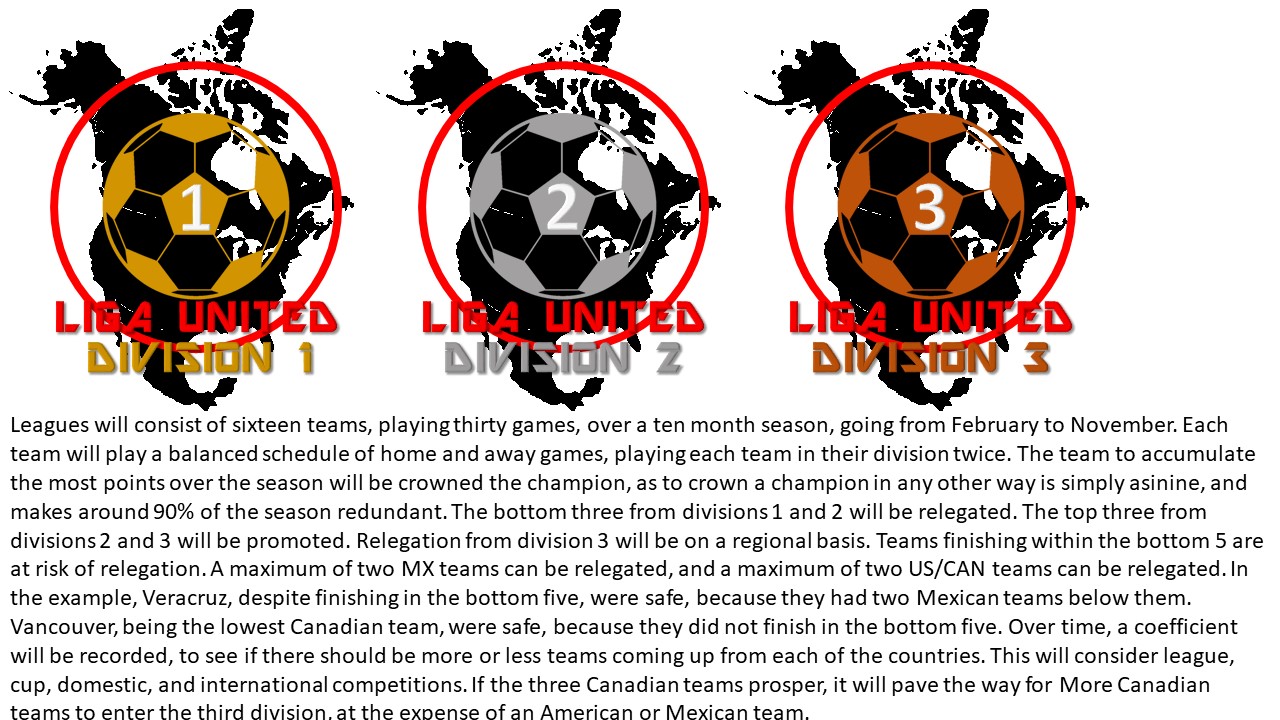
Here's how the three divisions would look. This is based off of Liga MX standings for the recent Clausura, and MLS Supporters Shield standings for 2019. Throw in the franchise expansion teams, and one of the bigger teams from Liga Acenso.


There would also be a cup across the three divisions, while the clubs still compete in their national cups too.
 Cup Simulation.
Club America versus LA Galaxy in a meaningful final would have SUM shooting their collective loads.

And then, as a Community Shield/Super Cup type deal. Cup winners taken from most recent real life editions.
How does this factor into Concacaf Champions League?

 How does the schedule work?

It all fits.

I'm not necessarily an advocate of this, just running a mere thought experiment. SUM still gets the summer opportunity to host those meaningless cash grab friendlies against big European teams. The league would not continue during huge international tournaments, which kind of admits your poor quality when you do that. Don't worry, we don't need a break for the World Cup, as they won't be selecting any of our players.

This also provides an opportunity for real rivalries to develop. Why do some teams in Europe hate each other, despite having no links or proximity? It's due to having played meaningful games at some point. And because games will be meaningful, real fan culture will develop. We will no longer need to hand out stupid hymn sheets at matches, run Simba cams at half-time, cheerleaders, freestylers, t-shirt cannons, dance cams, or dedicate every game to Autistic Military Pride appreciation night (I joke, but don't tell me you aren't 100% certain they haven't thought of combining these events to make way for new events). The fans would turn up excited, not because of free t-shirts, but because of three points.

And if the team doesn't do the business, they get relegated. You're crap. Leave. Come back when you're better.

What's at stake? Being the champion (in real countries, champion soccer teams are the most winningest teams, not the most playoffest teams), then there's avoiding relegation, CCL spots, prize money based on league position, and one which is somewhat neglected, NOT EMBARRASSING YOURSELF BY FINISHING LOW DOWN ON THE TABLE. Try it. It's kind of uplifting.

BUT 'MERICANS WILL NEVER GO FOR THIS

We still have cups. But essentially, if they have to be brought into football with gimmicks and flashing lights, it's not really the football they care about. There's enough people over here who love the game. Cater to giving them a good product. Make football good. Then people will join the hype. Seriously though, go back and look at the cup simulation. There are some very interesting story lines present there. Relegation threatened Veracruz travelling to Red Bulls and smashing them 5-1. Plucky Division 3 St. Louis enjoying a highly entertaining win at home to Division 2 Dynamo. We even had a Canadian derby in the second round.

Then look at the leagues. We want the top teams to play each other more frequently. Currently, MLS makes you play awful teams like Chicago, Cincinnati, and Orlando, sometimes three times a year. In a real league pyramid, you would only play them if they are worth playing. See how Division 3 has Kansas, Pumas, Chivas, Vancouver, who will all think they should be top division. Prove it.

In Division 1, there are many teams to have won an important trophy recently, that would think they are the best; Toronto, Seattle, Leon, America, LA, Atlanta, Cruz Azul, Galaxy, Tigres, Monterrey, Pachuca. PROVE IT!!! And if you can't handle these matches, there's a spot waiting for you in Divison 2, with plenty of teams ready and willing to come up and take your place.

This is a truly open system that puts the best against the best. And if you want to stay the best, you have to work really hard at it, over a sustained period of time. Who is the best? Playing four matches to determine a champion is not a scientifically valid method of doing so. The sample size is not large enough. Playing every team twice over ten months, collecting points for wins and draws, then projecting that onto a table, comes with more of the required statistical rigor to be able to determine a team as a "champion."

I do think each nation should have a strong and competitive team in its own right. MLS is stupid, Liga MX is corrupt and essentially broken (have a gander at the silly way they do relegation, thus protecting the big teams), while Canadians are waiting for the maple syrup to thaw for nine months of the year. They have just started a national league, called the Poutine Championship or something, but have Toronto, Vancouver, Montreal, and Ottawa in MLS and USL, with another five clubs in lower USL.

But most importantly, keep Alexi Lalas away from my television.

Sunday, 16 June 2019

Soccer In The USA: Private Training Charlatans

If you enjoy my content and want to express gratitude, I would be so happy if you made a contribution towards my Argentina trip in the summer of 2021. The plan is to go there for four weeks and look at everything football, development, coaching, and culture. Any amount helps. I won't be upset if you ignore this message, as I produce this content purely for the enjoyment of it. Here is the link: http://fnd.us/c1en5f?ref=sh_98yL48

Over the next year, I am going to produce a series of articles that document my thoughts and feelings on soccer in this great country. Now yes, many will feel that I should be saying "football" but the American version of the beautiful game is such a diluted and deranged version of the beautiful game, that I believe "soccer" and "football" to be two entirely different sports. Americans play soccer, the rest of the world plays football. And this is where we reach an impasse.

What do I want to do with this? Maybe someone will collate everything and put it into a book for me. Perhaps some parent somewhere will stumble across my corner of the internet and will be red pilled into change. Or even one of the dickheads I am going off on will realise that they are a dickhead. This is a very complex landscape, and so much is nuanced. Not everything can be made right. Not everyone will agree with me. Not everyone will walk away from reading this without being offended. But here goes.

Soccer In The USA: Private Training Charlatans

In my experience, this is something which I feel is unique to the United States. Hence why we play "soccer" here, and not "football." Nowhere else I have worked offers such a service on such a grand scale. I suppose there are two factors involved here; soccer is catered to middle class white kids, other people in other countries play more football and thus have little need for private training.

For those who may be unfamiliar with this, for those who were born outside of the Matrix, it often goes a little like this. One coach with between one and four players, working on individual skills. They are quite pricey, and can, depending upon the reputation (not quality or level of expertise) of the coach, can be upwards of $100 per hour. If you are like me, and believe to subscribe to some semblance of morals, you may feel this is wrong. If you wish to capitalise on the ignorance of others and make a lot of cash, this is your opportunity.

Let's first talk about the price of these sessions. The market here is strange. Parents are unaware that soccer coaching credentials exist. As someone with an accent who owns multiple tracksuits, I could quite easily fill my boots. Go out several times per day, charge a fortune, and make tons of money. My conscience doesn't allow me to do that. There are hyper-competitive parents out there who wish to buy their children into success. I do think some are genuinely trying to do the right thing, and are just misguided, which is where the morality of it creeps in. What something is worth is simply defined by what people will pay for it. What am I worth? However much I can get, really. So how much can I get? A lot.

I feel that outside the Matrix, the need for these sessions does not exist, because of three main factors;
1. Kids play football with their friends, so do not need to pay an expensive babysitter to supplement their soccer training.
2. Parents outside the Matrix are not stupid enough to pay an extortionate hourly rate to dribble around cones while coach yells at a kid to hustle.
3. Parents outside the Matrix still play with their kids, and do not need to offset that quality time to outside agents.

We shall discuss these factors further.

1. Kids play football with their friends. Simply, the more you do something, the better you get at doing it. Quality of training is more important than quantity of training, yes, but the training here is so formalised, kids are not afforded much opportunity to play. For every one hour of a formal practice, young players should be engaging in four hours of unstructured, unsupervised play. This does not happen in the Matrix, because black people, and everybody is a paedophile (for those of you new to my humour, it's worth noting that I think the biggest cowards on the planet are white middle class Americans. They drive big cars, wear camo, tactical sunglasses, but are afraid of their own shadow, set security cameras around all over their house, have apps on their phones which allow them to view their house cameras at any time, and some even have panic rooms. I mention black people, because so much of the fear held within the average American is based on race, and paedophiles because this demographic believes that everyone is out to get them. They watch Fox News, so everything is a threat to their life. I will not be explaining further jokes in this article).

Kids can't be dropped off at the park, left in the street, or even allowed in their back yard, such is the fear that permeates American society. I live in a very safe neighbourhood, but never see kids in the parks. They are always accompanied. And every second of kids' lives have to be scheduled. There's no time left over for dossing around with their mates and making up games. Kids wouldn't know how to. They literally do not have the skills, because parents do everything for them. When left to their own devices, American kids really struggle to initiate in play. More on this in a later article.

2. Parents outside the Matrix are not stupid. Not true in absolute terms, but relative to this sport, yes. If you asked an English parent for £60 to coach their kid for an hour, they would probably smack you in the mouth. £60 for an hour? Four hours with that one coach, and that's their entire season's club fee paid. So you see, it's all relative. Americans pay a fortune for soccer anyway, so what's an extra $60 or more for ONE ON ONE PROFESSIONAL TRAINING. And as they were not born into the Matrix, they are not plugged into this pointless competition, which is a zero sum game. The hyper competitiveness of parents inside the Matrix leads them to spend vast fortunes of money to gain the smallest of edges over other kids. American kids spend more on boots than English kids spend on football in a whole year. Why? Is it because American kids care more? No, it's because some charlatan has duped them, robbed them blind, and left them with their pants down. The charlatan is often not around by the time it all comes crashing down when the kid's journey is over. They have skipped town, found other clients, or the kids are at a different club, different, high school, or have left for college.

The ruse is simply if you want to be a better soccer player, pay for training with me, and you will learn new things. The parents fall for it. They are desperate through fear of missing out. They want to be a good parent. They want to win the dick measuring contest against other parents. It's like being told you need oxygen to live, and being convinced to live in a room that is 100% oxygen. It's not doing you any good. And as I try to tell people, one guitar lesson with Jimi Hendrix isn't going to solve anything, especially if they don't know how to hold a guitar.

3. Parents outside the Matrix still play with their kids. I think this is a huge factor culturally. Parents outside the Matrix actually know how to play football, so can join in with their kids. Parents inside the Matrix don't know how. The ones who told me they used to play in high school or college, upon seeing them in action, are shockingly bad. I mean kick with their toes bad. I mean fall over when trying to control a ball bad. And it's no secret that American parents aren't necessarily the most physically active. Some can hardly walk for two minutes without wheezing and needing a sandwich. So essentially they pay someone else to parent their kid for them for a while. Then a picture of it will go up on social media #baller #superstar #futureUSWNT to indicate that they have been duped into giving away vast sums of money, while offsetting their parenting, like a true American capitalist.

"But Will!" I hear you cry, "What does it matter if some snakeoil salesmen are ripping off people with deep enough pockets for this to just be spare change?" Good question. I am glad you asked. The United States soccer sphere has a problem with recognising what is actually important in football, and what is required to be good or successful at it. These charlatans with their bland advice and their obstacle courses, simply obscure and muddy people's judgement.

Coach A, who played in high school, works at a local club, and has an E license, high fives my kids, has nicknames for them, and has taught them all these cool tricks, like how to do toe-taps around cones, jump over hurdles with the ball between their feet, and juggle a tennis ball.

Coach B, didn't play in high school, has qualifications and experience that I can't understand, and isn't eccentric in his personality, simply told my kid that they need to reconstruct the way they strike the ball when shooting, because some coach should have taught them that four years ago. Most of his work is slow motion, repetitive, and isn't full of high fives. How am I supposed to tell who is better?

A big part of American training in general is that it lacks realism, and is based off of gimmicks. Gimmicks sell. People here want something tangible. My kid can do 300 juggles! My kid can do an around the world! It looks cool, but it is largely unhelpful. It's enough to pull the wool over their eyes, and make them think their kid is doing something useful. I have a boy who is fifteen who started coming to our practices. He has never played football before, but he has a good attitude, and is a quick learner, so we are going to give him a chance. He has learnt how to do an around the world. What he can't do is strike a pass, control a ball, or move into space to receive. Those things are hard to measure, and therefore, it becomes harder to sell the progress made to parents. Fundamentals are boring, but you can easily trick people into thinking they had a good time with catchphrases and high fives. I learnt that at Disney.

How can I, a force for good, affect positive change, if these charlatans are lying to parents? It's very difficult. And people inside the Matrix do not like negativity, as it threatens their world view, so they tend to switch off, or tell you to quit your bitching.

I don't believe that most personal training coaches are deliberately trying to deceive. Even worse, I believe many are so ignorant of real football, how to break it down into smaller chunks, and how to teach it, that they end up doing a bad job. Most people who get into coaching emulate the coaches they had, before realising that they were complete idiots, and then changing their ways. How terrible would you still be as a coach, had you not experienced that epiphany? In England, I did the FA Goalkeeping Level 2. In the US, I completed the USC 1, 2, and 3 goalkeeper courses. I am far more qualified than people out there who charge a fortune, and I also have less confidence in by ability to effectively deliver, thanks to impostor syndrome.

With keepers, it is different. They are a different animal. I do believe they require one-to-one work, and many footballing parents would not have the expertise required to help them. Still, a parent outside the Matrix could at least hit a few shots on target for their child to dive around for.

Look at it this way. All sessions, regardless of size, need to be ticking these three boxes; repetition, realism, relevance. Often in private training, the only box ticked is the repetition. They repeat the wrong things, or unhelpful moves. So much of the private training lacks the context of the game and the perceptual cues to have any useful transfer to the real game. Every now and then, a video will do the rounds on social media, some kid performing amazing skills with a ball, but when you take a step back, these are all circus tricks. They are essentially trained seals. But it looks cool, so people will pay for it.

We should call them for what they are. Most private sessions are just SAQ with a ball. That's fine. There is a place for that. But nobody is turning an average kid into a superstar by doing an hour of SAQ with them every now and then. Complete the obstacle course, do a million stepovers, and then volley a tennis ball into a pugg goal off a rebounder. Private sessions could be a great opportunity to work on coordination, but that would require a level of expertise far beyond what most of these trainers could obtain. Going into the mechanics of how a player's body moves, and then working to make it more effective, that is hard work. If their striking technique or balance is off, they might need adjustments. It is boring, takes a lot of hard work to affect, and needs to be constantly reinforced. It could even be a great opportunity to work on something psychological, like confidence in front of goal. Could your private trainer break down the decision making required to put the ball in the back of the net? No? Well here's a tennis ball. Do a rainbow.

Working with better players is fine. They bring the skill, the intensity, and the focus. Plus you're not reconstructing, but topping up. Most of the sessions we do are with disinterested ten year olds who have been dragged out by their parents. They do everything half-arsed, and keep asking if they can go home. They will not think about football again until they are dragged to their next session. But hey, as long as the money keeps coming in, keep charging, right?

It's 99% parent lead. The players don't get involved. They aren't lying awake at night in their beds thinking about how they need to spend a fortune on private training to become a professional soccer player. The parents though, they are tossing and turning. And then they talk to me with sheer hope and desperation in their voices. "My son just really loves soccer and he is not being challenged enough on his team" and then reel off a bucket load of clichés about all sorts of nonsense; kid needs a heavy foot, he's fast but doesn't use it, sometimes doesn't hustle, can jump really high, doesn't take enough shots, and on it goes. The kids don't wake up begging their parents to take them out to a private session. They, as the player, realise that what they are about to work on, will not really transfer very well, because it lacks teammates and opponents, so they become disengaged. They're not interested. Who can they beat? Who can they show off to?

And the market is full of gimmicks. Here are a couple of the more flashier ones.


Don't get me wrong. There is a use for this kind of thing. Especially for players that don't have the time or space to get a coach. That's why programmes like Coerver, Beast Mode Soccer, and Football Starts at Home are so good. They help you work on fundamentals in your own time, at your own location. And the advancements in technology, they are great for tracking your progress. My question will always be about the impact long term. At what point will kids get bored of this? How many days until it is stacked in the cupboard and never brought out again?

These gimmicks are not the difference makers. You don't buy a kid an expensive piano if they are not inspired by music. Having a Fitbit to track your exercise and weight loss makes no difference if you do not first attack the psychological problems that have caused the weight gain or lack of exercise. Spending loads of money on gimmicky toys and private training will make no difference if your kid does not actually love them game.


Have a look at where Usain Bolt trains, and the equipment he uses. Hardly what you would expect. The Bolt Supremacy is a fantastic book. Essentially, all the gimmicks in the world do not make up for lack of desire and poor fundamentals. I'm not saying don't invest in better training or better training equipment. I'm saying don't spend a fortune on a kid that isn't really that interested. Don't fool yourself into thinking it is necessary.

And try spending more time being mum or dad, rather than being their agent.

DON'T FORGET TO LIKE MY FACEBOOK PAGE FOR 5% OFF YOUR NEXT PRIVATE SESSION
BUY MY T-SHIRT FOR $20 AND SPREAD THE WORD TO YOUR RICH ACQUAINTANCES