When it comes to passing stats, we're well aware that simply possession, or pass completion, tells us very little. What use is 100% pass completion if all your passes were safe? Well, aside from not giving the ball to the opposition, which, like the Swiss flag, is a big plus. We've got to consider distance, area of the field, the amount of opposition players it bypasses, the position of the receiver, whether the ball is controllable, what happens next, and so many other factors. Whether the pass got there or not does not illustrate the true value of the pass. It's not binary, it's a spectrum. A fifteen yard square pass, unopposed, from the keeper to the right back, on the edge of their own box, is worth very little compared to a ten yard cut back from the winger to the striker inside the opposition's penalty area, allowing for a shot on target.
It's the same for shots on target. I recently coached my current team as we beat my old team 5-0. They were dreadful. We played at 50% pace and still bossed it. Technically, our opponents had five shots on target. That would imply my keeper had to make five saves. That's so very far from the truth. What she did cannot be classed as saves. No way. They had four weak shots from outside the box, which lead to her bending over to pick the ball up, and one from further out, which floated through the air, allowing her to make a routine catch. The way you may toss the TV remote to someone across the room. Sure, the ball probably would have gone in the goal had the keeper not been there, but can we really call it a save if she could have controlled four with her foot, and one could have been brought down on the chest or thigh? We know the value of it, as subjective as it may be, but a statistic doesn't know that. Hence, stats don't tell the full story.

Anyone who can count will be able to surmise from this that not every shot on target has the same value, or more precisely, likelihood of leading to a goal. A goal has a consistent value of one. Whether it was from two yards or forty yards, the skill required to score is irrelevant, with the only thing that matters being that the ball crosses the line.
There's also the idea that goals win games. That's absolutely true. But how many do you need to score?

The above is the WSL table from 2016. There's a few things to note. Man City won the league, and were undefeated. Goals win games, and in sixteen games, they scored 36 goals. That makes it 2.25 goals on average per game. Chelsea, who finished in second place, five points behind City, scored six more goals throughout the campaign, hitting the back of the net 42 times. Meaning their goal per game average was 2.625. That's a lot better. So if goals win games, just how many per game should you be looking to score? On average, top games have about two goals per game. If you score them both, you'll win. If you score one of them, you might win, draw, and may still lose.
Let's flip it round. Chelsea conceded 17 goals in 16 matches, averaging just above one goal conceded per game, meaning that they had to score two goals per match in order to win. Clearly it was an effective strategy, as they won twelve out of sixteen games. What's a way of guaranteeing a point per game? Not conceding, of course. Chelsea may have been a bit better up front than Man City, but City were incredible at the other end of the pitch, conceding just four times in the sixteen game campaign. That means that they achieved a 0.25 goals conceded per game, which is phenomenal. Or to make more sense of it, in four games, they would concede one goal. They kept twelve clean sheets out of sixteen, compared to Chelsea's five clean sheets. City would only have to score once to win most games. That puts a lot less stress on their forwards. In eleven matches, Chelsea would have had to score twice, sometimes three times, to win the game. For Man City, one was enough.
This gives us an insight into the value of a goal. Clearly, points are superior to goals. Goal difference only matters if you are likely to finish on the same points totals. During a game, with Man City winning 1-0 and Chelsea winning 2-1 or 3-2, Chelsea have to score two or three times as many goals as City in order to obtain the same amount of points. Meaning a Chelsea goal in this scenario is worth potentially 33% of a Man City goal. How about that. So do goals win games? No. If the defence is doing their job right, we can drop the plural, and change it to "goal wins games."
There are so many people that constantly try to compare Lionel Messi and Cristiano Ronaldo to say which is better. Players that have played with them both will be asked that question until the day they die. Why are we so obsessed with this pursuit of superiority between two people we'll never meet? Like politics, in a way, it reaffirms our world view. If either one, much like an election win, were to be crowned ultimate champion of football, it would bring such joy to his supporters, and promote all sorts of backlash from his haters. This website http://messivsronaldo.net/ provides pretty much every stat one could possibly think of.

Here's where they currently stand this season. Messi left, Ronaldo right. All club competitions, Messi is at one goal per game, and Ronaldo is at 0.8 goals per game. Their league records are similar. The Champions League stat is even more telling. In one less appearance, Messi has scored three more goals than Ronaldo. Surely on this evidence, we can conclude that Messi is superior. Right? What are the Ronaldo fanboys thinking? On some level, they could see the logic, but behind that there will be two things at play, and depending upon the makeup of the person digesting this info, the potency of each factor will vary strongly; the first one is that they will have their own biases which they cling to, telling them on an innate level to disregard the information in front of them which is plain and obvious to see. The second one is that we know this isn't the full story.
And they sigh with relief. Of course Messi can't be better than Ronaldo. The author just hasn't finished his point yet. See what I mean? Is that more down to their own unjustifiable desire to see Ronaldo come out on top, or due to their logical thinking knowing that these numbers give just a small insight into the bigger picture? Fans can be fickle, and numbers can blind us.
Let's look at the assists. It's not all about who puts the ball in the net, you know, but who can create. If we score an assist as the same as a goal, Messi wins by even more. In thirty six games, he's been involved in 47 goals, giving him a ratio of 1.3 per game. Ronaldo on the other hand moves up to thirty three from thirty one, giving him a ratio of 1.06 per game. Impressive, but still behind Messi.
Now we'll find potentially two justifications for this. It's a fact. Numbers don't lie. Although they can be used to tell a story that we wish to be more favourable to our narrative. I hate it when people climb up onto the fence and say "hey now, they're both phenomenal players, and we should feel grateful that we're alive to see them both." Shush. Neither group of fanboy is happy with such appeasement, and those like me who see that this can go way deeper, are not happy with such a wishy washy answer. No one is denying that they are both great. I am simply on a pursuit of deeper understanding, and these two are giving me the numbers. The first justification is that as Ronaldo has had less appearances, that's probably due to an injury, which can disrupt momentum. So even with such a handicap, he's still performing incredibly well. We've saved some face there. The second is Ronaldo has more assists in the Champions League, which is harder competition, and therefore, those assists are worth more.
Petty, but we're onto something.
Both have been accused of loading their goal tallies with penalties and free kicks, as if that means that they are somehow cheap goals to score. Other such accusations made to justify greatness are Balon D'Or wins, international titles, or that Ronaldo has done it with two clubs in two leagues, unlike Messi who has only ever been with Barcelona, and so therefore he may not be able to handle an onslaught of English cliches on a cold Tuesday night somewhere up North. It's as if these people forget the amount of goals Messi has scored in the Champions League against English sides.
Nevertheless, by throwing more things into the mix, it attempts to serve two purposes; one of clarity and one of distortion. Does Portugal's Euro 2016 win distort the argument about who is better by bringing in something somewhat irrelevant, or does it provide clarity to the argument as it is something Messi has been unable to do? That depends on whether you are truth seeking, or rhetoric appeasing.

Then how about all time stats? We can simply justify Messi being ahead by saying Ronaldo is not having his best season. Easy. Well good news. Ronaldo has more club goals, more league goals, more European goals, and more goals in his career than Messi. Thus proving once and for all that he is the better player. Now the Messi fanboys will pipe up. Ronaldo is a couple years older than Messi. If they both finish at the same age, but the time Ronaldo retires, Messi will be able to catch him up and surpass him in the two extra seasons he plays.
Take that.
All time, Ronaldo has 580 goals, which is better than Messi's 546 goals. His assists, however, are beaten by Messi's. achieving 191 to Lionel's 226. Add them together and we have Messi at 772, and Ronaldo at 771. It's neck and neck. Factor in the appearances, and we have Messi at 1.13 per game, and Ronaldo at 0.92. So there you have it. Surely this is undeniable proof that Messi is better. How can you justify him scoring more than Ronaldo if that's not the case? Well, because cold Tuesday nights, that's why. Who needs evidence, when you've got some unprovable belief that it's harder to score in the Premier League than in La Liga. Something to do with the mediocre English hackers, as opposed to the cultured lightweight Spaniards. Stereotypes don't really work in football nowadays that everything is foreign. If you do play a game in England, while it's wet and cold, on a Tuesday night, chances are you'll have a foreign manager. And so will he opposition. As well as a considerable amount of your teammates and opponents. Just how English is the Premier League? Just how Spanish is La Liga? Is that really something we can consider? Probably not, but many will say Ronaldo did it in the North of England, while Messi was enjoying the submissive Spanish defenders.
Anyway. That's still not the full story though. We should know this.

How about their trophy haul? Messi on the left, Ronaldo on the right. Even the trophies have value. The Spanish Super Cup would be worth less than say the European Championship, because it's a one off game treated like a friendly, rather than a final, whereas the European Championship is the best of the best over a four year period. Don't write off Super Cups. Remember that you do have to win a competition to get there, and that no one likes to lose, especially not a final. Trophies alone, Messi has 37, all with Barcelona. Ronaldo has 29, with Manchester United, Real Madrid, and Portugal. Messi has won the same six trophies over and over again. Ronaldo has won those same six, plus four more (this is including their four Balon D'Ors each). Which is more impressive?
If we start to include other individual awards, this is where it becomes more complicated, by posing more problems than it solves. Those competitions are so subjective. Opinions can be swayed by anything, and it can become political. People vote for who they like. So don't even consider that. A ball going in the goal, and a team scoring more than their opponent, is fact.
We can see that Messi scores more goals, assists more goals, and wins more trophies. That's got to be enough to definitively prove that he is a better player? It has to. Surely. Who can argue with that? The stats are true and obvious. The numbers do not lie.
Now this may be a bit extreme, but consider the following; Danny Simpson, Mark Albrighton, Danny Drinkwater, Wes Morgan have more Premier League medals than Steve Gerrard, Fernando Torres, Xabi Alonso, and Jamie Carragher. If you had to pick a team, which four are you picking? Of course you are. The answer is obvious, yet we can quite easily disprove someone with a certain set of stats. This is the danger of confirmation bias. If we use Premier League titles as the mark of greatness, we can quite easily convince people that the four Leicester players are better than the four Liverpool players. It's easy.
We'll try again. Would you agree that a player to have captained a team at the World Cup is better than a player who never played in a World Cup? Of course you would. It sounds silly not to agree with such a statement. For comparison, and surely you know where I'm going with this, we have George Best, one of the greatest footballers ever, who never played at a World Cup, and Aaron 'the Axe' Mokoena, who captained South Africa in 2010. As a Rovers fan, of course, Mokoena is by far the superior player, but for those who are not wearing their rose tinted glasses (see what I did there?) it goes without saying that Best is infinitely better than the Axe. The Axe was brought in to kick players like Best. Kind of like a goon in ice hockey. With the right stats, we can convince you of anything we like.
Team success depends largely on the players around you. Think what Gerrard's trophy cabinet could have been like if he played for Manchester United or Chelsea. Wes Brown won more league titles than Slippy G, but does that make him a better player? We know it doesn't, but how do we quantify it? What's the vital criteria we can use to truly demonstrate our subjective opinions? Since football is a team sport, it's very hard to judge and compare two individuals. Consider all the ever changing variables that come into play. Opposition quality, lineup, league position, form, strategy, coach. The same can be applied to the teammates. Factor in the weather, time of day, referee, venue, specific game instructions, and amount of recovery days leading up to the game. With so much influencing the potential outcome of a game, how can we isolate two players for comparison? We can't even accurately predict penalties, yet that involves just two players, performing a very simple action, governed by very specific rules and procedures.
Would Messi and Ronaldo have achieved as much as they have done if they played for Blackburn Rovers? Or if they played in France? Or if they joined MLS clubs when they were teenagers? What if Ronaldo was Swiss and Messi was Peruvian? I'm guessing that in each situation, your answer would have fluctuated somewhat. And would they have ever achieved the heights they have if they both didn't play in La Liga? Ronaldo could have stayed in Manchester and would still have been a world beater, but that would mean the two wouldn't be in direct competition and comparison like they are now. Surely, each one of them wants to be the best. Being two big fish in the same pond is going to spark a fight for supremacy.
By now you'll know that not every shot on target is as valuable, nor is every save, even though it still counts towards the tally, or is another tick in the box. It's the same with goals. We can admire it from the point of skill; a forty yard screamer versus a free header from ten yards out. They both count for one point on the scoreboard, but one is clearly much better (harder to achieve and thus more impressive). There's no extra points for the quality of the goal. Much in the same way that a goal is a goal, whether scored against top of the league, bottom of the league, your rivals, a cup game, a dead rubber, or a title decider. Whether the keeper is third choice, or is a World Cup winner, it doesn't matter. If it crosses the line, you score just one point.
We can agree with that... to a point. Are all goals created equal? Imagine this. You've achieved two results recently; a 1-1 draw, and a 5-1 win. Here's an extra goal for you. You can take this extra goal and add it to either scoreline, so you'll either have a 2-1 win, or a 6-1 win. Which one do you choose? Obviously, if you could take this magic goal, you'd add it to the 1-1 draw, thus changing your one point achievement to a three point achievement. Increasing 5-1 to 6-1 means you just win the game by more. You don't take home any extra points. This is precisely why, going back to the Man City v Chelsea comparison in the WSL, it's more important to keep clean sheets than it is to score tons of goals. Defences win titles. Just ask Liverpool. They've never had a problem with scoring goals. The same with Arsenal. What have Arsenal fans been crying out for since 2005? A solid goalkeeper (they eventually got Cech), a tough defender, and a vicious holding midfielder. Under George Graham they were boring, boring Arsenal, always winning 1-0. They'd take that now, right?
This is where we circle back to the modern giants of football, Messi and Ronaldo. As two highly skilled players, that play for the best clubs and countries in the world, that both have a plethora of trophies, and have freakish goal scoring records, and that happen to have played for years in the same country, we actually start to reduce the variables, and can hone in on the more important statistics. It's why we can't really do a thorough comparison of Best, Maradona, Pele, and Cruyff. They peaked at different times, played for different clubs in different leagues, and represented different nations. Messi and Ronaldo are both the stars for their teams, in the same league, and have played at the same time, both in their prime, for a number of seasons. We've removed all the fluff now.
Check out this article by The Economist. What we find here is that someone has done some very useful calculations. It looks specifically at the value of goals within the context of the game itself, and compares directly the goals of Ronaldo and Messi. During 2013 and 2014, Ronaldo scored more than Messi. Ronaldo took both the Balon D'Ors, and won a Champions League. Those two seasons are widely regarded as Messi under performing. That's not what the stats show. The real stats. The most specific, individual stats. It turns out that although Messi scored less goals, his goals were more important, as they were more game winning, or point earning goals. Messi would score deciders. He would also score in the big games, against title opponents. To put it into English terms, Messi would score more winners at Old Trafford, whereas Ronaldo would score a hat-trick in a 6-0 win at Villa Park.
Let's put it another way. What's more impressive; if I were able to land one punch to the face against David Haye, or I were able to punch a baby in the face one hundred times. We all know which one is harder to do. The baby wouldn't even be in my weight category. It's a completely unfair contest. David Haye, on the other hand, makes me look like the baby. If the baby were able to land just one punch on my face, your reaction would be "Damn, well done, baby!"
Another example is Peter Crouch's England goal scoring record. Let's not bash the guy. At the age of twenty seven, I am yet to score for my country. Crouch netted 22 goals in 42 appearances, which is impressive at any level, let alone international level. Now it's time to add some perspective. Of those 22 goals, only one came at a competitive tournament, which was the first goal in a 2-0 win versus Trinidad and Tobago at the World Cup in 2006. Apart from that, twelve were scored in friendlies. That's over half. Nine were scored in qualifiers. Four goals stand out for perhaps deserving some credit; his first was an equaliser in a 2-1 win versus Uruguay in a friendly in 2006 (fifth cap), an equaliser when England were 2-0 down to Croatia in the crucial qualifier for Euro 2008, which England lost 3-2, and thus didn't qualify (24th cap), the second goal in a 3-1 friendly win against Mexico in 2010 (38th cap), and finally a consolation goal in a friendly loss 2-1 to France in 2010 (42nd cap).
His other goals are far less impressive. A hat-trick in a 6-0 friendly win against Jamaica, braces in qualifier wins against Belarus and Andorra, and braces in friendly wins against Greece and Egypt. In fact, those 22 goals were scored in just 16 games, of his 42 appearances. His goals to games ratio of 0.52 is impressive. The amount of games he scored in 0.38 is also good. Entirely subjectively, I'd say perhaps only five of his international goals were important.
Crouch stats.
That wasn't meant to be a character assassination, more a demonstration of what BIG stats can do, before we begin to scrutinise the minute details. Crouch scored a lot for England, but few were of any real value, or even against tough opponents in meaningful matches. So with the value of goals being analysed between Ronaldo and Messi, and Messi coming out as the clear winner, anyone who wants to say Messi is a better player than Ronaldo now actually has proof. His goals are not proof of superiority, His trophies are not proof of superiority. The proof of Messi's superiority is that his goals have directly been responsible for more wins, points, and trophies, than Ronaldo's. Messi's goals were more important. Ronaldo likes to beat a dead horse. Messi likes to decide championships.
What's left for Ronaldo fans to clutch at? Ronaldo usually has more defensive responsibilities than Messi, and thus is required to be involved in play much closer to his own goal. There you go. You can have that one. Cling to it.
Evidently, a simple answer is never enough for me. The Ronaldo v Messi debate is had every day on messageboards, phone-ins, and comment sections all around the world. People spout fluff and hot air with nothing real, heavy, or gritty about what they say. Supposedly, that's what makes football more fun, in that we've all got a different take on the same events. To me, someone is right and someone is wrong.

This is how most people view football. What a nice sentiment that is. We're both right. It's all about perspective. We must consider the other person's values, especially in a sport full of variables and nuance like football.
No. Someone is always wrong. There's different levels of wrong, but there is always a line of wrongness, and someone is always more wrong than the other person. This picture is more like it.

Moving on. This piece has been largely inspired by the debate of Guardiola dropping Hart to bring in Bravo. It's funny seeing the prejudices and biases that come into play when people attempt to "debate" this issue. The first thing to consider is that there is a lot of hatred towards Guardiola in England. He challenges our world view. People want to see him fail. Apparently it was easy to win six titles in a year with Barcelona. Anyone could have done it with the players he had, simply forgetting that in his first season or two in charge he got rid of Ronaldoinho, Deco, Eto'o, and Ibrahimovic, which, of course, was obvious, right? Just as obvious as bringing through Sergio Busquets from the B Team. I mean, we'd all have done that. Those were clearly obvious decisions. Definitely not controversial.
Pep didn't just win trophies, he broke records, obliterated his opponents, and changed the way many of us (but not the majority of Brits) view football. Which, of course, anyone could have done with the players he had. You hear these excellent phrases like "There's no Darmstadt or Granada in the Premier League." I love that one. As if we never see teams in England destroyed by one-sided scorelines, or finish bottom of the table by record points. Nor do we see the English title being won by the same group of select teams, or even being won by record points.

Look at how well Derby did that season. 11 points from 38 games. That's just under 0.3 points per game.

At least Wigan scored though. BECAUSE US ENGLISH DON'T JUST ROLL OVER AND DIE!!!!
How about saying "There's no Wigan Athletic in Spain" or "There's no Derby County in Germany." Of course not. That would be irrelevant to the point we're trying to make by spouting unprovable rhetoric. Time for more analysis.
I'm going to go back through the last ten years and make some comparisons between The Premier League, La Liga, and the Bundesliga. The German league only has eighteen teams, meaning that there are four games less than in England and Spain. I WILL NOT adjust the points to make up for those missing games. Not yet, anyway.
First, we should note the different champions of each league. There are some passive stereotypes that may need examining.
Premier League
Four different champions in the last ten years
Manchester United x 5
Chelsea x 2
Man City x2
Leicester x1
La Liga
Three different champions in the last ten years
Barcelona x6
Real Madrid x3
Atletic Madrid x1
Bundesliga
Four different champions in the last ten years
Bayern Munich x6
Borussia Dortmund x2
Wolfsburg x1
Stuttgart x1
They don't look too dissimilar. Here are some pie charts to enjoy.


What have we learnt here? All three leagues have had either three or four different winners in the last ten years, and each league has had one team to win at least half of those titles. There's a clear dominance of Manchester United, Barcelona, and Bayern Munich. Six league titles, three in Germany, and three in Spain, can be accounted for by Pep. Is there that much difference in quality between the leagues? We're about to go deeper.
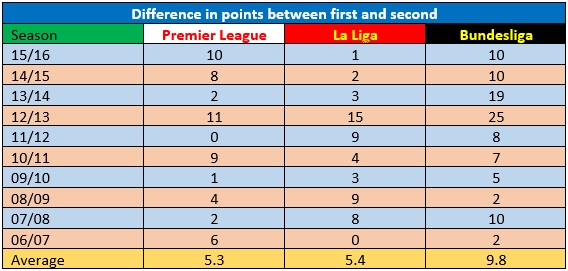
This table shows us that in Spain and England, the team to win the league does so by just over five points on average. There has been one season in each country where there were no points, when Man City pipped Man Utd on goal difference, and when Real Madrid, with an inferior goal difference to Barcelona, won on head to head. Interestingly, in the Bundesliga, almost ten points is the gap between first and second come the final day. Funnily enough, if we take out the last four seasons, Jupp Heynkes treble winning side that shook the world, and Pep's three seasons in charge thereafter, the average difference goes down to 5.6, which is more in line with England and Spain. Is that strength of the league or strength of the manager? We'll be able to tell a bit more later, but I do have one hypothesis which is hard to test; in Germany there is a long winter break, four less league games per season, and less cup games.
Spain plays 38, England plays 38, Germany plays 34. Spain has one cup, with many rounds being played over two legs. England has two cups, with most rounds being one leg, but there can be replays in the FA Cup, which big teams hate. Germany has one cup, with it being one leg. Spain has a winter break, Germany has a slightly longer winter break, and in England, fixture congestion can be a big problem. It would be interesting to discover what effect this has on the long run of the season. They say anyone can beat anyone in the Premier League, but some figures below may show that to be a little misleading. Barca, Real, and Bayern still lose games. The Premier League still gets the odd Derby County, Sunderland, or Aston Villa, capitulating and rotting in last place, as sitting ducks. The top teams in England could be competing in two cups, plus the Champions League, following a summer with an international tournament, while competing for the title. That's perhaps why these teams are prone to slipping up domestically, and not running away with the league.
Think about it. For a few weeks over the winter, while the English giants are scrapping it out in the mud and the rain, Bayern Munich jet off to Qatar to be pampered. They come back manicured and moisturised. They have recuperated, and are ready for the long haul. They will be less likely to slip up against weaker opposition. If you're a club at the bottom of the table, would you rather play first place after they've had seven days of rest since their last game, or would you rather play them after they've played three games in eight days? The weaker teams traditionally don't suffer from fatigue because they are usually only fighting on one front, against relegation. The top English teams can be stretched too thin, and thus don't run away with the league in the way we see in Germany and Spain.

This table shows us how far it is between first and last. The Bundesliga results come with an asterisk considering they play 34 games, compared to 38 in England and Spain. That means twelve more points are up for grabs, so you could assume there would be another six to ten points difference in there, had they played the same number of games.
What this table shows is that the difference between first and last is not too dissimilar across the three leagues. The bad teams do about as well as each other. Consider this though; over this time period, the Bundesliga TV deal has been around 25% of the Premier League TV deal. And in Spain, each team negotiates their own TV deal. Barcelona and Real Madrid make huge sums of money, while the other eighteen teams make about as much as teams in the English second division. In football, it's true that money = wages and wages = points (not transfer fees), so we can see that despite the huge advantage the lower end English teams have over their German and Spanish counterparts, it doesn't really seem to do much on the pitch in terms of their points haul. English clubs are so money oriented, that many of them spend more than 90% of their entire fortune on players' wages. Hence the widely reported financial troubles of teams that are relegated.

Again, the Bundesliga needs an Asterisk. The bottom two are relegated, and third from bottom enters a playoff with a team from the second division. Sometimes they win, and stay up, sometimes they lose and go down. Nevertheless, I have counted this as "team that could be relegated", so the survivor for me in Germany is the one who, like in England and Spain, finishes fourth from bottom.
The Premier League has the largest distance between last place and the first survivor. Some seasons it has been gut-wrenchingly close. In the famous Survival Sunday, I couldn't sleep the night before, as Rovers travelled away to Wolves, with both teams facing the drop. At half-time Rovers were 3-0 up, and looking safe. At the time, I remarked on Facebook, having been the morning after an all night party with my old women's football team, that I had spent the night alone in a house full of drunk girls, and not in my wildest dreams could I have imagined anything better than to be winning 3-0 at half time.
If the Bundesliga did play 38 games, just how big would the distance be between last and first survivor? This table shows it as not being as bad, compared to England and Spain. Perhaps there really are Granadas and Darmstadts in the Premier League.

The goal differences here do tell a story. I think this comes back to money. Real and Barca have all the fortune and wealth, and are thus able to buy the most insane attacking talent. Teams in Spain do frequently roll over and die when playing against bigger opposition. It's almost as if they say "Well lads, we're 1-0 down at the Nou Camp, probably not going to win now, so who cares if it's six or seven, just enjoy the day out." What's the way to stop a decimation? Well, if you're English, there's a very clear answer. Sadly, we'll never find out if it's true or not. Just how well would Pulis' Stoke, Allardyce's Bolton, Hughes' Blackburn, and McCarthy's Wolves have done against the two Spanish giants? None of those teams ever came close to appearing in the Champions League, but that Stoke side did make it to a Europa League game against Valencia, and lost over two legs, both games 1-0 to the Spaniards. Then there was the time Gary Megson's Bolton (with essentially an Allardyce team) earned a 2-2 draw away to Bayern, thanks to a Kevin Davies equaliser. The stuff of legend. This doesn't prove anything though, as the same size is too small to be significant. How would those games go if the teams competed more regularly, and thus were able to prepare more thoroughly due to having a better idea of their opponents? Well there is hope. Arsenal always make it to the Champions League knockout rounds, and they hate playing against these types of teams.
So is the secret English passion, with grit, guts, and determination? Out of the four managers mentioned above, only Allardyce is English. Mick McCarthy is clearly from Yorkshire, but represented the Republic of Ireland 57 times, thanks to his father's bloodline. Hughes and Pulis are both Welsh. Surely the core of those teams were English, or at least British? Some were, but it was hardly a pure Anlglo-Saxon eleven. Kevin Davies and Andy Todd sum up what it means to be English, but I'd argue Ryan Nelsen and Chris Samba were far better at being typical English defenders than most English defenders in the modern era. I'd also like to throw in there Jermaine Jones, on loan at Rovers from Schalke for six months, the German American, perhaps the most English midfielder I'd ever seen, with his dark skin and his dreadlocks. Englishness is turning into somewhat of a myth. It's a set of values more than anything. We import foreign players that adhere to these values. They're big, tough, and mean. Doesn't matter what colour you are, or where you were born. If you're willing to slide in the mud, throw elbows, go studs up, and shell it long, you're English.
It's perhaps a self-fulfilling narrative that only requires minimal evidence to be perpetuated.
Now, are these figures enough to show that each league has a dominant force, in addition to having weak teams that fall adrift at the bottom? Of course not. Going back further into La Liga's history will show even more Real and Barca dominance. Bayern and Man Utd dominate their leagues, but at least others get a turn occasionally. Yet again, we find limits to the numbers above. The top and bottom can give us a rough idea of the strength of a league, but there is still too much room for too many different interpretations. You have to view statistics as like a dartboard. You can be so close to your answer, but still very far away. We've really got to step up our game if we want to hone in on the truth. We're now going to do that with a cross league comparison of both champions and runners up. How many points does a team need to win the league? Just one more than second place. And if second place is driving you until the end, you've got to work exceptionally hard to get over the finish line. In this one, the Bundesliga results will be inflated to match 38 games. And, for a laugh, we'll throw in how many games that team played overall that season, if you include cups and European competition, and just how far the team progressed if they were competing in Europe.
We'll go back five years and work our way to the present day. Below is a table showing relevant information.

2011/12
This is probably the closest that the teams finishing first and second across the leagues have been for a long time. Just two points separate Barcelona in second and Man Utd in fifth. The Premier League was even won on goal difference. Both Manchester teams were elimited from the Champions League in the group stage. I was at Man City while they were playing Bayern Munich, knowing they were already out, with Manchester United losing away to Basel. It was a special feeling to be in a city where both clubs were eliminated on the same night. That's also the season Man Utd played the mighty Aldershot Town in the FA Cup. Both Manchester Clubs, following their poor Champions League campaigns, entered the Europa League, and definitely did not take that seriously, being knocked out pretty quickly. Doing so enabled them to pay more attention to the league, also being out of both cups.
Borussia Dortmund were knocked out of their Champions League group in dead last. They lost the DFB Super Cup to great rivals Schalke, and had an abysmal start to their league campaign. Pretty soon, with no midweek Champions League games to worry about, they went on an unbeaten run that took them to a league and cup double. Bayern had an off year by their standards, but were surely destined to win the Champions League. Chelsea, who were having an awful season, were able to rally together and pull off the unthinkable, despite all the odds, eliminating a very strong Barcelona in the semis.
Barcelona still had an impressive season, picking up four trophies, and earning enough points to be crowned champions in England and Germany, but Real Madrid were unstoppable. Both Spanish giants made it to the Champions League semi-finals, though it seems the extra six games Barcelona played, with the added travel to Japan, was enough to fall nine points behind Los Blancos.
2012/13
This was the year the Germans sang Football's Coming Home at Wembley. The newspapers were outraged, and made all sorts of beach towel jokes. Bayern stormed the league, but they did as well as Real Madrid, and themselves the following season. Just because there were no real challengers, does not make their achievements less impressive. They would have won both La Liga and the Premier League with twelve points to spare, while still picking up a cup. They were exceptional on all fronts. Dortmund, following their poor Champions League test the season before, stepped it up a gear, and pushed Bayern until the last few moments of the final. Clearly they didn't have the resources to fight on more than one front. Sure, Bayern were exceptional, but the difference between first and second was huge.
Barcelona and Real Madrid were both humbled in the Champions League by the two German teams. Those semi-finals sent shock waves around the world. Barcelona were defeated 7-0 on aggregate by Bayern Munich. Who does that to Barcelona? Dortmund beat Real 4-1 in Germany, meaning that a 2-0 victory for the home side in Madrid was not enough to progress. Still, the two Spanish teams demonstrated their superiority by achieving a very high points total, while playing sixty plus matches that season.
In England, first and second switched places. Neither team did particularly well in Europe, nor was there any success in the cups, meaning that they both played considerably less games than their Spanish counterparts. First and second in England played exactly the same amount of games as first and second in England, yet it was the German teams that went all the way in the Champions League. I believe there's a bit of a trend growing here.
2013/2014
This is the year Pep went to Bayern. He left Barcelona as world champions, and was about to do the same in Bavaria. There's a point to be made here. Yes, this team achieved huge success under Jupp Heynkes, and many feel Guardiola fell short in Germany because he didn't win the Champions League. Consider that in the modern era, no team has won it back to back, few managers ever win the Champions League, and even fewer still are able to win it with two teams, I don't really think that's grounds for failure. Bayern did, however, win the league and cup again, and achieved an exceptionally high points total. Their win ratio would have seen them become champions of Spain by ten points, and champions of England by fourteen points. I believe I know what most readers will be thinking by this point, that a lot of it is due to quality of opposition, and we will address that shortly. For now we're looking at how well the top two teams do in comparison to the other leagues.
In Spain, this was absolutely the year of Atletico. A bit like if in Scotland, Hearts or Aberdeen were in the title race, we'd all get behind them. Their success was brilliant to watch, though it was tarnished a little, when Real Madrid, who do not feature in the top two, won the Copa del Rey against Barcelona, and defeated Atletico Madrid in dramatic style in the Champions League final. Hearts were broken. Had it perhaps been Barcelona, or a team from outside of Spain, it may not have hurt so much. Real, that season, played sixty games, one more than Barca, and one less than Atletico, and also finished third, level with Barca, and a goal difference one worse than Barca. Hardly a bad season. All three Spanish teams would have won the Premier League.
In England, Manchester City were pushed all the way by Liverpool, thanks to Slippy G, with only a two point difference. Liverpool were dreadful in the cups, and did not compete in Europe, playing fourteen games less than Man City, yet Brendan Rogers' side could not find the three points necessary to leapfrog City, and give Liverpool their first Premier League title. With Liverpool's goal difference, they still would have finished behind the top three Spanish clubs, The difference in fixture congestion between first and second was huge. That freshness, the ability to be able to recover, and to prepare thoroughly for the next opponent, that's huge. It's a massive advantage that they failed to make use of.
2014/2015
Guardiola was in full swing with Bayern, desperately attempting to win the Champions League. They played a cool fifty two games, reached the Champions League semi-finals, and beat Wolfsburg to the title by eleven points. Wolfsburg had a great season, coming second, winning the DFB Pokal, and reaching the quarter-finals of the Europa League. Obviously spurred on by Lord Bendtner. Bayern, although dropping past their previous total, still did well enough to win the Premier League.
In Spain, it was business as usual, with Barca first, two points above Real, at 94 and 92 respectively. Both teams would have been English and German champions with room to spare. Barcelona took back the Champions League, defeating Juventus, and Real Madrid became world champions. They played more games than all the other teams, and had freakishly high domestic goal differences. As you can see, the Champions in Spain and Germany usually achieve a large goal differential, but between Barcelona and Real Madrid, they just destroy their opponents in the league. Is that due to the quality of the opposition? Again, we'll look into that shortly, but also consider their record in Europe.
Chelsea were champions of England, eight points above Man City, also winning the League Cup. Both Chelsea and City were eliminated in the first knock-out round of the Champions League, Chelsea had four more games to contend with than Man City. It's a slight advantage.
2015/16
Easily the weirdest season in football for a long, long time. Leicester City won the Premier League. Congratulations to them. Now let's take a look at how poor the Premier League was that year. Tottenham, it has to be said, managed to come third in a two horse race. Arsenal, who made it into second, did so with the worst goal difference on the entire table. Liverpool, Manchester United, and Chelsea, who have all won the Champions League in recent memory, failed to finish top four. The teams that came second in Spain and Germany, would have won the Premier League at a canter.
In a repeat of the 2014 final, Real Madrid yet again won the Champions League, once more defeating city rivals Atletico in heartbreaking style. Also of note was the Klopp v Dortmund match at Anfield in the quarter-finals of the Europa League. 1-1 in Germany, Liverpool came back from behind to win 4-3 (5-4 agg.) against BVB. Liverpool lost in the final 3-1 to Spanish side Sevilla.
Now we can look to analyse a bit more. These may seem like useful stats, but they are a synopsis, and not the whole story. You've got to read the book, and really know your stuff to be able to understand it deeper.
In each of the last five seasons, both the German and Spanish champions would have won the Premier League. In some seasons, even second place would have won the Premier League. Only once, with Manchester United, did an English team finish in the top three, when they came 3rd in 2012/13, joint on points with Barcelona, having played six games less. Remember that less games is an advantage, as the teams don't have fixture congestion, so their domestic points total can be higher. At a top club, second or third place is only justifiable if it was by a hair, and if other trophies were collected. So Real Madrid won't mind coming third in 2013/14, to city rivals Atletico, and El Classico rivals Barcelona, as it was by head-to-head, and they beat both of them in the Copa del Rey, and the Champions League final anyway, before becoming world champions.
The fact that these teams in Spain and Germany do so much better domestically when compared to their English foes is often put down to simply the quality of opposition. We've already seen that there are, at times, shockingly bad relegation fodder in the Premier League, We know that bad English teams do often lose by embarrassing scorelines. Many would argue, that in Spain and Germany, it happens by more, and more frequently. The goal differences show that quite clearly. It's also worth noting, that in the last five years, both Spain and Germany only had two teams finish in the top two; Barcelona, Real Madrid, and Atletico Madrid, with Bayern Munich, Borussia Dortmund, and Wolfsburg. In the Premier League, there have been twice as many; Liverpool, Manchester United, Manchester City, Chelsea, Arsenal, and Leicester City. That suggests that there are more strong teams in England. In the Premier League, during any given season, there may only be two or three title contenders, just like Spain and Germany, but in England, those two or three contenders could be any from maybe five or six teams.
There's also the case that English teams do spread themselves too thin. We can see that now. Even in a busy year, with trips to Morocco, Bayern still play as many, or even less than the English champions. Only once did Bayern play less games than the English Champions, which was last season when Leicester won it. Bayern played 53, Leicester played 43, and then we have Arsenal in second, who played 54 games, one more than Bayern, and the same as Dortmund.
So are English teams tiring themselves, and is this affecting them in Europe? I think there is some evidence here to suggest that, but it's probably not the biggest factor. In Germany, the cup (singular) is played as a one-off game, midweek, with the league being four games less, meaning players can recuperate midway through the season during the winter break, just in time for the first knock-out round of the Champions League. In Spain, the cup (singular) is played midweek over two legs, their season is as many games as in England, but their weekends are not disrupted by cups, meaning they have enough time to squeeze in a winter break, enabling them to recuperate just in time for the Champions League knock-out. In England, the cups (plural) are played midweek and weekends, mostly over one leg, but sometimes with two legs, or requiring a replay. With cups being on weekends, there's no time to squeeze in a winter break. December and January are hectic times for English clubs. While their friends on the continent are relaxing in front of the fire, or enjoying a resort in Qatar, English based players have to fight in the cold, sideways rain, of Boxing Day and New Year. Frequency of games, with lack of recovery in between, is the biggest factor in causing injuries. If you play three days later following ninety minutes, you're only at 80%. Three days later, you'll be at 80% of your 80%, and so on, until you either become injured, or just rest. It's an endurance sport, that requires a lot of speed and agility. That's a killer for the joints. English based players, simply don't get time to recover.
Convincing enough, but is there something else at play?
Position
|
Team
|
Games
|
GD
|
Points
|
GDPG
|
1
|
German 1st
|
52.4
|
73.6
|
95.4
|
1.9
|
2
|
Spanish 1st
|
58.4
|
77.4
|
92.8
|
2.0
|
3
|
Spanish 2nd
|
59
|
76.6
|
89
|
2.0
|
4
|
English 1st
|
52.6
|
49
|
86.4
|
1.3
|
5
|
English 2nd
|
50.6
|
42.6
|
80.2
|
1.1
|
6
|
German 2nd
|
52.8
|
50.4
|
79.4
|
1.3
|
Year
|
Champions League
Winner
|
Champions League
Runner-up
|
Europa League
Winner
|
Europa League
Runner-up
|
2016
|
Real
Madrid
|
Atletico
Madrid
|
Sevilla
|
Liverpool
|
2015
|
Barcelona
|
Juventus
|
Sevilla
|
Dnipro
|
2014
|
Real
Madrid
|
Atletico
Madrid
|
Sevilla
|
Benfica
|
2013
|
Bayern
Munich
|
Dortmund
|
Chelsea
|
Benfica
|
2012
|
Chelsea
|
Bayern
Munich
|
Atletico
Madrid
|
Athletic
Bilbao
|
2011
|
Barcelona
|
Man Utd
|
Porto
|
Braga
|
2010
|
Inter
Milan
|
Bayern
Munich
|
Atletico
Madrid
|
Fulham
|
2009
|
Barcelona
|
Man Utd
|
Shakhtar
|
Werder
Bremen
|
2008
|
Man Utd
|
Chelsea
|
Zenit
|
Rangers
|
2007
|
AC
Milan
|
Liverpool
|
Sevilla
|
Espanyol
|
Country
|
Points
|
Spain
|
40
|
England
|
24
|
Germany
|
12
|
Italy
|
11
|
Portugal
|
5
|
Ukraine
|
3
|
Russia
|
2
|
Scotland
|
1
|
2016/17
England 1-5 Germany
|
Spain 4-1 GERMANY
|
Spain 2-1 England
|
Germany 5-1 England
|
Spain 2-2 GERMANY
|
England 3-1 Spain
|
GERMANY 1-1 England
|
Germany 1-0 Spain
|
Spain 4-0 England
|
England 0-1 Germany
|
Germany 2-2 Spain
|
|
Germany 0-0 England
|
Spain 1-0 Germany
|
|
England 4-0 GERMANY
|
GERMANY 1-2 Spain
|
|
England 7-12 Germany
|
Germany 7-11 Spain
|
England 4-7 Spain
|
E1 D2 G3
|
G1 D1 S4
|
E1 D0 S2
|
England 4-2 GERMANY
|
Spain 1-0 Germany
|
England 0-0 Spain
|
Germany 3-2 England
|
Germany 2-1 Spain
|
Spain 1-0 England
|
Germany 5-1 England
|
Germany 2-0 Spain
|
England 0-2 Spain
|
England 2-0 Germany
|
Spain 3-0 Germany
|
Spain 3-1 England
|
England 2-1 Germany
|
Germany 1-1 Spain
|
Spain 1-3 England
|
England 2-1 GERMANY
|
GERMANY 4-2 Spain
|
England 2-1 Spain
|
GERMANY 1-1 England
|
Spain 2-1 Germany
|
England 1-3 Spain
|
England 4-3 GERMANY
|
Spain 2-0 Germany
|
Spain 1-0 England
|
GERMANY 3-0 England
|
Germany 0-0 Spain
|
England 3-0 Spain
|
England 1-2 GERMANY
|
Spain 3-1 Germany
|
|
Germany 0-0 England
|
Germany 2-3 Spain
|
|
England 1-0 Germany
|
||
England 20-21 Germany
|
Germany 13-18 Spain
|
England 10-12 Spain
|
E6 D2 G4
|
G3 D2 S6
|
E3 D1 S4
|
2014/15
Germany 0-2 England
|
Spain 2-2 GERMANY
|
Spain 1-0 England
|
England 4-1 Germany
|
GERMANY 1-1 Spain
|
England 0-3 Spain
|
England 2-0 GERMANY
|
Spain 3-4 Germany
|
Spain 1-0 England
|
GERMANY 2-0 England
|
Germany 0-2 Spain
|
England 1-2 Spain
|
England 3-2 Germany
|
Germany 3-2 Spain
|
|
Germany 1-0 England
|
Spain 3-0 Germany
|
|
Germany 0-5 England
|
||
England 1-1 Germany
|
||
England 17-5 Germany
|
Germany 10-13 Spain
|
England 1-7 Spain
|
E5 D1 G2
|
G2 D2 S3
|
E0 D0 S4
|
2013/14
England 0-2 Germany
|
Germany 1-6 Spain
|
England 0-2 Spain
|
Germany 1-1 England
|
Spain 3-1 Germany
|
Spain 2-1 England
|
England 1-1 Germany
|
Spain 3-0 GERMANY
|
Spain 0-0 England
|
Germany 3-1 England
|
GERMANY 2-0 Spain
|
England 1-3 Spain
|
GERMANY 0-1 England
|
Spain 1-0 Germany
|
England 1-0 Spain
|
England 1-2 GERMANY
|
Germany 0-4 Spain
|
Spain 0-0 England
|
England 3-0 Germany
|
Germany 2-1 Spain
|
Spain 0-3 England
|
Germany 0-3 England
|
Spain 0-1 Germany
|
England 0-1 Spain
|
England 1-3 Germany
|
Spain 2-0 Germany
|
|
Germany 2-3 England
|
Germany 0-2 Spain
|
|
Germany 0-5 England
|
||
England 4-2 Germany
|
||
England 24-16 Germany
|
Germany 7-22 Spain
|
England 6-8 Spain
|
E6 D2 G4
|
G3 D0 S7
|
E2 D2 S4
|
2012/13
England 0-2 Germany
|
GERMANY 2-1 Spain
|
Spain 3-2 England
|
Germany 2-2 England
|
Spain 2-2 GERMANY
|
Spain 1-1 England
|
GERMANY 1-0 England
|
Germany 2-1 Spain
|
England 1-1 Spain
|
England 1-1 GERMANY
|
Spain 1-1 Germany
|
England 1-2 Spain
|
England 1-3 Germany
|
Spain 0-0 GERMANY
|
|
Germany 0-2 England
|
GERMANY 3-2 Spain
|
|
GERMANY 4-1 Spain
|
||
Spain 2-0 GERMANY
|
||
Germany 4-0 Spain
|
||
Spain 0-3 Germany
|
||
Germany 2-1 Spain
|
||
Spain 2-2 Germany
|
||
England 4-9 Germany
|
Germany 25-13 Spain
|
England 5-7 Spain
|
E1 D2 G3
|
G7 D4 S1
|
E0 D2 S2
|
Too much to read? Think of how long it would have taken to assimilate. I replaced the names of the clubs with the country, colour coded it, and divided them into these columns to be able to make sense of the data, and to reduce the chance of error.
The teams involved are incredibly diverse, spanning six seasons of Europa League and Champions League. There were English, Spanish, and German teams not included as they did not compete against one of the other relevant nations, for example; Newcastle United and Southampton. It's also worth noting that Swansea City's games are included in here, though despite being Welsh, they play in the Premier League, and thus for the purpose of this study, are viewed as an English team.
England; Manchester United, Manchester City, Chelsea, Arsenal, Tottenham Hotspur, Liverpool, Stoke City, Everton, Swansea City, Leicester City. 10 Teams.
Spain: Barcelona, Real Madrid, Atletico Madrid, Valencia, Villareal, Sevilla, Athletic Bilbao, Levante, Malaga, Real Sociedad. 10 Teams.
Germany: Bayern Munich, Borussia Dortmund, Schalke, Bayer Leverkusen, Hannover 96, Augsburg, Borussia Monchengladbach, Wolfsburg, Freiburg. 9 Teams.
That's twenty nine teams, which, rather amusingly, is half of each league. Quite a diverse sample size, with some real heavyweights, and some minnows as well, playing 146 games since September 2011.
For those interested, the teams that really let their countries down are; Arsenal, Tottenham, Schalke, Bayer Leverkusen, and Villareal. Shame on you.
Here are the head to head comparisons.
Pos
|
Team
|
Games
|
Won
|
Lost
|
Drawn
|
GF
|
GA
|
GD
|
Points
|
1
|
England
|
51
|
22
|
18
|
11
|
81
|
73
|
8
|
77
|
2
|
Germany
|
51
|
18
|
22
|
11
|
73
|
81
|
-8
|
65
|
Pos
|
Team
|
Games
|
Won
|
Lost
|
Drawn
|
GF
|
GA
|
GD
|
Points
|
1
|
Spain
|
58
|
28
|
20
|
10
|
105
|
81
|
24
|
94
|
2
|
Germany
|
58
|
20
|
28
|
10
|
81
|
105
|
-24
|
70
|
Pos
|
Team
|
Games
|
Won
|
Lost
|
Drawn
|
GF
|
GA
|
GD
|
Points
|
1
|
Spain
|
37
|
20
|
10
|
7
|
53
|
41
|
12
|
67
|
2
|
England
|
37
|
10
|
20
|
7
|
41
|
53
|
-12
|
37
|
Head to head, Germany loses to both England and Spain, while Spain beats both England and Germany.
Pos
|
Team
|
Games
|
Won
|
Lost
|
Drawn
|
GF
|
GA
|
GD
|
Points
|
1
|
Spain
|
95
|
48
|
30
|
17
|
158
|
122
|
36
|
161
|
2
|
Germany
|
109
|
38
|
50
|
21
|
154
|
186
|
-32
|
135
|
3
|
England
|
88
|
32
|
38
|
18
|
122
|
126
|
-4
|
114
|
Now, even though England beats Germany in head to head games, German teams did comparatively better against Spanish teams than English teams did. German teams have played 21 more games than English teams in this England-Germany-Spain mini-league, which is perhaps indicative of the German teams going further in these competitions.
You can make a case either way for the Bundesliga or Premier League being superior, but the battle is for the silver medal. This shows a clear dominance of the Spanish teams. Surely by now, the conclusion is that La Liga is just the best league in the world. If you are still unconvinced, I noticed one more trend that needs sharing. What this neglects is two teams from one country playing each other. Obviously their results cancel each other out, but the Spanish teams appeared to encounter Spanish teams more frequently than English v English and German v German. So here's an analysis of the round of 16 and quarter finals of the Champions League and Europa League over the last five seasons, excluding this year.
Below is a table I have assembled. The points work as follows; Each Europa League round appearance is worth 1 point, and 2 points to win the trophy. Each Champions League round appearance is worth 2 points, and 4 for the trophy.
Team
|
Country
|
CL 16
|
CL QF
|
CL SF
|
CL RU
|
CL W
|
EL 16
|
EL QF
|
EL SF
|
EL RU
|
EL W
|
Tot
|
Villareal
|
Spain
|
2
|
1
|
1
|
4
|
|||||||
Leverkusen
|
Germany
|
3
|
1
|
7
|
||||||||
Sparta Prague
|
Czech Rep
|
1
|
1
|
2
|
||||||||
Lazio
|
Italy
|
2
|
1
|
3
|
||||||||
Dortmund
|
Germany
|
2
|
2
|
1
|
1
|
1
|
1
|
14
|
||||
Spurs
|
England
|
3
|
1
|
4
|
||||||||
Liverpool
|
England
|
1
|
1
|
1
|
1
|
4
|
||||||
Man Utd
|
England
|
2
|
1
|
2
|
8
|
|||||||
Fenerbache
|
Turkey
|
2
|
1
|
1
|
4
|
|||||||
Braga
|
Portugal
|
1
|
1
|
2
|
||||||||
Shakhtar
|
Ukraine
|
2
|
1
|
1
|
1
|
7
|
||||||
Anderlecht
|
Belgium
|
1
|
1
|
|||||||||
Bilbao
|
Spain
|
2
|
2
|
1
|
1
|
6
|
||||||
Valencia
|
Spain
|
1
|
3
|
2
|
2
|
9
|
||||||
Basel
|
Switzerland
|
2
|
3
|
2
|
1
|
10
|
||||||
Sevilla
|
Spain
|
3
|
3
|
3
|
3
|
15
|
||||||
PSG
|
France
|
4
|
4
|
16
|
||||||||
Chelsea
|
England
|
4
|
2
|
2
|
1
|
1
|
1
|
1
|
1
|
25
|
||
Dynamo Kiev
|
Ukraine
|
1
|
1
|
1
|
4
|
|||||||
Man City
|
England
|
3
|
1
|
1
|
1
|
11
|
||||||
Gent
|
Belgium
|
1
|
1
|
|||||||||
Wolfsburg
|
Germany
|
1
|
1
|
1
|
1
|
6
|
||||||
Roma
|
Italy
|
1
|
2
|
|||||||||
Real Madrid
|
Spain
|
5
|
5
|
5
|
2
|
38
|
||||||
Arsenal
|
England
|
5
|
10
|
|||||||||
Barcelona
|
Spain
|
5
|
5
|
3
|
1
|
30
|
||||||
PSV
|
Netherlands
|
1
|
1
|
3
|
||||||||
Atletico
|
Spain
|
3
|
3
|
2
|
2
|
1
|
1
|
1
|
1
|
25
|
||
Juventus
|
Italy
|
3
|
2
|
1
|
1
|
1
|
1
|
1
|
17
|
|||
Bayern
|
Germany
|
5
|
5
|
5
|
1
|
1
|
36
|
|||||
Benfica
|
Portugal
|
2
|
2
|
2
|
2
|
2
|
2
|
16
|
||||
Zenit
|
Russia
|
3
|
2
|
1
|
9
|
|||||||
Inter Milan
|
Italy
|
1
|
2
|
4
|
||||||||
Napoli
|
Italy
|
1
|
2
|
1
|
1
|
6
|
||||||
Dynamo
|
Russia
|
1
|
1
|
|||||||||
Club Brugge
|
Belgium
|
1
|
1
|
2
|
||||||||
Besiktas
|
Turkey
|
2
|
2
|
|||||||||
Dnipro
|
Ukraine
|
1
|
1
|
1
|
1
|
4
|
||||||
Ajax
|
Netherlands
|
1
|
1
|
|||||||||
Torino
|
Italy
|
1
|
1
|
|||||||||
Everton
|
England
|
1
|
1
|
|||||||||
Fiorentina
|
Italy
|
2
|
1
|
1
|
4
|
|||||||
Roma
|
Italy
|
1
|
1
|
|||||||||
Monaco
|
France
|
1
|
1
|
4
|
||||||||
Schalke
|
Germany
|
3
|
1
|
1
|
8
|
|||||||
Porto
|
Portugal
|
2
|
1
|
1
|
1
|
8
|
||||||
Real Betis
|
Spain
|
1
|
1
|
|||||||||
Red
Bull Salz
|
Austria
|
1
|
1
|
|||||||||
Ludogorets
|
Bulgaria
|
1
|
1
|
|||||||||
AZ
Alkmaar
|
Netherlands
|
2
|
2
|
4
|
||||||||
Anzhi
|
Russia
|
2
|
2
|
|||||||||
Lyon
|
France
|
1
|
1
|
1
|
4
|
|||||||
Plzen
|
Czech
R
|
2
|
2
|
|||||||||
Olympiacos
|
Greece
|
1
|
1
|
3
|
||||||||
AC
Milan
|
Italy
|
3
|
1
|
7
|
||||||||
Galatasaray
|
Turkey
|
2
|
1
|
5
|
||||||||
Stuttgart
|
Germany
|
1
|
1
|
|||||||||
Bordeaux
|
France
|
1
|
1
|
|||||||||
Newcastle
|
England
|
1
|
1
|
2
|
||||||||
Steaua
B
|
Romania
|
1
|
1
|
|||||||||
Levante
|
Spain
|
1
|
1
|
|||||||||
Rubin
Kazan
|
Russia
|
1
|
1
|
2
|
||||||||
Malaga
|
Spain
|
1
|
1
|
4
|
||||||||
Celtic
|
Scotland
|
1
|
2
|
|||||||||
Standard
L
|
Belgium
|
1
|
1
|
|||||||||
Hannover
|
Germany
|
1
|
1
|
2
|
||||||||
Udinese
|
Italy
|
1
|
1
|
|||||||||
Sporting
L
|
Portugal
|
1
|
1
|
1
|
3
|
|||||||
Metalist
K
|
Ukraine
|
1
|
1
|
2
|
||||||||
Twente
|
Netherlands
|
1
|
1
|
|||||||||
Marseille
|
France
|
1
|
1
|
4
|
||||||||
APOEL
|
Cyprus
|
1
|
1
|
4
|
||||||||
CSKA
Moscow
|
Russia
|
1
|
2
|
1. Italy 10
2. Spain 9
2. Spain 9
3. England 8
- Germany 8
5. France 5
- Russia 5
7. Ukraine 4
- Netherlands 4
- Belgium 4
- Portugal 4
10. Turkey 3
12. Czech Republic 2
13. Austria 1
- Switzerland 1
- Scotland 1
- Bulgaria 1
- Greece 1
- Cyrpus 1
- Romania 1
This demonstrates the power of Europe's big leagues. As we'll see shortly, Italy's ten teams to make it to the last sixteen, have not really done much once they've got there. The obvious exception being Juventus finishing Champions League runners-up to Barcelona in 2015. Their lack of dominant forces is evident of a league sadly in decline.
Chucked into a pie chart with the big four leagues highlighted, it looks like this:

Spanish, German, English, and Italian teams make up 42% of the teams that appear at these stages. Now it's time to put their points totals into perspective.
First, in order.
1. Spain 103
2. England 85
3. Germany 84
4. Italy 43
2. England 85
3. Germany 84
4. Italy 43
5. France 33
6. Portugal 29
7. Russia 16
8. Ukraine 14
9. Turkey 11
10. Switzerland 10 (Basel, all by themselves)
11. Netherlands 9
12. Belgium 5
13. Czech Republic 4
- Cyprus 4
15. Greece 3
16. Scotland 2
17. Romania 1
- Austria 1
- Bulgaria 1

When it comes to trophy haul and round progression, the top three leagues are on a different planet. Sure, you'd expect that to be the case. It's not just participation numbers, but also the funding generated by the leagues. There's no way one Cypriot team would have a chance against four teams from the top three leagues.
By dividing the points by the number of teams, we can find out how much a team is worth in European competition, using the formula that was utilised above. Such a table would look like this:
Country
|
Teams
|
Points
|
Average
|
Spain
|
10
|
133
|
13.3
|
Germany
|
8
|
84
|
10.5
|
England
|
8
|
65
|
8.125
|
Italy
|
10
|
43
|
4.3
|
France
|
5
|
33
|
6.6
|
Russia
|
5
|
16
|
3.2
|
Romania
|
1
|
1
|
1
|
Ukraine
|
4
|
14
|
3.5
|
Portugal
|
4
|
29
|
7.25
|
Netherlands
|
4
|
9
|
2.25
|
Belgium
|
4
|
5
|
1.25
|
Austria
|
1
|
1
|
1
|
Switzerland
|
1
|
1
|
10
|
Czech Republic
|
2
|
4
|
2
|
Scotland
|
1
|
2
|
2
|
Turkey
|
3
|
11
|
3.666
|
Greece
|
1
|
3
|
3
|
Cyprus
|
1
|
4
|
4
|
The Spanish teams are way out ahead, followed in second place by Germany. You should also have noticed the Basel anomaly. They are the only Swiss team to make an impact in European football over the last few years, and judging by this metric, we could believe they would be competitive in the top three leagues. Judging by their frequent shock results against English sides (shock + frequent = oxymoron), that's not inconceivable. Celtic fans like to tell us that their team would do well in the Premier League, but that's just not true. It's always a Battle of Britain when they face an English side in European competition, but against the same teams that the English play, they fall way short of the mark. Basel on the other hand, do better than everyone apart from clubs from the top three leagues. Perhaps it's worth giving them an invite into the Premier League.
These results show averages. Obviously there are some teams that contribute more to their league's international standing than others. Arsenal have been knocked out every season in the last sixteen of the Champions League since we played with dinosaurs for goalposts. I also mentioned Schalke, Villareal, Spurs, and Leverkusen to be letting the sides down. A special mention goes to Borussia Monchengladbach, who appeared more than once in the group stages, but not once in the last sixteen of either competition. Thanks lads. So which teams are pulling them up? It should be obvious from the league comparison earlier that the answers will be Chelsea, Bayern, Real Madrid, and Barcelona. By how much? Is the question. Below is the answer.
By separating the English, German, and Spanish teams, it creates a table like this:
Position
|
Team
|
Country
|
Points
|
1
|
Real
Madrid
|
Spain
|
38
|
2
|
Bayern
|
Germany
|
36
|
3
|
Barcelona
|
Spain
|
30
|
4
|
Chelsea
|
England
|
25
|
-
|
Atletico
Madrid
|
Spain
|
25
|
6
|
Sevilla
|
Spain
|
15
|
7
|
Borussia
Dortmund
|
Germany
|
14
|
8
|
Manchester
City
|
England
|
11
|
9
|
Arsenal
|
England
|
10
|
10
|
Valencia
|
Spain
|
9
|
11
|
Manchester
United
|
England
|
8
|
-
|
Schalke
|
Germany
|
8
|
13
|
Bayer Leverkusen
|
Germany
|
7
|
14
|
Athletic
Bilbao
|
Spain
|
6
|
15
|
Wolfsburg
|
Germany
|
6
|
16
|
Villareal
|
Spain
|
4
|
-
|
Malaga
|
Spain
|
4
|
-
|
Liverpool
|
England
|
4
|
-
|
Spurs
|
England
|
4
|
20
|
Newcastle
United
|
England
|
2
|
-
|
Hannover
96
|
Germany
|
2
|
22
|
Levante
|
Spain
|
1
|
-
|
Everton
|
England
|
1
|
-
|
Real
Betis
|
Spain
|
1
|
-
|
Stuttgart
|
Germany
|
1
|
Removing just the Spanish teams from the table above, the league now looks like this:
1. Bayern Munich 36
2. Chelsea 25
3. Borussia Dortmund 14
4. Man City 11
5. Arsenal 10
6. Man Utd 8
- Schalke 8
8. Bayer Leverkusen 7
9 Wolfsburg 6
10. Liverpool 4
- Tottenham Hotspur 4
12. Newcastle United 2
- Hannover 96 2
14. Everton 1
15. Stuttgart 1
Notable teams not included; RB Leipzig, Borussia Monchengladbach, Southampton, Leicester City, and you could make a case for West Ham. Add them to the table, and we have a league of twenty. How would that look?
This modified Anglo-Germanic table has Bayern way out front, then Chelsea in second, with the same distance to Dortmund in third. Then it starts to get closer. Man City and Arsenal make up fourth and fifth, with Man Utd level with Schalke. Of course, we'll never know for real what would happen in this situation. Football changes all the time. There's certainly enough proof that the Premier League is not the strongest league in the world. There's even a case to say that the Bundesliga is slightly stronger. Well, the best two in Germany are better than second and down in England.
As mentioned before, the stronger German teams show more consistency at the top than the stronger English teams. The next level in the table shows more competitiveness, as the teams in there change somewhat year upon year. Is that an argument for strength or for weakness? Looking at their European comparison, I'd say it's got to be a weakness. Barcelona and Real Madrid consistently finish top, and are consistently strong in Europe. Bayern and Dortmund are the same. The strongest English team in European competition can change each year. And we also know now, that this is not due to the rest of the teams in Span and Germany being weaker, because we've just seen that they're not. In Spain, the negotiated TV deals appear to be a big factor. In England, the shared TV deal makes the league more fair, more competitive, but could damage the chances of success in European competition. What would happen if the English adopted a system like Spain? Then onto Germany, with a more modest TV deal, and a lot of their success is down to transparent ownership, and incredible youth development. Are we missing something in England?
Hopefully this should end redundant questions about which league is better, or my favourite "Can he do it in the Premier League?" Very soon these figures will be out of date, and will start to lose their relevance. It's more to prove the point that if you're going to make a claim, be able to back it up with facts. If you think X is better than Y, by which parameters are you measuring this claim?
There's two more things I'd like to touch on here. The first one is to go back to Guardiola. It is my belief that many English fans wish to see him fail. I think they want this to happen as it will help to reinforce their belief that the English league is the toughest in the world, and that these silly foreigners with their silly ideas just don't truly understand what the game is really about. "It's easy to win the league when you're at Bayern Munich or Barcelona." Is it though? As we've already seen, it may be easier by some parameters (opposition outside the title race) but also quite hard by other parameters (the team challenging you for the title will push you further). When they say it won't be as easy for him in England, what they really mean, although I doubt they are aware of this, that it won't be as easy for him to win the league in England, because Man City are not as superior when compared to their opponents as Bayern are when compared to theirs. Bayern and Dortmund would finish in the top three if they played in England. So would Barcelona and Real Madrid. Judging by success in Europe, a top seven looks like this; Real Madrid, Bayern Munich, Barcelona, Chelsea, Atletico Madrid, Sevilla, Borussia Dortmund. That doesn't exactly look easy, does it.
The second point is that the German teams do better in Europe than the English, but do worse than the English in head-to-heads. Which one shows superiority? It's hard to say. What's the factor which determines who wins the games? And again, we come back to Bayern and Dortmund having very good records against the English sides, with the rest of the German teams not. Could it be tactical? Is it the quality of players? Once more, I'm going to bring up the number of games per season. Many of the English head-to-head wins came in the group stages. During the knock-out rounds, the German teams beat the English teams, and go further in the competition. I really cannot look beyond that winter break to explain this one. Does that make it an unfair fight? The two best German sides, rested and well prepared, clashing with what England has to offer from a point of no injuries, no fatigue, and no fixture congestion. I have no quantitative proof, but it appears almost blindingly obvious. I wouldn't know how to go about testing such a hypothesis. I can't see there being another contributing factor big enough to influence the results so profoundly.
The festive games in England are great for the fans, but if you're a fan of the big teams, what would you rather have; a boxing day fixture to watch in front of the fire with the family, or a greater chance of success in European competition? How much would the Premier League care if it became apparent? They'd have to do a cost benefit analysis of screening games during the weeks that the other big leagues are paused (win) versus the money they don't get from their teams dominating Europe (loss). It wasn't always this way, as ten years ago the English teams were running the show. Frequent semi-final and final appearances, the English were conquering the continent.
So what do people mean when they say the Premier League is the best? They don't have the best teams. The best teams are from Spain. They don't have the most even quality throughout the league, as that is a myth. Without knowing what you mean when you use the word "best", then we begin talking opinions rather than facts. To me, best would mean quality. Spain. Is it that we feel more teams have a chance of winning it? That's only slightly more applicable to the Premier League than it is the Bundesliga. It's more open now, certainly, but there was a time when we had the "Big Four" dominance, and no one else could appear to get into that exclusive club. Is it for the "passion"? Easily the most misused word in football. You don't see passion in Dortmund's Sudtribune? Or in El Classico? It must be that good old fashioned working class passion, or something. A vague term, all encompassing, that due to its lack of clarity, cannot be disproved. The crowds in Germany are huge and loud, in far better stadiums, with exceptionally cheaper tickets. The Germans also play with a lightning fast counter-attack. Is such application of brilliant methods not passion? I think what we mean is that they don't fight and snarl like bulldogs.
If you want parity, watch MLS. Any team can win it. It's more unpredictable than the Premier League. If you want fast paced games, go to Germany. The explosive counter-attacks are sometimes too fast for the human eye. If you want to see tactical battles between masterminds, watch La Liga.
Is it perhaps that the Premier League has the best players in the world? The last time an English based player was in the top three for the Ballon d'Or was in 2008, won by Cristiano Ronaldo of Manchester United, with Liverpool's Fernando Torres finishing third. Since 2009, only twice has a player from outside Spain made the final three; Franck Ribery of Bayern Munich in 2013, during Bayern's treble winning season, and in 2014 it was Bayern's Manuel Neuer, who won the league, cup, and World Cup that year. Both of whom finished third. There's definite arguments that the Ballon d'Or is political and quite subjective. 2013 was obviously Ribery's year, but that's not the way the votes went.
Something which isn't subjective could be to do a country based analysis of the players that represented the twenty four teams competing in Euro 2016, or even the thirty two teams that competed at the World Cup in 2014. The problem with this is that it's too messy and too broad. New York Red Bulls Roy Miller was in the Costa Rica squad in 2014. He's clearly not on the same level as the stars of that tournament. You'd have to look at playing time, goals, assists, and other more in depth match stats, then weigh them up against the quality of the opponent, assign a grading system, rate the best players, and work out in which league they were playing their club football at the time of the tournament. Even that has plenty of holes in it. Certain players may be left out because of injury, or just not fitting the system, and the sample size is limited to six or seven games over one month. Every dog has his day. Are we just to accept that Germany are the best country in the world because they will be world champions from summer 2014 until summer 2018? Why not consider Portugal who were better than Germany in Euro 2016? Or Chile? Or whoever wins the Confederations Cup this summer? Right now, Leicester City are still champions of England, but there's no one that thinks they are the best team in England. Most people would probably go with Chelsea due to their lead at the top of the table. And just like the winter break, how much of that is down to not having their calendar congested by Champions League fixtures?
We're now getting closer to a conclusion. This whole rant that has turned into a dissertation began when listening to people discuss the Hart v Bravo debate. Even top pundits on popular shows would say things like "I just can't understand why you'd not want a goalkeeper that can make saves." What they are trying to say is that Bravo has made some basic errors in regards to his ability to literally save the ball, and that Joe Hart would not have made those errors. It's impossible to prove, as we'll never know. That's the best thing when talking rubbish about football. Choose something that no one can disprove, and you'll never be wrong. We're more concerned about not being wrong than we are being right, as we humans are what we call "loss averse." We'll do anything to not look stupid. Alan Shearer would have won more trophies if he chose Manchester United instead of Newcastle. You could probably agree with that, but even if you don't, you can't prove me wrong. Blackburn Rovers would now be a major force in European football if either the signing of Zinedine Zidane or Robert Lewandowski came through. A bit more outlandish, but prove me wrong. A young Zidane, playing at Ewood, supplying the passes for Shearer and Sutton in their prime? How could they not succeed? Or Lewandowski at Allardyce's Rovers? Very shortly after that he went to Dortmund and set the world alight. What's to say, had it not been for an ash cloud, that he wouldn't have been scoring goals for fun and leading Rovers to European glory? You can't prove me wrong. And to say that Hart wouldn't have made blunders this season for Man City just cannot be proven wrong.
What we can do, though, is take educated guesses. We all know Hart is prone to a mistake. Some have been high profile. He's made a few at Torino, but is out of the spotlight, and we're all too focussed on Claudio Bravo to care. The next thing people like to say is "First and foremost you need a goalkeeper that is a shot stopper." This lead me to post a series of tweets. This shot stopper stuff is just absolute nonsense. It's spouted by ex pros and pundits, but it's like they have no idea what a goalkeeper is. My tweets were along the lines of "Saying a goalkeeper needs to be a good shot stopper is like saying a golfer needs to be a good hitter of balls, or a runner a good putter of one foot in front of the other." It's common sense. Much like when people tell you to "drive safely" as some form of alternative goodbye. "Well thanks mate. Until you told me that, I was thinking of driving like an idiot. Captain Obvious has saved my life." No, I don't think I'm being facetious. Well, maybe a little.
The first thing that bothers me about this is that stopping shots is a relatively small part of a goalkeeper's game these days. Next time you're watching a game, monitor the goalkeepers, and see just how many routine saves they make, versus how many reflex saves they make. We would class a routine save as something fairly central, that if conceded, the goalkeeper is heavily criticised, and his ability drawn into question. A reflex save might be any shot that you think should absolutely have been a goal had it not been for a super-human save from the goalkeeper. Thinking from just purely anecdotal evidence, my guess would be it's probably five routine saves for every one reflex save. I'd like to know for certain, but do not know where to go for the numbers. So is this all that keepers do? Stop shots? No. Here is a list that is by no means exhaustive; catch crosses, positioning, take goalkicks, organise the defence, distribute long, distribute short, start counter-attacks, slow play down, rush off their line for through balls, one-on-ones, be available to recycle possession, change the point of attack, and much, much more. If your keeper can only stop shots, but cannot do the rest of that, then they are more of a liability than a goalkeeper. Sometimes you're better off putting a strong defender in goal who can pass the ball, than a keeper that cannot accelerate off their line, jump for high balls, or kick beyond the edge of their penalty area.
The second thing that bothers me is that the type of shots is never determined. I broadly mentioned routine and reflex saves, which are sweeping generalisations. There are so many different saving techniques, all dependent upon the angle, distance, power, effect, and start position of the keeper. Do you catch, parry, or deflect? A catch is to keep it safe in two hands, a parry is to palm or punch the ball into an area of lower risk, and to deflect is to tip around the post or bar, due to the power or being at full stretch. No point being a great shot stopper if you can't catch. You may be able to dive all over the place, but if they ball is always rebounding to a striker who is six yards out, what's even the point of saving the first one? Then we've got low diving save, high diving save, collapsing save, cup, scoop, W, K etc. Goalkeepers will be able to list far more than that. So if you're choosing to judge two goalkeepers based on their shot stopping ability alone, at least be specific by which shot stopping technique you mean. Justify it. Explain it.
Opinions on keepers are usually entirely subjective. Here's the three arguments surrounding Claudio Bravo.
Bravo's saves. "Everyone makes mistakes. You're just highlighting them. He's actually a very good keeper".
Bravo's mistakes. "He keeps making the most basic of errors."
Three very subjective videos, and I think you can see where I'm going with this.
There's no absolutes. They're all great players, and they are all prone to mistakes. That's hardly news. The thing is that when we're talking about football we become so polarised. This is how they are both ranked on the FIFA games.


It probably isn't. It doesn't help that football opinion is often swayed by who says what. If I like Jamie Carragher or Gary Neville, then I am more likely to agree with them. Essentially, they know what they're talking about, they have more information than me as a fan, punditry is their job, and I can't watch every football match that took place over the weekend and scrutinise it in great detail before having football conversations with friends and colleagues. So when we see alarming headlines such as The Mirror's "Horrendous stat proves Man City's Claudio Bravo is currently the worst goalkeeper in the ENTIRE Premier League." Note entire in capital letters. This implies he's even worse than goalkeepers of bad teams. Oh no. How could it be. This TalkSport article ranks the current Premier League keepers. It has Bravo at 8th. Much like the sensationalist Mirror article, it has been designed to spark intrigue, there's not really any solid proof that one is better than the other. There is, however, a distinct lack of goalkeepers to have won titles, though that's not the be all and end all.
The Mirror article shows that Bravo conceded six goals from six shots, and that at the time of writing, he had conceded sixteen of twenty four shots on target. Firstly, is that a large enough sample size? Secondly, what do they provide for comparison?
The comparison given makes the data become less clear, as it is just too murky.

For some reason, they love the number 24. It seems a bit random. Why not 50 or 100? If I talk about my last game of football, I scored three goals. Does that make me a three goal per game player? Absolutely not. Apart from being a random number, it gives no idea as to how many games this is from, nor who the opposition was against. By now you've probably realised that there are twenty teams in the Premier League, and twenty six goalkeepers listed. The variables that we would need to consider would be strength of the opposition, strength of the defence protecting the goal, team strategy, and that's before we get into the shots themselves. What about distance, power, angle, bend, goalkeeper start position, amount of players between the ball and the goal, and also the transition that lead to the opposition's possession. Remember earlier on in this piece I mentioned my goalkeeper that made five saves in a game against our rivals? But of course she didn't. The shots were so poor that they can't really count as shots. Looking at opposite ends of the table, what were Tom Heaton's shots like compared to Claudio Bravo's? That's very conveniently left out.
Another important piece of information excluded from this set of data, which would provide as much of a direct comparison as we could possibly have, would be to have a look at the last 24 shots against Man City's other keeper, Willy Caballero. This Mirror article was published on January 21st. Caballero has had eight Premier League appearances this season. Let's work out how many of them were before the article was written. Including all competitions, Caballero has kept 7 clean sheets from 17 games, and Bravo has kept 6 clean sheets from 25 games. Even though they are two keepers at the same team, this doesn't tell us the full story. We need to look at the competition and the opposition.
Since the Mirror published their article, Caballero has played in these Premier League games:
Stoke at home 0-0 D (2 shots on target)
Bournemouth away 0-2 W (1 shot on target)
Sunderland away 0-2 W (3 shots on target)
Swansea home 2-1 W (2 shots on target)
West Ham away 0-4 W (1 shot on target)
That's not too bad. He's not really had a lot to do, averaging 1.8 shots on target per game. Easy enough. For those very same games, I'm going to add in possession stats.
Stoke at home 0-0 D (2 shots on target) 65% possession
Bournemouth away 0-2 W (1 shot on target) 62% possession
Sunderland away 0-2 W (3 shots on target) 71% possession
Swansea home 2-1 W (2 shots on target) 69% possession
West Ham away 0-4 W (1 shot on target) 70% possession
Now the job looks even easier. Just under two shots to save, and 67.4% of the possession. One could definitely consider deck chairs if they were to keep goal in those games.
By contrast, here are Bravo's last five appearances for Man City across all competitions.
FA Huddersfield home 5-1 W (2 shots on target) 66% possession
FA Huddersfield away 0-0 D (3 shots on target) 63% possession
PL Spurs home 2-2 D (2 shots on target) 55% possession
PL Everton away 4-0 L (4 shots on target) 71% possession
PL Burnley home 2-1 W (3 shots on target) 55% possession, and played with ten men for 58 minutes
During this time, Caballero was played intermittently. In the Champions League, Caballero was in goal for the 5-3 win versus Monaco, which saw six shots on target, and 67% possession. And in the game following the Spurs fiasco, Cabellero was selected for the 3-0 FA Cup win away to Palace, where Man City had 63% possession and suffered 3 shots on target. As well as a 4-0 FA Cup win away to West Ham, with 67% possession, facing just 2 shots on target.
Looking at these games, who would you say had the easier run of fixtures? Bravo conceded eight goals in five games, with an average of 2.8 shots on target per match, and an average of 62% possession. Those are more difficult circumstances than what Caballero perhaps faced. The Spurs and Everton games in particular were dreadful defensive displays. Man City were so susceptible to counter-attack. My subjective opinion is that Otamendi is not coming under enough criticism for some of his performances. Stones has faced criticism as the other central defender, but he's supposed to be the next best thing since sliced bread, so is ripe for slaughtering in the media.
Focusing on just the Premier League, the Mirror were able to skip over Caballero's performances. By capping the number of shots on target at 24, goalkeepers would have to have played quite a few games. Even if we were to go by three shots on target, that would still mean eight starts to be considered in their table. A team with possession stats like City's can go that many games with such few shots faced.
Caballero started the season at home to Sunderland. Man City had 77% possession, and won the game 2-1, conceding only 3 shots on target. The next Premier League game was a 4-1 win away to Stoke, Caballero also in goal, which was 58% for possession with 3 shots on target. Caballero was again in goal for their 3-1 home win to West Ham, with 67% possession and 2 shots against them.
We have one instance where we can draw a direct comparison between Hart and Caballero, which is that they both played against Steaua Bucharest in the Champions League playoff match. Caballero was in goal for the 5-0 away win, with 71% possession and only 2 shots on target. Hart played in the home leg, a 1-0 win, with 62% possession and 3 shots on target. All this really tells us is that they both had little to do, and didn't do anything stupid.
The first game for Bravo, chucked right in at the deep end, was a 2-1 victory away to Man Utd, with 60% possession and 3 shots on target to deal with. This game is remembered for Bravo's failure to catch a cross, and for not being punished for taking down Wayne Rooney. A good way to make a first impression. If that's your first game in English football, and you have just replaced the England national goalkeeper in what is viewed as an international crisis, people will be looking to jump on anything they can to criticise you. Now we're getting some kind of idea of what the keepers have faced, it's time for more in depth analysis. I'm going to compare Bravo with Caballero, to see just how bad Bravo actually is, when placed under similar circumstances. I've been mentioning possession a lot, which does have some relevance. For a team that keeps most of the ball, chances are that the goals they concede will come from counter-attacks. That's why Man City still appear to be conceding goals, despite having so much of the ball. Perhaps.
So I have a hypothesis that it is Otamendi is more at fault than people realise. We're now about to test that. In the Champions League, Man City have thus far played 9 games, with 5 wins, 3 draws, and 1 loss. They have scored 18 and conceded 10. Hart has that one clean sheet in the 1-0 playoff win against Steaua Bucharest, meaning Caballero and Bravo have played 4 games each. Caballero has 4 wins to Bravo's 1 win, 2 draws, and 1 loss. Bravo has 1 Champions League clean sheet, Caballero has 1 Champions League clean sheet.
The comparisons look like this:
Bravo
|
Caballero
|
|
Goals conceded
|
8
|
4
|
Shots
|
16
|
16
|
Possession average
|
58.25
|
57.5
|
Goals per game av.
|
2
|
1
|
Goals per shot av.
|
0.5
|
0.25 |
Goals scored av.
|
2
|
3.5
|
Average match score
|
2 – 0.5 W
|
3.5 – 0.25 W
|
The same shots on target, possession is not even a point different, and yet Bravo concedes twice as many goals. In the Champions League, Bravo has conceded 50% of the shots he's faced, compared to Caballero who has conceded 25% of the shots he's faced. There is one game of note, which was Barcelona way, where Bravo was sent off after conceding 3, Caballero came on and conceded one more. Having been sent-off for a stupid handball, we'll let Bravo take the heat on that one.
In their nine Champions League matches, Man City have had four different CB partnerships.
Partnership
|
Games
|
Goals
|
Goal Average
|
Stones + Otamendi
|
5
|
9
|
1.8
|
Stones + Kolarov
|
1
|
0
|
0
|
Kolarov + Otamendi
|
1
|
3
|
3
|
Clichy + Adarabioyo
|
1
|
1
|
1
|
Now we put this to the test of the Premier League. Below is a table showing all of Man City's games this season, with the goalkeeper, and the two CBs. Sometimes they would act as a back three, but it's as correct as can be. We also have, for comparison, shots on target, and possession average.
Check next article for the continuation. http://unorthodoxcoaching.blogspot.co.uk/2017/03/blinded-by-stats-do-you-actually-know_15.html