.

.

Monday, 1 September 2014

North Carolina: National Diploma and Much More

North Carolina: National Diploma and Much More

Thursday 14th August 2014

Course book and free t-shirt.
A half one flight from Mexico City was quite easy going. Finishing work two days before the other guys, but my dedication to coaches education and my pure awesomeness were justification for special dispensation. An easy flight time provided no real worries, and an attempt was made to complete the consumption of my remaining perishable goods, thus providing me with a nutritional breakfast of cheesy chips and bacon. The driver was seemingly in quite a rush, despite not having a flight to catch.

Before Raleigh, there had to be a stop in Charlotte. Two hours doesn't sound like much, but most of that was trying to get through customs. There was a huge amount of people funneling through, and not many staff to cater for it all. To make it worse, I was surrounded by French people. Eventually I got through, and I had enough time for a Pinkberry, which was consumed on the plane. That, and the Sbarro before leaving Mexico, were a nice homage to my old home, Kuwait.

A full fridge courtesy of WalMart.

The flight into Raleigh took just half an hour, cruising at an altitude of about ten feet. As soon as the seatbelt light went off, the pilot gave us his first address of the flight, and then mentioned that we were also beginning our descent. This reminded me of one of the early episodes of Futurama, when the gang went to the Moon. Fry began the countdown for liftoff, and by the time he hit seven, they were there.

North Carolina looked very green coming in, decorated by little lakes, ponds, and swamps. It is clean, tranquil, warm, and very easy going here. A lovely place to spend eleven nights. The hotel has provided me with a microwave and a fridge, but more importantly, good vibes. My new friend Hungry Howie had one of his finest employees bring a bacon cheeseburger pizza to room 331 just before midnight. The guy even had change for a hundred ("bloody foreign exchange"). It was delicious, and I wholeheartedly thank Howie and the guys. After initially exchanging my money at Benito Juarez, I nearly made the fatal mistake of leaving my passport, salida, flight tickets, and course confirmation (essentially everything I need to get into the country and convince them I'm not trafficking drugs, and also to get me back into Mexico). Five steps was all it took to realise this fatal error.

To end the day, I fell asleep watching Comedy Central.


Friday 15th August 2014

The CASL clubhouse.
The day has come and the course has begun. A beautiful warm sunny day accompanied me on my hour long walk to Wal-Mart. It was there that I purchased lots of microwavable meals that are full of nutrients. A short ride back in one of Amigo Taxi's finest vehicles, and then it was time to prepare for the course.

The first thing one would notice about the fields at CASL is that they are far better than anything in Mexico. Crisp, green, and much like a carpet, it would be a dream to play on stuff like this. They are also open to the public, so you will see the occasional American out his cleats on and shoot some net while shooting the breeze. The country needs more of this.

One of the ten million fields at CASL.
Straight away it was clear to see that the American coaches on the course are better, far better, than the American coaches I have encountered before. Most of them were dads on a rec team, where as a lot of these guys are coaching at college level. It's very strange to hear Hank, Bill, Dale and Boomhauer discussing the benefits of playing three in midfield, or of the triggers that would initiate the second player press when defending in a 2v2 situation. Nevertheless, there are other foreigners on the course. There's one from Edinburgh and another from Reading. Even the instructor is from Trinidad & Tobago.

From Day One it appeared that the technical side of coaching is in much greater and deeper detail of the courses back home. It appears most American coaches have an encyclopedic knowledge of all coaching points. Even the course manual explains every move in great detail. This could be part of our problem back home in that we assume people just know what the coaching points for all technical skills. Our general population has a much greater knowledge of football than the Americans, but perhaps this causes ignorance in that we don't know the finer details, and also how to break down a skill into ways kids can understand. What if they're not getting it? Now we can identify where the fault is technically. At times it has felt like listening to two coaching point definition books having a conversation.

The stadium at night time.
The most worrying thing I have seen in these first few hours on the course is a sign on the back of the cubicle doors in the bathroom. The sign reads; Notice: Please flush after use. My immediate thought is that this is an unfortunate situation that they have encountered an infuriatingly frequent amount of time, so much so that they can justify purchasing a sign that explains the most natural reflex of post-toilet etiquette. Most of my coursemates are not local to Raleigh, and maybe in the other states, flushing slips their minds.

We did a couple sessions, lead with a Caribbean flavour, which gave us a chance to see how the NSCAA want their sessions to be structured. We saw the content and the level it was to be pitched at. For those of us interested, we got a good look at each other as players, and learned who can play, and who thinks they can play. The field we were playing on was an old fashioned astroturf, and this was cutting me up like a demon. I could feel big bloody blisters forming, so allowed another coach to take my place as a player.

At the conclusion of our first day, we were handed our coaching topics. With absolutely no energy left, pretty much everyone on the course stated their intention to go straight to the shower and fall asleep. My head was too full of information to concentrate, so I watched more Comedy Central and fell asleep.


Saturday 16th August 2014

Blistering heat at 7:30 in the morning.
And so begun the fourteen hour day. Luckily one of the other guys is staying at a hotel pretty much opposite mine, and has been kind enough to provide me with transport. We gather before eight in the morning, and know we have to slug it out in the hot sun until ten o'clock at night. A third instructor showed up, a West Brom fan from the Midlands who works in Georgia. This is a guy who definitely has a more advanced sense of humour than your average American.

The day was very hard going, and from the early morning until the evening, we were on the field, in the sun, playing soccer. Session after session, breakdown after breakdown. The stopping, the starting, the standing. A few of us had fashioned our pinnies (bib or casaca) into a head garment resembling a turban. I can't recall a time where I have ever been redder. Whilst being bombarded by the sun, pounding down and burning you to a crisp, a large variety of local bugs want to come out and say hello. Most of them go for the eyes or the ears, just in case you can't see or hear them. It was noticeable that more and more of them settled on an area around on my shorts that covers my nuts. All day in the sun playing football. Try not to imagine the smell, but understand it would not have been a bunch of roses.

Lunchtime brought some special NSCAA subs, where participants had the choice between ham, roast beef, and turkey. Mine was ham, but was accompanied by a lot of vegetables, all of which they failed to mention before making your choice. A ham sub to me is bread and ham. What I had was a ham, lettuce, onion, and tomato sub. Lies. Those other ingredients could have been replaced with ham or cheese, or better still, given to poor rabbits in the area that struggle to make ends meet. The reward after the playing was over was pizza. About twenty boxes showed up, and they mentioned that I demonstrated speed in getting to the front that my performances throughout the day had been hiding. It was pizza and it was open. I had seen the opportunity and made the run. Sometimes it's not about speed of feet, but speed of thinking. The defence was caught napping and the space was exploited. When everyone was feeling full and satisfied, two slices remained. They were to be handed out auction style. Again, my blistering pace took me to the front, and I claimed both the slices. People told me I was greedy, yet I told them they were not brave enough to follow their dreams.

Still, the grass is perfect and better than the turf.
When it comes to my coursemates, a lot of them are very knowledgeable about soccer, and know their European stuff too. Most of them can move and demonstrate a decent level of skill. The ability and intelligence of the participants is similar to what you would find back home on a course of that level. These Americans just represent a smaller percentage of their nation than we do. Another thing I have noticed is that their level of humour has been increasing over the last few years. I pointed this out to one of them and he told me that they have been trying harder. I asked him "When did Americans discover sarcasm?" We have been wondering when they were going to catch up, but like with football, they are making progress. This has lead to some of the jokes and conversations on the course being of top quality, something which everybody needs in order to be able to keep going through the fourteen hour day.

Match analysis template.

The sessions were seemingly endless, and we had been paying for nearly four hours before it was even midday. The format involves two initial exercises, with a simple progression taking you into the second one, then a functional practice, followed by a 6v6 game. Everything is based around the 6v6 idea. The instructors insist that everything is played to an end. The job of the defender cannot be to just steal the ball. If that is their only instruction, they lose interest and the session intensity drops. Plus it becomes unrealistic in terms of the game. Do you just kick it out, or do you then try and begin an attack? Transitions in coaching are often neglected, which is why a lot of youth teams are slow to react when they win the ball. A lot of defenders only ever play D, and do not understand that once the team has the ball, every player is a member of the attack.

The grey keeper plays GK for the U17MNT.
The instructors look for us to make interventions, and have suggested the different methods that they wish to see. We can coach at natural stoppages in the game, such as when the ball goes out of play, or we use the STOPSTANDSTILL method and have everyone freeze in their positions. They recommend that we do not talk for too long as the interest of our players will decline.

For all the sessions, the instructors, just like back home, are using the course participants as the players. This means we have to volunteer and step right up. Some are old or injured, and so the young fit athletes like myself have to step up and take one for the team. After a while, I needed a break. I layed down at the side, with a bib turban on my head, and continued to watch. I could feel my body shutting down as it was experiencing a longer rest period. My eyes closed, but I thought that no one would notice as the turban was shading my face from the sun. A few others were on the ground, so I wasn't exactly standing out. I then heard some snoring, so turned around to see who it was. There was absolutely no one behind me. Then I noticed a time lapse. There was missing time. It was at this point that I had realised who the snoring had come from. He was English and is writing this blog.

My player only played a half and didn't do much.
Part of the course is match analysis. It was our task to watch a game together, focusing on one player, and then devise a session for submission based on either technical or tactical weaknesses that were displayed by the player. We watched an U17 game, though a few of the players were a little younger, of CASL versus a team from Richmond, Virginia. A few of the better players were away on national duty. That's right, they play for the US youth sides. The goalkeeper was not away with the national team, so we were able to watch him. A commanding young man with supreme confidence, clearly agile, and with great anticipatory skills. He definitely had a presence about him. The guy I had to watch was the CF for Richmond. He looked fairly strong and confident, playing a lot of one touch balls to bring teammates into play. Mostly he was isolated, and as the focal point of the attack, he made a lot of runs back to come deep. Perhaps this was because his service was limited, but now I need to create a session to help him, if I were his coach. I'm going to focus on making runs in behind the defence from the attack. Throughout the first forty five minutes he only made one run behind the defence to receive the ball, and was never really breaking that line with his movement. He demonstrated average speed, but fantastic strength, as well as a good ability to read play. Perhaps if he were able to run along parallel and then break the line, he may receive the ball in 1v1s more frequently with the keeper.

Finally, fast approaching ten o'clock, the day had come to an end. No one had plans other than bed and shower. I added food and Comedy Central to the list, watching Bad Boys and Men In Black in bed, having a Will Smith night. We had sessions to plan, but my brain was too tired for that. I scribbled some stuff down, doodling little footballers, rationing that I would write it up properly before the start of the next day.

My three sessions are:
1. Coach the second attacker when and where to support the first attacker.
2. Teach the first defender when to delay and when to tackle.
3. Coach the first, second, and third attackers in tactical decisions of attacking when numbers up.

Match Analysis Session: Coaching the centre forward to break the lines Pt. 1.

Match Analysis Session: Coach the centre forward to break the lines Pt. 2.

Sunday 17th August 2014

Melted Oreo seasoned bread.
Today was bloody hot. Holy hell. Seriously, it was so hot that my Oeros actually melted. I found the melting point of an Oreo. After experiencing all that, I'm going to be purchasing some bug spray and sunscreen, and also bring my hat. I'm red, aching, and scratching bites.

It was all about our first practice session. Although it is called a practice, we are actually being assessed on it, with it going towards our overall grade. We thought it literally was just a practice, after which we would receive feedback, then make some adjustments to our delivery to improve on the delivery of our sessions the following week. What they've done is use "practice" in the same way we would use "session", rather than meaning something like mock test.

A common criticism was talking bollocks and taking two or three minutes to make the coaching point. When it comes to talking too much while making an intervention, I believe this is largely due to wanting to keep talking to demonstrate that we know what we are talking about. It should be "you move there, look here, why? Run, what is your trigger? Try again" bish bash bosh, done. Quick, succinct, and play. Don't waffle. Coaching adults, everyone is wondering what their peers are thinking of them, yet the large majority are not judgmental, and will not take any coaching points personally. Telling another coach that he started his run too late when trying to initiate an overlap is not going to cause an argument. Even if they might reflect and think you are a bad coach, the only opinion that matters is that of the instructor.

Every single one of us had a run through, and there are some good coaches here. A few completely bombed as their nerves got the better of them. Hopefully now they know what's coming, they can calm down and focus, giving themselves a better grade next week. In the scorching heat, we played and played and played. By the time we got to me, we'd been through thirteen sessions. I think I played in all but two. Being pure magic with the ball, it was only fair I graced as many sessions as I could.

Naturally there was a lot of thought that went into the planning of the session. Although I didn't spend ages on it, I did consider many different options. I thought over the finer details, such as the exact dimensions of the area. Due to being the fourteenth session, I used more players, giving less reps, thus not knackering my fellow coaches. I explained that I would normally do this in two groups to give more playing time to each player.

It looked good, sounded good, I was energetic, funny, and loud. It didn't go entirely to plan right from the off. Having an attacking topic, looking at the second attacker, a few times I coached the first attacker. My feedback showed that I talked too much during my explanations, which was very true. Worst of all, it was too easy. The defending was terrible, and so there were no problems for my attackers to solve. They kept achieving success. What could I coach if they were always winning? I added a second defender, but it was still too easy. I was really scrambling for coaching points. When it was over, I knew all this straight away. The assessor was very helpful in his comments. I received a pass, but a low pass. I know I am capable of much better, and I will show that. I want to improve and I need to impress.

And now, the evening was mine. I tried a mall not too far away, after a delightful evening walk. I made myself comfortable in a sports bar called the Fox and Hound, and also caught the new Planet of the Apes movie. It was alright, but the best part was that Maurice survived. Following that, I headed back to the bar, continuing my time in there as a sad lonely loser. But the brownie and ice cream dessert was fabulous.

The peer to peer review implemented by coaches in a kind of buddy system.

Coach the second attacker when and where to support the first attacker Pt. 1.
Coach the second attacker when and where to support the first attacker Pt. 2.


Monday 18th August 2014
This is a standard NSCAA session plan, developed using Academy Soccer Coach. All of our sessions have to follow this template. Members can submit their sessions online, which are then rated and available for use by other users.
Monday was the first day I had free since being here, so I wasn't going to think much. I wanted to go see the Carolina Railhawks in a friendly versus the University of Carolina, but it was the other side of the city. This would require a two hour bus ride with three transfers, leaving the game early, and the same back. If I missed one on the way back, I'd be screwed until morning. Any taxi would cost a fortune as the stadium is twenty seven miles from the hotel. I went back to the Fox and Hound, deciding to watch the Dingles play Chelsea. It was getting close to five o'clock, and I had no plans for the evening. The very few people in the bar looked sad and lonely. Who goes to a bar on a Monday evening at five? I asked the staff if they could recommend anything to do, and they were short of ideas. I tried a mall, which lead me to check out two shops. It was then that I went to buy a McFlurry and found that my card had been blocked. You see, living abroad and travelling for a couple years now, what threw them off was a $2 McFlurry in the United States. This problem happens to me far more than you would think. Buying stuff off Amazon has made them block my card before. So I went back to the hotel, made some calls, and woke my parents up. After a long time, it was eventually unblocked. I was very angry, leading to this Facebook post:

"Genius stuff from the ***** at Barclays. A while ago they removed the function on their website which you could use to inform them you were going abroad. They said that they have technology which can assess whether out of the ordinary payments are being made, and can then block your card. Using the old system, I never encountered a problem. Using the new system, my card is blocked every time I even look at it. So here I am, abroad, in a shopping mall, unable to make any purchases or withdraw cash. My card has been blocked. Anyone who knows me, and definitely a piece of high tech software, will realise that I live abroad. I have done for a while. I travel quite a lot too. Me trying to spend $2 on a McFlurry is not an out of the ordinary purchase. I have to call them to unblock it, but unfortunately the line is not open twenty four hours. The number you call for help when out of the country is only open for times that are applicable to a day in England. I phoned them anyway and was transferred to a different department. The guy asked me all sorts of questions, very few of which I am able to answer in a mall as it is not advisable to carry all of that information around with you. After answering the questions, he said he would transfer me, and thus put me on hold for all eternity. Moments before giving up the will to live, I hung up. Now I will try again. Essentially it's THEIR FAULT I have a problem but it is ME who has to solve the problem. And spend a lot of time and money trying to fix it. What a bunch of incompetent ********* they are. Every time this happens, I should be given a tenner. Now to try once again to establish a connection with their telecommunications headquarters in India. *********." William Wilson, August 2014.

With all that taken care of, I went to check out downtown. It had been a rainy evening, so the streets were empty. The bars and restaurants were pretty much dead, even at nine and ten in the evening. I had some food and watched the Little League World Series. It's a worldwide tournament for youth baseball, and it appears to me to be obscene. The guy behind the bar started talking to me and he agreed, echoing those sentiments exactly. The shortstop for one of the teams had made two fumbles. This was a big game and was live on TV being broadcast in many countries. If he's playing in the park with his friends, he is called a rude name, cries a little, and life moves on. Now, I imagine, due to the pressure placed on him by the circumstances, he will have many sleepless nights and will never forget that mistake. Why do that to kids? It's a lot to handle.

And that was Monday.


Tuesday 19th August 2014

The astroturf field for the NC State soccer teams.
Possibly the most interesting and eye opening day so far, I found a lot going on in Raleigh for soccer, starting with the training session for the men's team at N.C. State. Straight away I was awestruck by the whole experience. Now one must bear in mind that I went to Southampton Solent to study football at the Lawrie McMenemy Research Centre for Football. Since I graduated, they spent millions on Test Park. The facilities we had at a football specific research centre, supposedly the best in the country, pale in comparison to what they have here in North Carolina. The taxi driver dropped me off in the campus, which already appeared to be majestic. Most likely common for Americans, but jaw dropping for us. I walk into the soccer facilities, and I am first hit by the sheer seclusion of it.
A young blonde physio is always on hand for injuries,
Powerade, and to do doughnuts with the kart.
 Once inside, unless using their free field wide wifi, you will not be distracted by anyone or anything. There must have been an area around 50x50 of unmarked astroturf before reaching the floodlit astro field. There's plenty of space to train and play. As I walked over, I noticed a second field behind it, a grass field. It was better than anything I have seen in my entire life. Probably even better than most Premier League grounds. The grass was perfect height, and all the same length. It was like a bulldyke's buzzcut.

How wolves commute. They are not
allowed to drive in N.C. Still can't
believe just how far behind the U.S. is.
I arrived at 8:30, the time I was told practice would start, but all that is there is three coaches, the physio, the Powerade buckets, the injury mobile, and tons of cones set out. The team, entire squad of thirty, was indoors going over match analysis. The training was to last for two hours, and there is another one at 16:30, in preparation for the game tomorrow. The head coach and the team then show up around 9:00. The team is dressed exactly the same, apart from the goalkeepers who are in grey tops. Everyone has socks pulled up and shinpads on, and something which struck me is that every single player looked like an athlete. No one was short, and all quite muscular. As they put their boots on, the guys got some balls out and passed them between them. Unlike back home where the players will shoot at the goal, or unlike in Mexico where they will be sat down and not even putting their boots on. Once everyone was ready and on their feet, the coach whistled, and all the players were on him within a second. The last person there was someone not paying attention, who had to do a silly dance in front of the group as a punishment. By the time the dance was finished and the team had been taken over for the warm up, we'd still be trying to collect our Mexican players in. Perhaps this is something that has been drilled into them since they were young, maybe it is because of the level they are playing at, or maybe Americans have more respect for the coach. Whatever it is, we need more of it in England and in Mexico.

SAQ warm-up.
The fitness coach lead them through a dynamic warm up which was great for intensity. Right away, the application from the players impressed me massively. No one was half arsing it or only doing it properly when the coach was watching. This was all aided by the use of hurdles and other props. The players were then lead by the head coach into a drill of passing patterns, still warming up essentially, but moving into ballwork. They put their bibs on within seconds, and understood the coach the first time he explained what to do. They went straight to the cones "jog until you get there" and begun on his call. No what? How? Er... like this? Almost with military proficiency. I wonder what would be the punishment if anyone did not listen to him, if the players even know how to do that. Stop, add to the pattern, continue. The intensity was high. "If you're not making bad passes, you're not doing it fast enough" was the call from the coach, achieving two things; players striving for a higher intensity, and also reassuring them of mistakes yet praising effort. What I have noticed from the players here is that communication is not an issue. The thought process is very quick, but in addition to that, they are supplied with sharp and useful information from all their teammates. This is definitely something I'm going to take back to Mexico. We all tell our teams they need to communicate more, but rarely show them how.

Passing:
Bounce - one two.
Take - takeaway.
Turn - receive the ball and turn.
Steve - pass to Steve.
Feet - pass to feet.

Defending:
I got ball - I will press the player with the ball.
Take runner - take the player making the run off the ball.
Drop - take steps backwards in anticipation of the penetrating pass (sometimes accompanied by a number to indicate the number of yards)

There's many other examples, but these are off the top of my head. We'd all know what these meant if they were barked during a game, but these are quick and easy words that are coming out as if they are well rehearsed.

8v8 with two neutrals.
The players moved into an 8v8 possession/pressure game that had two neutral players. The box was probably 40x40 with the team in possession taking up spaces near the outside, and the defending team on the inside. The nearest man would always be the one to press, so shape and integrity was strong and balanced. This made it hard to penetrate and so the team in possession would always have to pass around the outside rather than passing through the middle to the two neutral players. That was the idea; to see if they could open up the defence and get the ball into them. Once possession switched through a bad pass or an interception, the transition was instant, as the defending team moved to become compact, and the team with the ball dispersed to create space. At no point was anyone complaining about not being able to take shots, that they don't want to do it, or it is boring. These players appear to have complete trust and faith in their coach, and know that if they want to play, improve, and make something of themselves, they must listen and apply themselves to the instructions given to them by the guy whose job it is to make them better players.

Oh Wendy, how my heart yearns for you.
Whilst this is going on, the four goalkeepers are working on their distribution with the GK coach, and the injured or recovering players are doing their own work on the far side, under the supervision of the fitness coach. This allowed the fourth and remaining coach, most likely the assistant, to watch over the session. During the passing patterns, the team was split into three groups, with a coach watching each group, while the fitness coach cleared away the equipment for his warm up. It was slick, organised, and clearly very well prepared. These guys are in the zone with each other, and appear to have a great working relationship. You can tell who the coaches are from their uniform. They wear white shirts, black shorts, black socks, football boots, and are pretty much identical. I doubt any of them would ever consider as paid professionals, turning up to a game in a pink Lacoste polo shirt, chinos, and Converse. Professional standards create professional performances.

The indoor facilities at XL Soccer World.
Ten o'clock came and I had to get off to watch the US women train at WakeMed Soccer Park, a few miles up the road. I began my walk, and after about an hour, went past a building that had a big sign outside; XL Soccer World. How could I not investigate? I went inside and asked if I could look around. An Englishman, upon hearing my accent, came running out. He introduced himself to me as Gary, and showed me around the facility. There are some very good quality indoor astroturf pitches, where they have leagues and train their own teams. They offer team training, with both an indoor and an outdoor service, as well as leagues and pickup. Gary turned out to be the technical director, and Gary Heale who played for Luton, Reading, and with Louis van Gaal and Danny Blind at Sparta Rotterdam. He was also the assistant coach at Seattle Sounders. He took me in to meet the boss, Rich, a QPR fan. They offered me doughnuts and water, and we began chatting like we had known each other for years. They are part of an organisation that runs sports tours, and has a few other facilities like these in the United States. Gary was kind enough to offer me a ride up to the stadium in time to watch the game.


Wing play patterns with a shot on goal.
At WakeMed I saw a very good and modern facility with training pitches around it. Very impressive. It has a capacity of 10,000, and there must have been at least 1,000 that had come out to watch the women train. Upon searching for a seat, I encountered one of the course instructors. I sat with her to watch and we chatted a lot about football, the cultures in our different countries in regards to sport, the impact of the recent growth and expansion of soccer in the US, and the session taking part in front of us. The big names were all there, including Alex Morgan, Hope Solo, Abby Wambach, Sydney Leroux, and Megan Rapinoe.

https://www.youtube.com/watch?v=08lAM3MWolQ&list=UUk1pcWQ5E19g0Cgp4c1eI1w

Abby Wambach after her ice bucket challenge.
9v6 with two neutrals in blue.
One of the shots cleared the scoreboard.
The game tomorrow night is only a friendly, and a lot of the players were involved in very important games on Sunday, and will be flying out to even more important games at the weekend, so it had a light feel to it. The repetitions were low and the rest periods high. They started with wing play patterns, working to a finish. It gradually became more complex, but nothing mind blowing. The players were in lines and had to make a specific play before crossing it in to finish on an empty net. The two keepers were training by themselves. It included one-twos, checked runs, and third man runs. All of their movement was realistic and at game intensity. At this point they were split.  The defenders were working on aerial clearances and their footwork in anticipation, two players on free kicks from the left hand side of the goal with a wall, and the rest finishing from a cross, two at a time versus a goalkeeper while in lines. A lot of the goals were greeted with cheers from the fans, as well as any good saves made by the keepers. There was a 9v6 possession game with two neutrals, very similar to the exercise used by N.C. State earlier, but with an overload and far less space. Their control was tight and crisp, the passing accurate, but you still felt they were holding back a little. They finished with a 4v4 in big goals, a keeper for each team, while four waited in reserve behind the goals. The numbers changed slightly, and the teams would suddenly switch on the coach's call. The rest periods were  there to keep the players fresh and to not tire them out before the game, and to keep them injury free for their club teams. Lastly, there was stretching and then autographs.
"Take a selfie with me".
After all this, I wanted to watch the Champions League games. My instructor knew the guys I met at XL Soccer World and was kind enough to call them and ask if they were showing the games. She talked to Rich who put the game on and even bought me a large pizza, all this after she dropped me off back down there. Unparalleled friendliness. Following that, I went for an evening walk. The sun was still burning down, but that didn't deter me. By now, both of my phones had so little battery left that I couldn't listen to my music. I checked out the stadiums for N.C. State Football, and also for the Carolina Hurricanes, who play in the NHL. Both were outstanding and modern, and I'd love to see them both on gamedays. Now I had a bloody long walk back to the hotel, no map, and no music. I was around eight miles away, and unsure in which direction I needed to go. What was I to do? Within moments, the trees in front of me parted, and I spotted a sports bar. Decorated in flags, I knew this was my kind of place. The friendly smiles of bar staff welcomed me, as I plonked down my sweaty bum and cream covered face to watch the Real v Atletico game, while eating a chocolate brownie with ice cream and jelly babies. Not long into this dessert, there was a huge announcement from the function room behind me. The guy wanted us all to "give it up for" a fat baseball team. Suddenly began the cheering and high fives as a group of matching adolescents strode their way around the bar, collecting high fives as they completed their lap of honour. This team had just returned from the Little League World Series, and were champions of whatever division they played in. World champions, they will have you know. A lot of the beaming parents had their matching hats and jerseys. Below I will copy and paste my post from Facebook regarding the matter:

"Yesterday evening I was in a sports bar, watching the game and drinking a Pepsi. As time went by, I noticed an increasing amount of boys and dads in USA baseball shirts. The main body of the shirt is white, but with a kind of army pattern. This is not the main issue, and I digress. It turns out that the kids and their proud entourage of parents have just become Little League World Champions. Congratulations to them. The statistics show that none of these players will become players in the major league, so this is pretty much the best moment of their lives. Again, another unimportant issue. The announcer was reading out a list of names, meaning that each of the players could receive a special mention and a huge round of applause. It wasn't until the final name that my concern grew. The last boy to be commended was called Lane Rhodes. I scanned the faces around me, and not a single person flinched. That right there, in just a name, is the biggest example I have ever seen, and the most succinct way of showing THE difference between us and them." William Wilson, August 2014.

Below are some more photos from the USWNT session:
The teams would change on the coach's call.

4v4

Crossing and finishing with keepers.

A light team jog.

The first two to come over.

The team coming over to sign autographs.
Below is the video of Abby Wambach's ice bucket challenge.


Highlights from the training session.


Wednesday 20th August 2014
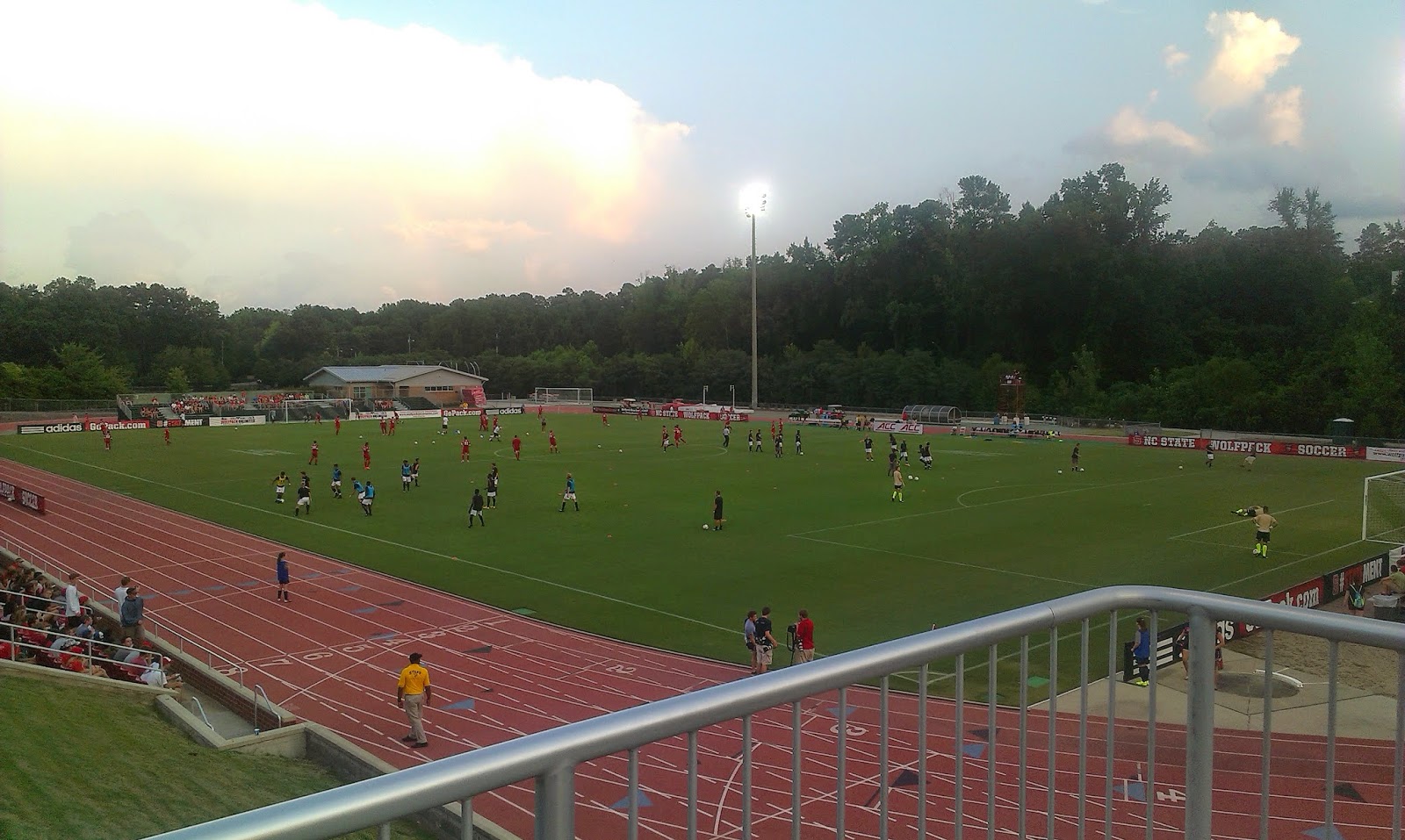
Dail Soccer Stadium


NC State 2 v 0 Campbell Match Report

Wednesday was all about getting to the game. This was a preseason match between two colleges, right in the heart of the university. The college is lovely, clean, easy to get around, and with incredible facilities. The stadium was just the other side of the trees from their training ground, so it is of great convenient for the players, being right in the heart of campus. The game was advertised as a seven o'clock start, but that was when the gates opened. I got to the ground a while before seven, and there was already a large queue outside, which became bigger as time progressed. I was relatively close to the front, though realised I only had six dollars on me. Tickets had been advertised at ten. I asked a couple guys if they knew if card would be accepted, but they thought not. I enquired for the whereabouts of an ATM, and they pointed me up campus. On the way, I asked a few more people, and eventually found it. Out comes the money, and it is time to get back to the game. Now I found myself in the line about two hundred yards further away than where I was before. When I went in, low and behold, due to being only a friendly, admission was free. Sweet.

Searching for a seat, I ran into another familiar face. This was a coursemate who was there with her husband, to watch her son, a freshman looking to get into the first eleven. Upon telling her that I had been to see the women train yesterday, she told me she had coached Abby Wambach when she was younger. What a fascinating network of people I am beginning to get to know. The attendance was recorded at 1,630, though it felt like a lot more. It was mainly made up of students, dressed in red, with the ones behind the goals waving flags and telling the keeper he sucks. A few of the players on display were in the U20 national pool, which gives an idea of the standard on show.

Around the seventy minute mark, a few people began making their way to the exits. Apparently today was the first day of class, but then as I saw later, there were a lot of students out who had no intention of getting and early night. I was sat with my coursemate and her husband, and the mother and brother of another player. They seemed to have a much better idea of what they were talking about than most American crowds that I have been a part of. I mentioned to them like I felt that I was through the looking glass. I think it was taken as a compliment.

There wasn't much penetration from both teams, and NC State did not push many men forward when attacking. I was told that this was due to them working a lot defensively recently and them wishing to solidify the back line. It appears to have worked with a 1-0 and 2-0 in their first two preseason games. Campbell didn't send many men forward when they had the opportunity, appearing a little timid going forward. Their support off the ball was underwhelming. They had a shot cleared off the line in the second half, but apart from that, they hardly threatened. A lot of people were telling me much about the transformation that NC State have been trying to make, saying that they have a lot of faith in the coach, but that there is a lot of pressure on him.

The game had an announcer who I remarked was clearly not being paid to sound excited. You can follow the game through live updates on Twitter. This is actually all a big deal. I'm very impressed at how much time and effort has gone into all this. The whole system is very different to back home. These players would be playing in professional academies, youth teams, and reserve teams. Instead, the American system doesn't work like that. It is changing as the MLS is insisting its teams all have academies. This is likely to reduce the number and quality of college players, but could also make a career seem more feasible to young American athletes. Basketball and football are the huge money drawers, although baseball and hockey still make you a young millionaire.

It seems odd to find this amount of soccer in the United States, but then the players do have to come from somewhere. Brad Friedel and Clint Dempsey didn't just become good the moment they got on a plane to Europe. They would have had coaches, leagues, teams, and represented their college. Brad Friedel went to UCLA and that provided a wonderful insight into the US college and Olympic systems, as well as the impact of the World Cup on a country that didn't even have a professional league. There's definitely progress being made, and huge amounts of potential. With the room there is to expand, the US is clearly going to become a big player in the world game over the next couple of decades.

Following the game, I went looking for somewhere to eat. I was dropped off on a strip nearby that had bars and restaurants on it. It was there that I found an Irish bar called McDaids. It was showing some games and offered fish and chips, so was a great place to start. The music was incredibly loud, making it very difficult for the other eight people in there to converse with each other. Looking to see what else is going on after having my food, I went for a walk. The most packed event was a place called Alley. It wasn't until my second pass that I realised this was a bowling alley and a bar. It was as if every student in Raleigh decided to make an appearance. The line was huge, which was surprising. Apparently bowling is the place to be. Walking back down the road I saw another huge line, though this time was to get into the very same Irish bar I had walked out of ten minutes ago. It was now rammed inside. I joined the line to see what was so different, but it took about twenty minutes to get in. There was a lot of cutting and queue jumping going on. While inside, I waited fifteen minutes for a drink and decided that life was too short. I left, walked down the street, and found a cookie shop that was open until three in the morning. A cookie and chocolate milk, enjoying the warm night, that was enough to keep me happy. Not knowing better, you would assume that all the guys in the bar were called either Dude or Bro. There were a few Mans too. It was all about high fives, back slapping, and comparing summers. It felt like I had been dropped right into the middle of a scene from American Pie. At any second I was expecting Stifler to arrive and start handing out insults. The girls were dressed in a way that advertises their features. All their features. It would take the shorts of fifteen girls accumulated to cover the length of my jeans. I could smell the STDs in the air, as well as the desperation and the quest for bro points.


Highlights of the 4-1 win for the US over Switzerland.


Thursday 21st August 2014

Today consisted of Comedy Central, research, session planning, then an evening out. The night before it was suggested that I try a jazz club. I went to the area of the bar on the search for this club, starting off in an Irish bar, eating chicken and chips with honey mustard dip. Holy hamburgers. I'd never had this stuff before today, but damn, it was good. Next was a jazz club, which actually was undergound, called C Grace. For about twenty minutes I felt incredibly cultured and very intellectual. There were some people in there using the dim light and low attendance to get their grope on, but as I sipped on Raleigh's finest Coca Cola, I enjoyed the virtuoso performances of these four guys. Most people would have been annoyed after realising that there was no vocalist, but I just enjoyed listening to real music for a change. Following that, I went in search of frozen yoghurt, but came across a second Irish bar. Not intending to be out past twelve, there was a band playing who went until two. They were alright, called "The Restless", I believe. They did some interesting versions of songs, including a fast version of Steve Miller's "The Joker", and Wonderwall, mixed with another song as the chorus. Why the Hell not? I'm twenty five. I do what I want.


Friday 22nd of August 2014

Casey Brown delivering a typical NSCAA defending session

And so began the first day of the second weekend. I feel a lot better compared to this time last week, a sentiment echoed by my peers. We went straight into the coaching, having a few example sessions from the instructors. A point they try to emphasise to us is that of simplicity. Don't try to put too much bollocks into your sessions. There is no better teacher than the game itself, so try to make your sessions as true to the real thing as possible. Obviously you can put in rules and conditions to force the learning outcomes, but they don't need to be complicated or unrealistic. Just a simple 3v3 can bring out so many of the basic principles of the game. This knowledge can then be taken into and applied to the larger field. What I really enjoyed, as a player and a coach, was a 3v3, with both teams defending three goals. The area was probably thirty yards wide and only twenty from goal line to goal line. We initially worked with one assessor on the defensive side, looking at pressure, cover, balance. The first defender applies the immediate pressure, and thus will delay or tackle. The second defender applies cover, allowing the first attacker to now shape up and make play predictable. The third defender comes into line and give balance to the defence. It is in those moments of disorganisation and confusion that mistakes are made, space exploited, and goals scored. Although I have worked on all of this stuff before many times, and got very successful results from it, I feel even from the terminology alone that it will make my journey time a lot quicker, reaching the destination of a more effective defensive unit much quicker.

Throughout the course they have used a lot of rest periods, which they advocate is it means you can work on the group together as a whole, keeping your eye on the whole team. This is especially useful for the younger ones as they don't act like clowns while your back is turned. Secondly, it helps keep the game at a high intensity. A thirty second rest, a reward for winning the game, it keeps it all fresh, interesting, and provides an incentive to play well and try hard. Unless playing with a team at a high standard, full of motivated players who are being paid and competing for positions, playing a 3v3 against the same opponents, with no breaks, for five minutes, without constant supervision from the coach, it is easy to see how attention can be lost sometimes. After the defending topic, the other assessor used the exact same setup to enact an attacking topic. That just shows how it can all work. It's essentially the same thing, but you're now working on the opposite points. Instead of creating balance within your defence, you're attempting to create unbalance within their defence. So really, why would it need to be any different? Three goals provides width, but also means that pressuring defenders have to be aware of penetrating passes, much like a line of three in the midfield having to be aware of any penetrating passes through, or defenders trying to cut out any balls in behind.

The rest of the day was about preparing ourselves for the 6v6 assessment. I haven't prepared too much for that as I like to know what I'm up against before I devise a cunning plan, so I was waiting to see what exactly we had to do in terms of setup and coaching. I may have had four days off, but it isn't until Sunday, and now that I've seen it and can picture it in my head, I'm not afraid of it at all. They want three coaching points, and we have twelve minutes to do it. Essentially it is just a game. No rules or restrictions, just a game. All you have to worry about is finding coaching points, and correcting the plays through your interventions and recreations. "Freeze! You go back to where you were when you played that pass. I'd like you to make this run just as he plays that, to receive the ball in there. Watch how I do it". Simple, right?

Assessment criteria.

Whilst you are coaching your topic on your six players, there is another coach coaching his six players on his topic. Can you see how that may create problems? All the topics match up. If you have an attacking topic, they will have a defending one. I expect a lot of coaches to shout freeze just as their opponents are about to score, and then show their team how to defend against the play they are facing right there in the moment. We can also demonstrate what they call "coaching on the fly". That incorporates many different techniques, like instructing while the ball is in play, pulling a player aside, having a quick word while the ball is out, and much more that does not affect the flow of the game. That is not really what they are looking for though. You can do that, but your marks come from your interventions.

The evening discussion was on the topic of ethics. We were broken into small groups and had to discuss two situations. The first one involved an beating in the final from an unpleasant team, where the players and coaches act obnoxiously. What would you have done? Would you ever condone these actions? How would you deal with your players if they did this? We got a good laugh out of a hypothetical defender named 'Chopper' who committed a terrible foul and took a red card, just to keep a clean sheet when his team were already four or five up with not long left in the cup final. The second example was about a game that decided which female team went to the playoffs, and again, one of them was acting unsportingly, making deliberate fouls, and deliberately blocking free kicks and encroaching the ten yards.

So is it our duty as coaches to teach fair play and ethics to the players? Should we be playing to win or to develop? How can we create an environment where this does not happen? It then became a course wide discussion about what is acceptable in terms of bending the rules. I was very clear that none of it is okay. Claiming balls that aren't yours, pressuring the ref, collapsing under contact, blocking a free kick from being taken quickly etc. I won't have any of that. My teams win because of their ability to play the game, not how to con the ref or get in the heads of their opponents. If you don't play with honesty or integrity then you are devaluing the spirit of the game. If we have to cheat to win, then we are not truly deserving winners. One guy made a great point in that as coaches, we have to help our players solve problems. Can they come up with solutions that are within the rules of the game? Thinking for themselves is what makes them better and more intelligent players. If they're having to cut corners and see if they can get away with things while the referee is not looking, that's not solving problems and becoming better players. It's our responsibility to do that do them, and if we don't, then we are cheating their development. Not everyone was as strong towards the fairside as I am, though there were a few in the honest bunch who gave me nods of approval. Most coaches said they don't encourage cheating, but will tell a player to go down if they are fouled, and to stand on the ball to block quick free kicks. To me, that is cheating. And it is a slippery slope. If that is okay, then why is the other stuff not okay? Who makes these rules?

I shared with them a story about the girls in Mexico. Some of the cheating I have seen down there, and in Kuwait too, almost redefines the word. Compared to what some coaches do in Mexico in regards to cheating, I think what I have seen before can only be called gamesmanship. Mexicans aren't world renowned in much, but I believe the average youth coach would have a great chance of winning gold in the cheating event at the Olympics. I told them that in my first game with the girls, I saw a player on the other team try to get away with attempting to punch the ball past our keeper. A sly attempt, but the ref spotted it. Rather than cautioning or having a stern word with the player, the ref acted as if it was normal. I have since learnt that that incident is nothing really. At half time, before I gave any feedback or made any alterations, I changed my tone of voice to serious, and told them that if I ever see anyone do anything like that, they will be coming off, and they will not play again. Even if we had eleven, I'd rather go down to ten than play with a cheat. The message appeared to hit home well. So well in fact that quite a while down the line, we'd had none of this sort of thing. They are a really good bunch and I am proud of them, something I probably don't tell them enough. Then in a game that had been raining quite a bit, against one of the many teams that likes to shoot from kick off, we were beating this team by about seven goals. Now their seventh kick off, and thus their seventh shot from the halfway line. The ball bounced about five yards or so in front of the CB, but the ball skidded as it bounced, due to the surface water. This changed the trajectory of the ball, and put it right in her face. Purely out of reaction and nothing else, she put her hands up to block the ball from hitting her. This was on the edge of the box, thus giving a free kick away. She apologised profusely, as if she thought that I believed it was on purpose. I know this player very well, and anyone could see it was a complete accident. I like this kind of honesty in my team, though it was quite funny.

I think this kind of stuff makes coaches think about the game in more detail, refining their philosophy, focusing deeper on their role, and considering situations they may not have thought too much about before. It's good to open discussion as you may learn new perspectives. For instance, I learned that in Tampa, you get three field refs, no linesman, and they all have whistles and an equal say on decision making. This completely changes the game, and brings up a whole new bunch of problems. There's also a rule that the distance at free kicks doesn't have to be ten yards unless you specifically ask for it. Why complicate rules? This is another issue, but seriously, to quote the Great Russell; "Keep it simple". Now you understand what other coaches are going through, and can also share your ideas and opinions, and then have them analysed by your peers. Does it hold water? Does it make sense? Do you have to think again because your idea is actually stupid or ill informed?

Now I need to plan for my sessions and get to bed.


Saturday 23rd of August 2014

Following how intense last Saturday was, we were not looking forward to today. Someone up there did us a favour, and we got away two hours early, not exhausted. Some of the guys who work at the club had arranged for kids from the teams to come in and help us out. For some sessions we were able to use solely kids, and for some, only a few. But this meant the onus was not on us all the time to play in the sessions. it also gave us a greater likelihood of encountering coaching points as kids provide more of them. It clearly made some coaches feel more comfortable because they were no longer instructing their peers, but kids, much like they are used to.

We started the day with a goalkeeping session. Goalkeepers from CASL were brought in, and were lead by an American Jason Statham lookalike. Just like last Saturday, I fell asleep again. This time I had sunglasses on and thought that not many people had noticed, but later in the day, someone who was sat nowhere near me asked about it. Woops. Pretty much all the basic topics of goalkeeping were touched upon, but not in great detail. I believe it was done that way to show everyone just how much there is involved in goalkeeping, and how we can break down the techniques. None of it was particularly advanced, and it didn't demonstrate how to establish and create a goalkeeping session, much like the main body of the course. What it did do was give an insight into the technical side of it. Of course, for an experienced goalkeeper coach like me, it was nothing new. That's why I could afford to doze off.

Following the keeping, we were shown an example session of system development. It involved pattern play, and then how to relate that into a formation. The pattern was a little complicated to begin with, as I feel that the players were being asked too much to think about right away. The direction of passing is easy enough to get, but at the same time, they were given a way of checking to double back and then come to receive the ball. Normally, I would show where the passing goes, let them have a few runs through, then demonstrate the types of movements to receive once they knew where the passes were going. Taking this into the game situation, the passing patterns and positioning then actually came out in the match. It shows that a bit of thought and some rehearsing the movements can really benefit you in a game.

So now, time for the second assessments. Who is first? Me. Teach the first defender when to delay and when to tackle. I was able to incorporate a few U12 boys in there, meaning that I was going to get some more opportunities to identify mistakes. The assessor is looking to see about two or three decent coaching points, then move you on when they feel you have shown you are good enough. My session was 3v3 outfield players playing to big goals with keepers. Simple. They advocate not putting too many rules in there, and keeping the game as true to the real thing as possible. Today we'd be showing our third exercise, then going into a 6v6 game. I let them play for a couple of minutes as it was the first one of the day, then I went into coach mode. Bang. Coaching point. Bang. Coaching point. Bang. Coaching point. With the topic being defending, I felt I was able to identify points far quicker, and with it being kids,the game is slower than with adults. Far more comfortable. That must have been six minutes. We then go into a 6v6, our guys versus the guys in the other group (all coaches are in one of two groups, being assessed by their respective assessors at the same time). In this game, I was quick to get two points out, though one of them was only a little relevent to my topic. The assessor told me "in a game, that's a very good coaching point, but it's not quite what you are trying to teach here". After the second one, he was happy enough to give me a passing grade, and said that if I could find another and do it well, it would bump my grade up even higher. I was looking for an obvious one, as I didn't want to manufacture a point and perhaps lose my strong position. Nothing else really happened that I was able to intervene on, but I still got a very high pass, and a lot better grade than last week. Remember that at the same time, we are playing our team against the team of a coach from the other group. You can intervene at any time and stop the game to make your point, regardless of whether the opponents will score or not. If the other coach does that to you, tough tits. They tell us to not care at all about your opposite number, and just focus on doing your job right.

Lunchtime came, and it was subs. I wanted pizza, which actually works out cheaper. As a group, we crowded round the TV and began watching Everton v Arsenal. Before the game, the Ted Lasso commercial, the one with Jason Sudekis, came on the TV. I turned to the other guys and told them that Ted Lasso is exactly how we see Americans in soccer in the UK. One guy admitted that he is exactly like the large majority of them. I feel privileged to see so many people who are knowledgeable and passionate about football.

Below is the second Ted Lasso commercial.

Being the first coach to go, I had little to do and nothing to worry about until much later in the evening. This meant I could have a bit of fun in the games. In one exercise, I decided to play upfront. As is common on these courses, I manage one stunning goal. "Every squirrel eventually finds a nut" the assessor told me following my twenty yard screamer into the top corner. The very next play, I turned, caught the ball on the bounce, and bent it onto the crossbar. This impressed my peers, as until that moment, all they had seen of me was a top speed of 3mp and the touch of a rapist. "That was like a cannon, man" remarked one coursemate. Right at the very end of the playing day, I was striker again. They had been putting me in attacking positions from then on, though the shots had been dreadful. I'd been apologising a lot. Finally, I was laid a square pass from my left about sixteen yards from goal. I took this first time from the centre of the box using the inside of the foot. As I shaped up, I could see my teammates about to have a go at me, but they bit their tongues as the ball flew into the top left corner, hitting the bar on the way in, and bouncing behind the line.

A short trip to Wendy's for dinner with the guys brought me a jacket potato with bacon and cheese, plus a chocolate frosty. That thing was so thick I had to wait twenty minutes to be able to drink it. What was next was our match analysis question and answer session. In groups of three or four, we had to explain to the assessor what we saw in the game, what we would do in our session with the player, and then to explain our decisions in a tactical situation given to us on the spot by the assessor. That was a lot of fun, and quite a useful and interesting thing to do. It gives the instructors a great chance to see who actually knows what they are talking about, and who can just talk rubbish. My tactical situation was a 1-1 cup game with only ten minutes to go. My team is playing a 4-5-1 and the opposing goalkeeper has distributed to the left back in a position on the corner of the box. How do I get my team to press? To me, that is quite vague, and leaves a lot of important information out of the equation. I asked how good the teams were in relation to each other, to which I was told we were of equal ability. How about my philosophy? Am I going for a draw? Penalties? Do I want to win the game before extra time? I was told to win the game in the remaining time. When answering my question, I threw a few bits of information in there, such as were going to press high, with the CF doing a lot of running to close down the ball and cut off any passes to the infield, reducing their chances of switching play. I knew that he could do that as I made a change around the 70th minute, meaning I know he has a lot of energy left and can press like that, no problem. Secondly, my right winger is going to attempt to block the forward pass. Either the LB will boot the ball forward, to which I know we can deal with because of our aerial dominance in defence, or the ball goes out for a throw, and as I signed Rory Delap recently on a free, I fancy our chances from restarts. The other players I was able to put in balanced and covering positions similar to what I do with my teams anyway, as we play a 4-2-3-1, which slots into a 4-5-1 when defending. This made it quite a comfortable question for me to answer. But all that bollocks about Delap and the rest, that was made up on the spot. I feel it helped demonstrate my points, but also justified them.

The night finished with a wonderful conversation in the lift of the hotel. A woman with a hat that said FBI Jesus (Firmly believe in Jesus) heard my accent and asked where I was from. She has relatives in England with the last name Abbey. I informed her that I live in Mexico, and a big smile came up on her face as she informed me she was going to say a prayer for me. I thanked her sincerely, and eye contact was broken as she left the lift.

Coach the first defender when to delay and when to tackle Pt. 1.

Coach the first defender when to delay and when to tackle Pt. 2.


Sunday 14th of August 2014

Got more taxi cards than I ever
had Pokémon cards.
And so we began the final day. The morning began not as hot as the others. We started the day with a big team photograph, and then the jokes started about how short my shorts were. I do it for the fans. As well as an asset to the defence, I'm also eye candy. At ten we were due to gain lots of kids who were to play in the sessions, but before then, we had to do a lot of them ourselves. It was Group A versus Group B, and although it wasn't a real competition, we kicked ass. The first three games, us guys in Group B, the blue team, played some serious kick ass samba style soccer. The games lasted for about fifteen minutes, and the play was so silky that we were banging in goals left and right, playing together like we had been practicing for an entire season. It even became funny. Sadly, we were so good that it became difficult for our coach to make interventions as we were not making mistakes. Quietly, the word got out, and we began to engineer points for him to address. One coach told me to shoot from forty five yards next time that I got the ball. I thought he wanted me to do something stupid so he could come in and coach the decision making. Turns out he was just egging me on and wanted me to look like a an idiot. "I just wanted to see your magic". These Americans are getting much better. I am proud of their progress.

After a couple of hours, our quality was dropping. Then the kids came in. We were able to split into two groups and get things done a little faster. What the assessors want to see is three decent coaching points. Once they see that, session's over and the next coach comes in. There were enough kids to have one session entirely them, and about three or four spare to shove into the other session, playing with us adults. The quality of these boys was very high, being U13s I believe, and they took advantage of our fatigue and desire to not crunch them. One boy nutmegged me on a 50/50 because I noticed he was about the size of my leg, so I went in easy. I wasn't having that. Next time he got the ball, I dispossessed him efficiently, as if to say "Don't try that again you little...". Not long after that, I cut out a pass that was heading towards him. As the ball was going towards my own goal, we raced for it. I got their first, and could see him over my shoulder. He was coming in quite fast and with a wide stance. In ten years time, this kid will be far better than I ever was, but he's not better than me yet. With the information being processed, I nonchalantly executed a drag back, which went right through his legs. I spun around and went past him retrieving the ball with the boy not quite sure what had just happened to him. I passed the ball to a teammate and proceeded with "I ain't takin' no **** from a twelve year old".

The jokes, the laughter, the back and forth, all with jest, was of top quality on this last day. Knowing the end was in sight, that we would be going home early, and that we probably won't see each other again, spirits were high. Some of the games required spare coaches to act as linesmen, thus making the movements within the session more realistic because they could be caught offside. There were some questionable calls against my team, though most of them were obvious. This meant that some of our boys were through on goal and were being flagged. I started giving it a little to the coach acting as linesman, and he made fun of my shorts. This happened a few more times, and I accused him of ruining these kids dreams, I think labelling him a dream killer. He said life is tough and that they have to learn how to deal with disappointment. I asked him if he would like a bowl of cornflakes so he could urinate into them, as I held an imaginary bowl and thrusted my pelvis at it.

In the environment, some of the coaches struggled with their topic. Nerves can do that, especially as it is an unnatural environment. You may feel you are being judged by your peers, but regardless of your ability or experience, as long as you are friendly and try your best, no one should really have a problem with you. We all want to learn, and being in such an environment creates that. Instead of thinking negative thoughts about how bad you look, if that was the right point to make, if the assessor would have made that point and in that way, get rid of all the noise and just coach. It's easier said than done, and many people were telling me how calm I looked. Everyone on the course knew their stuff, but not everyone showed it. Sometimes you would see a coach wait a long time to make a point, make a point that is irrelevant to their topic, correct a play that actually had a positive outcome, or even to recreate the situation completely wrong from how it actually happened.

Neil Diamond with a fairly well known tune.

As the day went on and we approached my turn, I took some time to sit in the shade, stop sweating from the playing, and focus on my coaching points. I had to work with the first, second, and third attacker in tactical decisions in attacking when numbers up. Essentially I'm looking at movement and combinations that will create and exploit overloads, either 3v2 or 2v1 situations. I think I'm much better with defending topics as I can identify those points and situations much quicker, but at least in this attacking topic, it's not a specific move that I had to work on, and thus had lots of room within to manoeuvre. Some topics were specifically wall passes, overlaps, third man runs etc. Mine could incorporate all of them, giving me plenty more moments to coach.

Before the session began, the lead instructor came over to me and told me to tell the boys that I am English and work for a team in Mexico. She said it would be great for them to hear that. Possibly it does something for the reputation of the NSCAA, but really, where I am working is nowhere near as great as what they have at CASL. Still, they don't know that, and their parents don't know that. A lot like when I used to go out with girls whose parents were impressed I went to private school. They have no idea that it was a bad school and that I achieved a consistent stream of bad grades. The idea was impressive, yet they knew nothing about the truth. Ignorance is bliss.

My session began. I told them who I was and where I worked, to which, most surprisingly, one of the kids said "this is the one from Mexico City I was telling you about". I tried my best to not break stride, but I believe my face looked like this for a moment:

Wtf?
Once I got the greenlight, it was pretty much over. I went in and made my three coaching points. Bang, bang, bang, finished. The assessor said he wanted to mark me down because of my shorts. I had a very positive feeling about it, and got good feedback from my peers. We weren't allowed to know anything about it, and won't know our grade for about two weeks. Throughout most of my life, not being the academic king that I claim to be, I've always been happy with a pass. Now, as I am older and want to excel in the field, especially as I work in a field that is all about excelling in developing players, I want to do better. The qualification will be great, but there will be disappointment if I don't get a high grade. I know it is within my reach, and therefore it is entirely down to me to achieve it.

I took on the feedback from the previous sessions, believing that I talked louder. Last week was loud, yesterday was quiet, and today I think was closer to loud again. I also tried to shut up quicker. On these courses we have a propensity to talk bollocks, rather than getting in, making the point and getting out again. You go there, do this, like that, play. That's how it should be. We need to do a demonstration, a rehearsal, then play live. I think I nailed those. I think my three points were on topic. The only thing I can think of that may drag me down is that I was supposed to be coaching in overload situations. Maybe not all three were in overloads, but they certainly demonstrated how to create an overload through combinations and movement. I wish I had the chance to video myself coaching and watch it back. They highly recommend that. And then, literally within five minutes, the assessor called it. Third coaching point and he said "that's enough". Usually that's a good sign. Something a few of us noticed from some of the weaker displays from coaches was that their restarts were not true to the game. They weren't playing corners, throws were taken with the feet, and goals did not result in a kick off. This created a lot of unnatural situations, and had players out of position or not focussed. If your defence gets caught out from a quick throw, that has a coaching point right there because someone wasn't doing their job properly. If someone collects the ball from the side and plays it with their feet, the game is slowed down significantly, and it takes two or three passes to see something realistic. I was very clear with my group that all restarts are exactly like they would be in the game. I definitely felt very good at the conclusion of the assessment.

And then came the goodbyes. As we do a lot in England, there's a lot of email address swapping to be able to build and extend your network. All my coaching contacts in the US are British, so keeping in contact with this bunch of Yankee Doodles will help broaden my horizons. There was a lot of "and if you hear of any openings.." nudge, nudge, nudge. You never know. The United States is definitely where it is all happening right now. The investment, the facilities, the determination to be the best, these are all huge draws for coaches. On top of that is the lifestyle. North Carolina is a beautiful place, and I know I could take a job here no problem if one was offered. I have said before that the Middle East will be the next place for a large influx of British coaches, what with the money, the ever improving living conditions (some even becoming close to paradise), them buying old Europeans for a lot of money, and then the World Cup in Qatar in 2022, which will be celebrated by the whole region. You've got to be careful when shagging the locals, and there isn't as much space. Plus bacon is hard to find. I think these are the factors that will hold it back when compared to the United States. It will be a long time until the US becomes self sufficient in terms of football. As much as they improve, they will still be depending on foreign imports for a very long time. Even we do it back home, and we invented the game. Just think that no English managers have won the Premier League, and that we've had foreigners in charge of our national team.

Coaching the first, second, and third attackers in tactical decisions of
attacking when numbers up Pt. 1.

Coaching the first, second, and third attackers in tactical decisions of
attacking when numbers up Pt. 2.


Monday 25th of August 2014

Here I am, waiting in Raleigh Durham Airport, not long from my boarding time to Houston. I've got a quick hour there before heading back to Mexico. The day was not a great start. I planned on having Chef Boyardee's finest ravioli, but there was no tag on the tin. Damn. That meant having tacos instead. I have since had chocolate ice cream. A good breakfast always has a dessert. Before going through security, I encountered a course mate, and a really good guy. He is on his way back to Miami. After progressing through, I noticed I had stepped on a gold necklace which was outside a restaurant. I went in and handed it in over the bar. Two minutes later, via the PA system, they announced a piece of jewellery had been found, and gave instructions on where to go to claim it. That's lovely. I really like the friendliness and caring attitude I have found amongst people here. Not once have I felt threatened or unsafe. North Carolina is lovely. It was a real pleasure being here.

Darius Rucker performing Wagon Wheel.


Conclusion

Going into the real American soccer, and not the polished slick marketing of the major camp companies, I have seen genuinely good coaches in a country that has so much potential, both nationally and on the global scale. The college system has very much impressed me, and it is even more something that I wish to get involved in. It will be difficult from a visa point of view, but if I work hard, I can achieve anything. The knowledge and the passion demonstrated by my peers gives me great hope for what is already very clear, in that the United States is an emerging power in world football.

The work that the NSCAA does is wonderful. They have pitched so many coaching resources to the American public, and I believe they are doing this in the right way. A lot of it is attainable, and what they offer is far more relevant and easy to find than what we have back home offered by the FA. The USSF also does not have much in the way of resources, but then as the the FA and USSF are governing bodies of the sport as a whole, coaching is just one of many strings in their bow. They are responsible for everything in regards to the sport, whereas the NSCAA can focus solely on the development of coaches. The FA has the Coaches Club, but that is still associated with them, and although I believe they value the improvement of coaches, it is not their number one priority.

The NSCAA has recognised the needs of the United States, and then come up with so much appropriate content, and so many applicable learning resources and opportunities, that it is easy to find something suitable for you and your level. Whether you are the coach of a Division One college team, or a parent helping out on a rec team, the NSCAA has something for you. They realise that this is not a majority sport in their country, and thus common knowledge of the game is little and is lacking. It´s not like back home where everyone knows football, and this you can skip a few steps in your understanding the game, because you already know it. In some areas, they really are starting from scratch. Under the same umbrella, as part of the same mission, they also have to educate and improve the coaches at the very top, and so offer the advanced courses, which have some very detailed content on there.

It is the demands of the nation that determines how they operate. Some courses are two weekends, some are a full week. This is to cater to different types of people that are in different situations. I personally would have preferred a week long course as it may have given us more time, and would not have the added stress from people making huge journeys on the eve of the course.

What I liked about the course:
- Match analysis. Having coaches look at the game, recognise the strengths and weaknesses of a player, then devise a session to aid the development of that player in those areas. That is essentially what coaching is for. Can we see what we need to work on, then comprise a plan to put into action that will work on that efficiently and effectively?
- Clear framework within which to operate. We do this back home too, but I felt it was far more rigid, and therefore less room for misinterpretation, and less room for error. Stick to what they want you to do, and you will pass. I'm not here just to pass a course and gain a certificate, but also for knowledge and improvement. Though the point of view from the coaches is that not all of them will have learnt how to structure a session properly before, so do it like this. This is an easy and effective way to structure your session.
- The friendliness of my peers. If we're going to be working hard together, and also relying on each other to perform in order to pass, we need to get along. On top of that, it can become quite frustrating and boring, so being able to laugh with each other and make jokes is a massive stress relief. I found them very informative too, as I still have much to learn about the grassroots of American soccer. It was great to compare and share with them. They are all lovely people and I wish them all the greatest success in the future.
- The debates. Something we have done on the FA courses, and it is something that needs to be incorporated more. It is how we learn about other opinions, but also how we can make our own. A lot of people, in whatever profession, they just do. They don't understand the why, and they never look deeper than the day to day stuff. This helps expand the mind and to understand just how much more responsibility there is applied to our line of work. It is not just about dropping cones and making kids kick footballs.

What I would add:
- Coaching theory. Very little was done about the science of coaching. We were just shown a way of doing it, then had to copy it to be assessed. There was nothing about why that works, the other coaching styles, which is most effective in which situation, how to manage players, build confidence, create a cohesive unit, instill discipline, work together when the odds are against you, motivation, feedback, communication, control etc. I felt that not everyone on the course could have discussed these matters, and that some would not even have known that they were a factor in coaching. How does a nine year old learn best? Why should you not shout at a seven year old after making a mistake?
- Practice sessions. A session that is actually a practice, and will not count for our overall grade. I think it was a small grade, and so not too significant, and we also got a lot of feedback from it, but I think the coaches would be better with one go first, no pressure. Jut enjoy it and see what you are up against,
- No practical in the afternoon. When the sun is at its worst, from twelve until four, we should be in the classroom. This is not the time to be making us run or compete. You will not get 100% effort or maximum output between those times as people begin to switch off in the hot sun.

All in all, it was worthwhile, and I will recommend this to others. I didn't learn too much that is new from a coaching point of view, but I am grateful for the refresher. It's given me a few new ideas and dusted the cobwebs off of my brain. I've been coaching without supervision for a while. Although it is great for freedom, there's also no one to tell you that you are an idiot when things go wrong. That stuff keeps your feet on the ground, and helps you to avoid bad habits. It was even better that I was able to visit and explore a new place, and learn about a new part of America.

Tuesday, 3 June 2014

Complicating The System: Why Mexico Has Not Won A World Cup

This piece will discuss the issues within youth football in Mexico, explaining how and why things are complicated, and thus the implications it has on the participation and development of children in Mexico. If we can't develop good players, we'll never see this great country compete on the national stage. All football begins at grassroots, so let's get that right. At no point will I name teams, players, or reveal the identity of anyone I work with or compete against.

The goal of all nations that compete in football is to win the World Cup. Obviously a country like our neighbours in Guatemala can't hold out much hope currently, but a football mad country with a large population like Mexico should be doing much better. The same can be said for China, Russia, and the USA when you think about their population and resources, but football in Mexico is part of everyday life, and permeates the very essence of this country. They love the game. As you will see me discuss, winning cannot be the objective if you are incredibly unlikely to win. Instead, it should be steady improvements, achieving targets, reaching goals, and ticking boxes. That's what youth football is, on the long and winding road to becoming a professional. We need to make absolutely sure that if a player does not make it into a World Cup winning side, that from the day they began their footballing journey as a young child in shorts too big for them, they enjoyed it and learnt a lot about life and about themselves. Little by little, the pieces come together.

My experience of Club America v Cruz Azul.


Winning is for adults, and learning and fun is for kids. You will find that a mistake often made is that we judge kids by adult standards, or that we intend for them to adhere to a more mature and advanced way of thinking, but that is not how they are wired. Kids learn in their own way, and experience a different world to grown ups. So let's cater to them, rather than force them to do things they are not yet ready for. Whatever your reason is for playing football, we need to make certain that we use that correctly and appeal to the motivation of the player. If you're not interested in winning, and just wish to have fun with your friends, that's fine. If you want to improve and compete at a higher level, that's fine too.


Playing football in Mexico. It should be a paradise.
This is a long and complicated issue, one which has me losing sleep at night, and losing my hair too. What is sad here is that the situation is self-destructive, being established by a group of well intended but misguided individuals. Two equal teams play two equal halves. Why make it more complicated than that?

A phrase we hear often here in Mexico is "That's Mexico". It's said as a way to justify below average to appalling standards. The people seem to embrace this reluctant acceptance of things which are simply not good enough. Why? Where did it all go wrong?

In my head I have visions of these idiots sat round a table coming up with genius ideas. Here are some examples of league rules that frustrate and bewilder us, each one being more ridiculous than the last:
  • Each team takes two penalties at half time. Apparently a separate competition from the league.
  • Coaches are allowed to coach from within the field.
  • After drawing a league game, the two teams play penalties for extra points. There are only three penalties each, and if the score is level after that, there is no sudden death and the game finishes.
  • The league format sees a certain number of teams progress to playoffs to compete for the title. This is a straight one game knock-out format. What happens if there is a tie? Can you guess? If after regulation time is complete and the scores are level, the team that finished higher in the league progresses.
I do believe that the last rule makes the whole point of a playoff season null and void. Now consider this against the earlier point above how teams must take penalties after a draw in a league game. Do not search for logic in this situation or else your head will explode.

As if life weren't complicated enough, there is no consistency. The referees change the half length every week, in the same age category. The amount of substitutions you can make changes each week. It depends who you get. The league has rules but the referees don't know them. Sometimes it is as if they guess the time as a thirty five minute half often ends around minute twenty eight.

To make matters worse, there is absolutely no communication between the coaches prior to the game. This leads to teams getting lost, teams not having enough players, getting the kick off time wrong, even getting the day wrong, and worst of all; teams cancelling a game and not showing up. Believe it or not but these are very real occurrences that happen frequently and cause much disruption. How can we solve these problems? With an email or telephone call.

I am not convinced by the playoff system to decide a champion. Just look at the Red Bulls in 2013 and even Cruz Azul this year. Both were the best team and top of the table, yet both fell at the first playoff. After the season, the best team is at the top (or the team most deserving). Apply that to kids, and with games being played any day at any time, how fair would it be if you win every game in the league, but on playoff day you lose half your team to a school trip? The American soccer hierarchy is different and has different needs as it is new and not well established. And in other major US leagues they play a series of seven, so the best team usually prevails,

The kids speak.
What happens in the Mexican youth leagues is by the league end date, some teams may have played ten games, whereas others will have played six. Naturally down here, if you are not going to win the title, what is the point in showing up? Your opponent has two games remaining and can still win the league, but they will probably beat you, and that will make you look like a bad coach. The most important thing to coaches here is reputation.

If you are in an eight team league, expect to play ten games, playing three teams twice, and four teams once. There is no rhyme or reason as to who you play twice. One of the biggest problems here is teams just not appearing for their scheduled games. What happens to the teams who don't show up? They lose the game. That is it. So if you are likely to lose, run away and hide. Don't inform the other coach. Let his team wake up at six on Saturday morning to not play a game. "But that's Mexico". No, that is the act of a coward and an idiot. Fine the teams. Deduct points from them. Call the coach to rearrange. Or take a massive step forward and say "We only have eight players. How about we give you the points, take a few of your players, and we play a friendly?" That kind of thinking is lightyears ahead and I don't think Mexico is ready for it.

Watching Mexican coaches talk to their players.
The strangest thing I have seen to date was one fine Saturday morning two months back. I turned up with sixteen girls to play 11v11. The field was made for 7v7. The keepers are within shooting distance of each other. The other team only had eight, so we played 11v8. We won the game 9-0. At one point, the coach of the opposition was so angry at the performance of two of his players he pulled them off to shout at them and made them sit down for five minutes to think about what they had done. In that time we scored three goals.

At half time, 5-0 to us, he insisted we play with eight too. No. I had sixteen players. That means half of my team sits down and does nothing. They don't deserve that. I am not punishing them because another coach is an idiot. They are teenagers who got up at six on a Saturday. They deserve to play. This is where the friendly suggestion would make sense. What does anybody gain from a 9-0 match? What does anybody learn? It's too easy for us and a pointless endeavour for them.

Since being here I have been playing somewhat regularly with some friends in an indoor league. I'm not sure if it is six or seven-a-side as that appears to differ each week. The rules are dumbfounding. It is virtually no contact, thus encouraging players to go down like a ton of bricks. A yellow card warrants a two minute sin bin for the offender, but the team remains at full strength as a replacement comes on. If one player makes four fouls in a game, they cannot finish the match. If a team makes seven fouls, the opponents receive a penalty kick, although it is actually a 1v1 with the keeper, with defenders able to chase back as soon as the whistle is blown. Don't worry, the taker gets a head start of two metres.

The indoor field is divided into thirds, split by two horizontal red lines. Most free kicks don't take place where the offence occurred, but on the nearest red line. Play is continuous as the pitch is surrounded by boards, but if the ball hits the net above the board, it is a free-kick. The goal is built into the wall and is a square shape. The wall surrounding the goal is about three metres high, though less than one metre at the sides of the field. Shots above the bar that hit the wall are still in play. And finally, there is no overhead height rule, but you cannot pass directly from the back third to the front third, with the ball having to go through a teammate in the middle when transitioning from attack to defence. The worst thing is that everyone looks at you like an idiot when you don't know why you conceded a free-kick.

Does that not just serve to complicate and confuse? How can you enjoy the game when you have no idea what is going on? Creativity is stifled and players just look for ways to bend the millions of rules.

Those of us with careers in the game, and those who are well versed in the business side of things must remember that football is a game played for fun. Many people have forgotten that and lose sight of the reason why we all do our jobs. It is for the kids (everyone at the Tyro League's favourite phrase). In another piece I wrote, I kept mentioning the phrase "Time spent not playing football". The bane of our existence and a source of great ball pain is player cards. We have to present these before games to prove the player is registered. The information we need takes ages to acquire, then it takes even longer to receive the cards from the league. It is easier to get into the country than it is to register your kid to play football. These player cards also present dangerous and uncomfortable situations. As coaches, we receive photographs, birth certificates, school details, and something akin to a National Insurance Number, or Social Security Number. We don't need this information, and shouldn't have it. It is potentially harmful. The leagues request all this information, and as the coaches, we are the middle-man that provides it to the league. This gives us a large database of photographs and sensitive details. We should not have this stuff, and other countries wouldn't allow it. It needs to be made simpler. To top it off, there's no CRB checks or safeguarding children registrations. There needs to be.

A lot of parents here are lazy, or just believe "That's Mexico" so are never in a hurry to respond. Some are very good and are very quick to help, but others have no concept of deadlines. Due to this, their kid often misses the cut-off for registration and therefore can't play football. Mexico is losing footballers simply through laziness.

It's hard to do our job when we have to fight against a culture and deep set attitudes. Getting kids to wear kit is a seemingly impossible task. Football boots? "Well I didn't realise". Shinpads? "They're ugly". Training shirt? "I didn't realise we had to wear it". We have spent four months repeating ourselves. How can you not want to wear a training kit? You get to look and feel like a professional team. The kids here do not like wearing long football socks, and opt for white ankle socks instead.

Lateness is an epidemic across all age groups. No one is ever in a hurry and they rarely apologise and give no warning. The first ten minutes of any girls session is spent with them all hugging and kissing each other. Once the session begins, if the session is too difficult or complicated, a lot of players don't try and just mess around. Rather than trying their hardest or leaving their comfort zone, they create problems for themselves and their teammates. It is a self-destructive attitude that is part of a blame culture that accepts no responsibility for their own actions.

I don't know what it is, but here you will witness a complete disregard for the effect of one's actions on those around them and others in the greater society. This is clearly reflected in the scheduling of games, which cares so little for families. Games are scheduled with other coaches much in a way that is reminiscent of perhaps the stock exchange, or even a cattle market. The coaches or coordinators are all packed together in a room, glance down at their fixture list, then proceed to call out for the coaches of the opponents that are written on their fixture list. That kind of thing would be absolutely obscene in England.

Brendan Rogers: "Manchester City? Manchester City!"
Manuel Pellegrini: "Hello? This is Manchester City".
Brendan Rogers: "It's Liverpool. We are down to play you in this round of fixtures with our U14s. Can you play Saturday?"
Jose Mourinho: "Manchester City, we need to play you with our U12 girls this weekend. We can't play Saturday or Sunday".
Manuel Pellegrini: "There's no way we can play Friday evening. Most of our players are at a school event".
Brendan Rogers: "Hey, I'm trying to arrange a game with them. Give us a minute".
Jose Mourinho: "We need to play Liverpool U18s. Do you have a field available Sunday at ten?"
Brendan Rogers: "No. What about your field?"
Jose Mourinho: "We don't have a field. We play all of our games away".

As I have been saying for my entire time here; everything can be solved by organisation, initiative, and communication. Put simply, phone calls and emails. Screw dedicating two or three hours one weekday evening, plan in advance and communicate.

We were victims of a travelling band
that accompanied our opponents.


So, we witness utter chaos. On top of that, it's difficult to have a commitment to a team as the game times are so random. Players have other commitments, but not just them, the parents have other kids, as well as their own lives to lead. The fixtures are set out in advance as to who each team will play in each round of games, but the games themselves are arranged on a Tuesday night. We are then told on a Wednesday, and tell the players and their parents as quick as we can. This becomes a pain in the bum for the organisation of their weekend and their free time. I've been in the car with parents who have two boys, one played Saturday morning at eight, then the other Sunday at eight. They looked dead. You work hard all week and look forward to your weekend, but suddenly receive an email on Wednesday telling you it's early to bed both Friday and Saturday night.

Bring plenty of water.
When you have been doing anything for a while, you begin to believe you have seen everything. Like I mentioned before, the rules still baffle me. You also think you've heard every excuse in the book for players not playing, but if Mexico ever wins anything in regards to football, it will definitely be excuses for not playing. I've left my boots at home. I don't have shinpads. I forgot. It's my birthday. It's raining. I got the time wrong. I have homework. My sister is doing something at school. I came back from vacation yesterday (a four hour drive). My dad can't take me. I have exams. It's cold. Much like in New Jersey, when there is rain, a couple clouds in the sky, or even someone who didn't dry themselves thoroughly after a shower, they don't turn up. Excuses like "I might get sick" and "My mum won't let me" come into play.

We regularly experience dialogue much like this one:
Coach: "Why didn't you come to practice?"
Player: "Because it was raining".
Coach: "So?"
Player: "I thought it would be cancelled".
Coach: "Could you not call or email to ask?"
Player: "Maybe".

You can have excuses or you can have results. You can't have both.

These excuses present a blame culture that shirks from responsibility. What happened to overcoming the odds? Trying your hardest? Not giving up? That's too difficult, and we might lose. I'd rather stay in my comfort zone where it's warm and cosy. If you want to achieve something you've never achieved before, you have to do something you've never done before. Mexico keeps doing the same things over and over again, resenting and resisting change, yet still expecting progress.

A lot of teams here are beaten before they even begin the game. Preparation is dreadful as very few players do a thorough warm up. A lot of them don't even touch a football, and do nothing to raise their heart rate. They show up in dribs and drabs, with the majority of the team arriving within ten minutes of kick off, often not in kit. Fail to prepare, prepare to fail Another factor is the frail mentality. If the other team is better than you, you are likely to lose. Oh no, I don't want to lose. We're going to lose. And there you have it, beaten before a ball has even been kicked. The quality of the opposition is not the only variable that can destroy belief. The size of the field, the time of day, and a whole list of other irrelevent issues pay on a player's mind.

The beautiful ankle breaking playing fields you
can expect to experience while here in Mexico.
Recently I went to meet the coach of the local university team where I am going for Spanish classes. Both the home and away team got changed on the pitch. What shocked me more was that they turned up with their kit in their bag, and weren't given their shirts at the game. So why the bloody Hell aren't they getting changed at home or somewhere else before arriving at the field and having to strip in front of everyone? This may have been a university game, but I have seen more athleticism in English pub leagues. The start was 12:30, but as expected, no one was there. The opposition showed up around 13:10. The warm up for both teams was a couple fat blokes in jeans crossing some balls for the three dressed players to shoot at the keeper. The pitch was mostly grass, though the white lines could not be seen, and no one was missing the corner flags. The goals had still not been wheeled into position by the time I left for work.

Home of the Seahawks and the Sounders
How can this be the standard of a university representative side? How can that be the pitch that they play on? A lot of fields here are multi-purpose, meaning they are full of lines. It reminds me of a lot of the MLS stadiums that ground share with NFL teams. When the Timbers played the Sounders in the play-offs, the Sounders were ridiculed for having many different lines painted all over their fields. That is common place in Mexico. Just last week our keeper used her hands outside the area as she was confused by which line to play to. Now we all know that grass needs water to grow, and that at times Mexico can be very dry. The groundsmen use this as an excuse to well and truly flood the field. Sadly, this has a negative effect on the grass as it ceases to grow, and pitches turn into dirt baths. Can we expect our kids to be safe on such a terrible field? Can we expect them to play good football when they have to navigate a surface akin to that of the moon? Again, not a difficult problem to solve, but one that was self-inflicted and one that is self-destructive.


Estadio Azteca: An iconic stadium that
demonstrates the potential that Mexico has.

How can we expect the young players in this country to grow up aspiring to be good footballers when those that represent the club sides play themselves like children? Common sights in Liga MX are players performing overhead kicks in the middle of the field, and just lumping the ball forward as far as they can without direction or thought. The players are trying as hard as they can, but it is misguided, much like the kids. The thinking of a goalkeeper is the same as that of an eight year old being shouted at by his parents. "I better kick this ball as high and as far as I can" rather than playing a pass to a teammate. When the ball goes high in the air "What's the coolest most impressive skill I can do right now?" rather than controlling it and playing a pass to a teammate. This is what young players see and try to emulate. This is what parents see and demand their children do.

Before coming here I thought that the style of play would be more akin to Spain's pass and move, but Mexican football really is about twenty years behind the developed football world. They can see it when they watch European football on TV. The average Mexican is not stupid and knows that the teams and players are lacking in quality, but nothing is being done about it.

Although I believe kids in the UK are becoming soft, we have nothing to worry about when compared to the kids here. It's still a very British belief that to show pain is a sign of weakness, and that you must be tough and strong, sucking it up and playing on, giving 110% no matter what. Here, with the kids, adults, and professionals, it seems as if everyone in football kit is auditioning for a part of a wounded soldier in a war movie. I know from travelling the world that most foreigners can't hack it as well as us world conquering Brits, but it is a despicable act to feign an injury in order to try and get another person into trouble. It is lying and cheating (completely un-British) and goes against the code and ethics of sport in the first place. The belief must be that no one is going to believe you have been fouled unless you roll around on the floor and become really angry. Again, much like a child that doesn't get what it wants. How can you act like that when thousands of people are watching? We have it in Europe, and it is happening more and more in England, though we do frown upon it. It seems to be encouraged here, and that is not the way to play football.

Referring to the tactics employed by professional teams, Club America play with five in defence. They are one of the strongest teams in the league, and yet they have a flat back five with no attacking full backs. That now leaves just five players to do the attacking, who are all at least forty yards away. Forty yards is about the closest you will ever see a midfield to their own defence. No one tracks back and there is no build up play. For a country that is absolutely crap at heading the ball, why on Earth are they playing long balls? It's because of things like this that we can't easily relate fluid movement and off-ball support to kids as it is largely non-existent here.

Youth coaches do what every idiot coach does, and only picks the best players. The crap kids who make it into the lineup have to play in defence and always pass to the good kids. I lost a game 9-0 with my girls one day. We are by far a better team, but the score doesn't show that. Our opponents only had two or three good players, with the rest of them being technically deficient. It was sad to see. The instructions of the crap girls was to not take more than one touch, booting the ball as hard and as far as they can in whichever direction they are facing. Doing this around one hundred and fifty times in a game will inevitably mean the ball falls to your good players in good positions, allowing them to score. By not taking more than one touch and clearing the ball, without exception, regardless of time or space, will frustrate your opponents, break down their chances, and not allow them to play their way. What is it these crap players are actually learning? They are not being taught technique or tactics, and only the good players are allowed to improve and to flourish.

Before I begin to slate Mexico too much, it must be said that we must first get our own house in order before we put this football revolution into full force. I don't like to criticise colleagues as we are on the same team, fighting the same battle, but I see and hear things that make me cringe. Here are some examples:
  • Kick it out. Just kick it out for their throw-in. - Don't try and learn how to play your way out of trouble. Instead, understand just how crap you are, panic, and relieve possession.
  • Don't do stupid turns. You wouldn't do it in a game, so don't do it in practice. - That's the exact opposite of what practice is. Try things in practice as it is a place to make mistakes and to learn from those mistakes. Don't stifle creativity.
  • I don't want to put this player into a higher team. Even though this player deserves to be in a better team, if they leave, it will leave a massive hole in our team. - These are kids. Think of the player and their development. Don't hold someone back for your own personal gain. If there's going to be a hole, it will be filled by someone else who will develop into a better player.
  • Those three are going to stay defenders for the entire drill because they are my three best defenders. - Why not give someone else a turn so that they can practice their defending? What if the three don't want to stay in defence? Young players should not be forced to play only in one position, and should be learning and allowed to experiment in other roles. Think if a solid defender learns how to take on a player, pass, and shoot. Won't that make them a more complete and versatile player that can benefit the team with many more skills?
This kind of coaching and this kind of thinking is rooted firmly in the mind of a coach that values winning rather than development. They are kids. Winning comes much later in life. These early years are all about learning, discovery, understanding, and fun. Let's not take that away from them. Allow them to be creative, allow them to try. Provide a safe environment for them in which they can experiment with the ball and have fun.

Young players should not be playing in leagues until they are approaching double figures. At that age, absolutely anything can affect performance. Even things like butterflies and aeroplanes can make a player forget a game is going on. With there being leagues, misguided parents begin to feel that winning is important, and therefore see losing as failure. It might be that a coach inherits a team of six year olds that are absolutely terrible. What are their chances of winning? Does that now mean that losing is failure? There's not much that can be done in the short term to greatly increase their chances of winning, so lets look more at goals and targets. What can be done as individuals? Can we string three passes together? Can we get at least four shots on target? Can we avoid losing the ball in front of our goal? All these little hurdles are steps up the ladder towards improvement. Winning is not the only way to measure success, but it's the only way these people can see. Change your parameters and expectations. To me, winning is being a little bit better than you were last week.

Well Will, if you take the competition out of it then the kids will become softies like you were lamenting earlier. No. Not quite. Kids can count, therefore they know who is winning. All kids want to win. They are super competitive, in all aspects of life. Who can eat the most peas? Who can press the button on the traffic light to cross the road? Removing competition just removes the pressure from the situation, allowing them to play freely without being held back by fear the consequences. One example I can give to prove this was a session I conducted the other day. It was more in the way of guided discovery, giving them an idea and letting them figure it out themselves. I had twelve boys of six and seven years old. I split them into four teams of three, playing a four goal game. Each team has to defend their goal and can score into the other three. We finished playing this game with three balls. From a technical point of view, it covered many different topics as so many things were being engaged; goalkeeping, shooting, dribbling, 1v1s, passing, tackling, moves to beat, awareness etc. What was key was that I didn't step in to coach, and only gave encouragement and praise at the appropriate times in the appropriate proportions. The intensity of the session was the highest I have seen with them, as no one was left un-engaged. If we played 6v6 then only the good kids will touch the ball. Twelve players with three balls is a 4:1 ratio, meaning that there is always a ball somewhere. If the two good kids are in a dual, go and get the other one, or the other one. Every player could play at their own pace and not have to worry too much about the others, whether it was too easy or too difficult. Every player scored goals, every player made tackles, every player had fun, and every player can remember many things that they did well in that practice. I didn't keep score, but I know the kids knew how many goals each team had as I could hear them counting as they ran around chasing the balls.


Can the FMF not provide
learning resources to coaches?
It would appear that there is very little support from the FMF when it comes to coaching or grassroots development. Currently I am a member of the coaches associations of England and the US. The English FA has improved their grassroots development so much, and made the knowledge and resources more accessible to all. The NSCAA has been doing this for years, and it is nice of England to have finally caught up. Surely Mexico can even just hand out leaflets that give the most basic advice to youth coaches. I'd start with "You can shout and scream all you want, that won't make them better".

Talking to a lot of Mexican football fans, they are aware of the problems. They know there are many areas in which they lack. It is evident that the coaches play to win, sacrificing development for personal gain, but why is that? Mexican society does not have a welfare state like we do back home. If you are out of a job, the government can't help you, so you must do all you can to keep that job. When everyone views winning as the priority in youth sport, winning is how you keep your job. Aside from those in the professional league, most coaches don't make a lot of money. Hardly enough to live on. Even those in the top leagues aren't on too much. Reputation is so important, and it makes those involved in football become selfish. Due to this need to keep up a reputation and the lack of money to be earned from the game, coaches often take bribes in order to play players. Much like the society in general, as police here earn very little. They will stop you for nothing and will demand money. When the needs of the individual are promoted above the needs of the team, how can we expect the team to achieve success? These people do not have the needs of the team at heart, and therefore the players within that team will not develop and progress.


The best coaches I have worked with can have lengthy discussions over the correct and best practices. They are constantly researching, reading, watching, and analysing in their spare time. Like anything, if you want to be good at it, you need devotion to your subject. It consumes your life. When I can't have these discussions with coaches, when I don't see them analysing, I lose respect for them. Everyone needs time to switch off, and I often have a day where I have nothing to do with football or work in order to refresh my mind, and spend time and attention on loved ones and those dear to me, who may have been neglected recently due to my dedication. There are some journeyman British coaches I have met who just do the job because it is football, it beats working in an office, and they like the aura of telling people they are a football coach. Football doesn't need those people. There is a very high proportion of coaches like that here in Mexico. I've seen it done by my compatriots when abroad; "Hey girls, yeah, I'm a professional British soccer coach". Naturally, they swoon, as I have found out. The coaches here need to be trained and monitored to ensure top standards can be delivered and achieved.

Like I mentioned before with the games being scheduled all over the place, there needs to be more consistency. The fixtures here are irregular, and it makes my blood boil when they affect our training times. Back home, you only ever play on a weeknight when May is fast approaching, the winter was bad so games were called off, and you don't have enough weekends to get all your games in. Or, you are fortunate enough to make it to a cup final and get to play at a stadium under floodlights. Kids need consistency. Everyone needs consistency. Each age group should have a specific time and day that they play, so they know when their game is likely to be. Something like this:

Saturday:
8:00 U8
9:00 U10
10:00 U12
12:00 U14
14:00 U16

Sunday:
8:00 U6
9:00 U12 girls
10:00 U14 girls
12:00 U16 girls
14:00 U18

The above is just an example of how it could and should be. That is your set time, and home or away, you will play at that time on that day every weekend. Now you can arrange your personal time better. Another factor to filter in is that Mexico has a public holiday about every three days. We had three in the first week of May alone. To celebrate Teachers Day, the schools are closed. To celebrate The Day of Work, everyone is given a day off. We don't get it. It's like they celebrate every good thing to ever have happened in Mexico, then run out of ideas, so celebrate anything even remotely important. Could you imagine if everything great in England was celebrated with a day off? We don't even have a day off for winning the Second World War. It's in the past and should no longer affect daily life. We recognise it and pay our respects, then go to work and carry on with our lives. Let's make St. George's Day a day off. Let's have a day off to commemorate when the Titanic sunk. Why not even World Cup Day to celebrate the win in 1966? Then, to add to the list, the birthdays of Sir Paul McCartney and Jimmy Page, Shakespeare's birthday, Geoff Hurst's birthday, Lord Admiral Nelson. The list is endless. Why don't we do that? Because it is incredibly disruptive and we would get nothing done. The country would soon slow down and become a place of lethargy.

In Mexico it greatly disrupts our football season. No games were scheduled over the Easter holiday. Why not? Apart from Easter Sunday and Easter Friday, why do we need to spend the other days doing nothing? What baffles me even more is on a normal weekend we have a player say "I can't play this weekend, I'm going on vacation". Why? Last week was a bank holiday and next week is a bank holiday? Why are you going away on holiday this bloody weekend? This constant disruption greatly impacts the league as we can go up to four weeks without playing. Again, there's no consistency. Arrange the games. If a kid is on holiday, tough, you don't play. Enjoy your weekend at the beach. Don't get me wrong, we are grateful for the occasional surprise day off, but after a couple it just becomes boring and pointless.

To make matters worse, as I keep mentioning, communication is bad. Not just between the clubs and leagues, but within the clubs themselves. Several times within our own establishment, the club has leased our fields to another cause. They then forget, or responsibility is not delegated and thus becomes diffused, and leave us with only two day's notice to rearrange games and sessions. Mistakes happen, we are all human. Once is a mistake, twice is an unfortunate coincidence, three times is a habit. It happens so frequently that I'm beginning to believe that they are either incapable of learning, or that it is sabotage (a lot of people here are upset that Mexican coaches have been replaced with Brits).

Many of the teams we play are actually school teams. With the amount of hard work and dedication that everyone seems to apply to their professional lives here, asking for a little bit more from them is a huge offence. Thus schools can't be bothered to open their fields on a weekend, or the groundsman can't be bothered to prepare the field, or the coach can't be bothered to work on a weekend. Somewhere along the line, someone can't be bothered, thus once again putting the needs of the few above the needs of the many. It results in us having to play many games just after schools finish on a weeknight. This disrupts our training, disrupts our preparation, and means parents have to drive around like idiots trying to get their darlings to a game. But who cares? I'm tired and don't want to do extra work, so we are playing the game when it suits me. These selfish attitudes deeply hurt Mexican football and Mexican society.

Most teams around the world always have that one hothead who is capable of losing his cool at any moment, and earning himself a pointless and unnecessary red card. Your average Mexican team has at least five players like that. Again, self-destructive. "But that's Mexico". Is that an apt justification for acting like a idiot and hurting your team? It's like everyone, regardless of their age or ability, has the temperament of a spoilt child. It's not good enough. It's like watching a team full of Sergio Ramos clones. They are all capable of shoving a player off the ball in front of the referee, arguing with officials, reacting badly to a tackle, or doing a needless foul on a player who was going nowhere. Simple: grow up.

Listen to them. It's their game.
Mexico is still very much in the dark ages when it comes to women in sport. This appears to permeate society. What they describe as "Traditional Values, the rest of us would describe as "Sexist". Working in Kuwait, our head coach was a woman. I personally did not like her, but she was good at her job. At lot of the dads would come and talk to me, shaking my hand for about thirty seconds too long (as is the Arab way) and proceed to ask me what were my views of women coaching. I was shocked and appalled as they tried to imply that a woman could never do as good a job in something as complex as football. Where they don't outright say it like that in Mexico, you do get the impression that girls are protected and discouraged from playing sport. It's also evident that males and females do not receive equal funding, support, or promotion. We're not perfect in England, but the FA is doing a lot to bridge that gap. The US is the model for females in football, and yet they share a border with this country that is still so far behind the developed football world. I believe this serves to create a superiority complex within the males, whose egos inflate even more. They're already way too confident of their own minimal ability.

Miguel Herrera is currently on every TV commercial.
Football is a funny thing in that everyone has an opinion, regardless of how valid. This lack of credibility is further ignored in the minds of Mexican fans as the national coach Miguel Herrera has to explain his tactics in a way reminiscent of Andy Gray and his Subbuteo table. He does this on live TV within half an hour of kick off. TV demands it, the sponsors demand it, but what it really does is allow people to scrutinise every little detail. It creates an unwarranted self-importance among the armchair fans who now feel that their opinion is valid. Don't make idiots feel intelligent and worthwhile. Shows like X-Factor and The Voice already do that. By giving fans this information, it also serves to put everything you do under the microscope. "Herrera said that Hernandez was going to come deep in Zone 14 to receive the ball, but he stopped making those runs after twenty minutes. This guy is clearly an idiot and is not good enough to be the coach of the national team". That's just an example of how a fan would react if given some information regarding the team's strategies and ideas. Let's pretend that the opposition became wise to the runs of Javier Hernandez and that they were becoming ineffective. So why did he stop making those runs? Because the coach identified that and made adjustments to the game plan. Fans have no idea what really goes on, both on the field and on the training ground. Please don't attempt to make them feel intelligent.

Everyone here judges without knowing the facts.
It's also this kind of thing that makes a parent believe their opinion is valid. Unless one of my dads is Pep Guardiola or Jose Mourinho, I don't care what they have to say. And even if the dad was a top coach, he would know not to interfere. It does more harm than good. Who likes being told what to do? Who likes being told what to do by someone with no credibility? Who values the opinion of someone who is clearly not impartial in their thinking? Back off, and let the coach do their job. When we go to games here, we're often against the coach, the assistant coach, the coach's friend, and ten dads, even some overzealous mums too who have crawled out unnoticed from the Mexican barriers of sexism to pipe up and shout just as loud, or even louder, than the coaches and dads, proving their absolute worth to the team and the cause. Which one of them truly believes that all this interference, instruction, aggression and noise is actually beneficial for the kids? Like most parents, they are influenced by pride and blinded by fear. Kids need to make mistakes. Let them fail. It is the best teacher.

Arsene Wenger; "The day you stop
learning is the day you stop teaching".
Sadly, coaching here is not viewed as a profession. It probably doesn't help that most of them show up in jeans and the shirt of their favourite football team. The relaxed attitude and terrible preparation do not help create the image of a guy who knows what he is doing. They are completely unaware that coaching qualifications exist, that one can obtain degrees, masters degrees, and even PhDs in sport. To them, a coach is just someone with an interest who is fortunate enough to have a friend in the business, and is too lazy to get a real job. Here in Mexico they have the University of Football in Pachuca. It is my intention to go and check this place out one weekend in the summer. For now, their website will do: Universidad del Futbol. I suppose that like a lot of things in this country, a uniform and a title mean very little, as most people in those roles get very little done. There is no accountability, and if you do a bad job, you can just drive off and nothing bad will happen to you. Police are often asleep in their cars, or are seen eating and chatting at the side of the road. The average person has no fear, no respect, and does not believe they are capable of doing their job. That scepticism is taken into all other areas of life, especially one where you believe you could do it better. At first, a lot of parents found it very difficult to believe that we were professionals. They have not experienced that before. Since then, they have started to see new things that are revolutionary here, like not just turning up on time, but actually turning up earlier. I know. Incredible. People going above and beyond the requirements and expectations of their job. I'm overwhelmed. Good thing I am sitting down.

Sean Dyche may be a Dingle, but he said; "I don't scream at
my kid playing football 'cause I wouldn't when he's learning to read".
Something we see quite regularly at youth games is parents, or fans really, bringing instruments to games, and making a loud and intense atmosphere. It's all meant for good fun, but it creates noise, distractions, and puts unnecessary pressure on kids. Not many of them can concentrate well enough as it is. Now we start bombarding them with music, instructions and criticism. Why?


Perhaps I'm just miserable and don't like fun, but really, it's not that fun for the kids. The most important thing in youth football is the kids, and they have all stated that playing, seeing friends, learning new skills, scoring goals etc. are their number one priorities. Winning is on that list eventually, but is not their first and foremost thought. All the academies and top clubs have a silence rule for their parents and spectators, and that needs to be enforced here. There would be a lot of "That's Mexico" being said when first suggested, but if you want to achieve something you have never achieved before, you have to do something you have never done before. Just applause, please. It allows the coaches, players, and referees to focus on the game. If this is what the best clubs do, and we want the best for our kids, why aren't we doing it? Allow them to play in a pressure free environment. This will allow kids to experiment and try things they can't do without fear of failure.

A young kid asked this question during some FA research;
"Why do I have to defend the same sized goal as Petr Cech?"
What is the next thing that we have to change? The best countries play smaller sided games. Even in England we are slow to do this, with the changes coming next year. Ten year olds are playing with size five balls, 11v11, on full sized pitches. Why? They are not adults. We should not be applying the same demands and expectations on kids that we do on adults. Why don't we teach three year olds calculus? Why is astrophysics not a subject available to kids to study? It's too much for their brains. With more players on the field, the game becomes more tactical. It is too tactical to understand for a kid to work as a unit, when their technique is still too poor to achieve the demands set upon them by the game. At too young an age they are trying to maintain a defensive line, rather than improving their ability to control the ball and pass to a teammate. With such large pitches, only the stronger and faster kids succeed. Keepers can't take goal kicks out of their areas. Corners never reach the box. It just becomes boot it and run. With goals too large for the kids to adequately defend, it becomes easy to score. We need to play smaller sided games in Mexico, with more appropriate sized goals. U7s should not be playing more than 5v5. U10s should not be playing 11v11. Personally I'm not sure that 11v11 should be played until kids are around fifteen or sixteen years old. With smaller sided games, most teams can be cut in half, providing two teams; one with the more developed players, one with the weaker players, thus allowing like minded players to revel in an environment more suited to themselves.

Coaches on the field of play. A very common sight.
What else? The leagues need to be better. First, simplify the rules. Two equal teams play two equal halves. The team that finishes the season with the most points is the winner. All age groups are designated a day on which to play on, rather than random fixtures throughout the week. If a team does not show up, they are deducted points and fined. Coaches should be provided with a database of contacts and will be encouraged to engage in communication. The option to play a friendly should be a mandatory suggestion if a team does not have enough players to field a team. Playing smaller sided games will actually make it easier to field teams. The referees have to play the full amount of the half, and not cut it short because they feel like it. For every minute that a team is late beyond kick off time, that is one goal awarded to the opposition. Finally, standardise the rules. Are we playing throw-ins or kick-ins? Corners or no corners? Offsides? Sin bins?

More ideas of things to implement here are ideas that are lightyears ahead of Mexican thinking. First, rolling subs should be standard across all age groups and leagues. With my girls, sometimes it's seven, sometimes it is unlimited, sometimes they can't go back on if they came off. We have no idea what is going on. As long as a player is registered and named in your matchday squad, they should be allowed to leave and enter at the discretion of the coach. In a lot of countries there are retreat lines which are to be utilised at goal kicks. A lot of keepers, or even defenders taking the kick, are instructed to boot the ball as far forward as they can to bypass the risk of losing the ball in front of your own penalty area. With a retreat line, defenders are able to receive the ball without immediately being closed down, and keepers are able to pass to their teammates in space. This teaches young teams to play out from the back, rather than kicking it long and hoping that it gets to one of their players. Let's teach them to protect the ball, and show them that it is the most important thing on the field.

And then, let's educate the coaches. Provide a national curriculum of best practices, and provide a development centred philosophy that all clubs have to adhere to. Belgium did it a while ago, and look at the wave of talent they now have. Germany, Spain, France, Netherlands, USA all have this in place. And so does England now. What's helping us back home is a new generation of coaches who have been educated in best practices. We are slowly phasing out the coaches with old style thinking. Let's educate some teenagers and young adults and get them involved. Provide coaches clinics, educate the parents with Ray Winstone videos, make free and online content for those who can't attend or afford a proper coaches education.

The home of Cruz Azul. Football in this country could be amazing.

All this will eventually filter up to the professionals as these players progress, having been taught the right way. The US has done it. It's the fifth biggest sport in the country, and yet now, due to their hard work, the revolution has paid off as their league, players, clubs, and national team are better than their Mexican equivalents. How could Mexico let that happen? Their biggest rivals are now better. Mexican football has been sleeping. Then you won't have morons doing overhead kicks in the middle of the park for no reason, diving, cheating, bribes etc. More players who are capable will be willing to take the risk of moving across to play in Europe.

If we ignite a football revolution in this country, in twenty years time, Mexico could be one of the strongest nations in world football. Up there with Brazil, Spain, Germany, Italy, Netherlands, Argentina, Uruguay, France, England (when we get our act together), and the USA, who will also be joining this group in the future. Imagine the euphoria that would be experienced if Mexico was to win the World Cup. We have to do  the simple things right, as they are being done so horribly wrong. The grassroots must be done well, or else players are too flawed by the time they reach professional. It's going to take patience and time, but it's not impossible.

Is this noise necessary? It seems only to distract
and add extra pressure onto the players. The coach and
players struggled to communicate effectively. Is that helpful?


So why is it that despite all the flaws, Mexico still produces some good players? Simply because some players respond well in this environment, are driven, or have encountered good coaches along the way. It's not inconceivable. Though these players are not up there with those of Brazil, Germany, nor the Netherlands, all of which have a long history of producing world class players. If we want to see Mexico become successful, we need to include and appeal to all of it's footballers, and engage them in the way that is most appropriate to them.

I hope that you, the reader, do not mistake my ramblings for that of a hate-filled ungrateful imbecile. I have loved my time here in Mexico. It has given me a house, a job, a girlfriend, a new challenge, opportunities to learn and to explore. I am frustrated by the many things that are wrong here, though I vow to do my very best to play whatever part I can in improving the football of this great nation. If you have the time to complain about it, you have the time to do something about it. One must always remember when working and living abroad, it is not your right to live there, but a privilege.

Think all this is bollocks? Here's some further reading for you:

Competitive Sport Puts Off Schoolchildren - BBC
Jason De Vos: How Parents Can Look To Develop Young Players - ESPN
Survey Reveals Poor State of Grassroots Football: Poor Facilities and Lack of Funding To Blame - Sky Sports
Survey Says Soccer Moms Overwhelmed By Pressure Off Kids In Sports - My North West
Parents Ruin Sports For Their Kids By Obsessing About Winning - The Atlantic
10 Things Not To Say At Your Kids Soccer Game - Chicago Now
Silent Running Soccer League Tells Parents To Pipe Down - The Globe and Mail
The FA Votes For Smaller-Sided Matches For Young Footballers - The Guardian
Optimal Youth Development In Football - The Beautiful Game

Still bollocks? Check out these videos.

Ray Winstone shows how it's done.
Les Ferdinand and Barry Evans play with no ref.
Imogen shows adults what it is like to play on big fields.
Lord Triesman, Sir Trevor Brooking, Robbie Earle, Stuart Pearce, and a whole load of kids tell you their thoughts.